There are days you know are coming, and yet when they arrive, they catch you unprepared, as if you had misunderstood the terms. I had just bought a plane ticket to Alabama, picturing an ordinary visit: my mother in her new kitchen, my father settled into the small routines of a life that had narrowed but not yet vanished.
Then came the message from my brother: ‘Urgent, please call.’
When I did, he was crying.
“Dad’s gone,” Keith said.
Two words, and everything after them felt strangely suspended, as though spoken from another room.
My father went to sleep on Thanksgiving and did not wake up. The do-not-resuscitate order held back the paramedics from trying to undo what his own body had already begun. In its way, it was a mercy.
He had dwindled to ninety pounds. “Nothing but skin and bones,” my brother kept repeating, as if naming the truth could soften it. A year of strokes, Parkinson’s, diabetes — an accumulation of slow undoings. He had long been unable to walk, living in the narrow corridor between decline and endurance.
My mother moved him from Florida to Alabama so Keith could be close enough to help. “This is not how I wanted to spend our golden years,” she would say on the phone. No answer made any of it less true.
From across the country, guilt was easy to reach for. Anger too. Anger that I didn’t get to say goodbye, didn’t get the hug, the last talk about camping trips, the golf clubs he gifted me or the way he taught me to tie a necktie. His final message came in 2021: Happy Thanksgiving, John. I love you too. After that, the words no longer held their shape. His mind couldn’t steady them.
Watching him fade, even from a distance, was its own kind of grief — this man who had built a dream house with his own ambition, who traveled the country to watch the Seminoles play, who climbed the corporate ladder in the way men of his generation believed they were required to. He came from the deep South, from a world where tenderness was rationed, where men learned early to keep their guard high and their feelings unspoken. Toughness wasn’t just a personality — it was cultural instruction.
It is impossible to understand him without understanding that.
He was hard on me growing up. Hard in ways that left marks — some visible, some not. The hole in the drywall stayed for months after one fight, a quiet reminder of what happened when tempers ran too hot. Maybe he believed he was preparing me for a world he thought would be even harder. Maybe he feared what he didn’t understand about me. Maybe he was reenacting the discipline he had survived.
He wasn’t a saint, though he belonged to the Knights of Columbus. But he was also not a villain. He provided everything he knew how to provide. He earned status, built a life from almost nothing, raised two sons, and gave generously to his community. And like many men of his time and place, he struggled with the more fragile currencies — encouragement, softness, apology. If he withheld love, it was because no one had taught him how to offer it.
His marriage to my mother was a 55-year journey with its battles; divorce hovered more than once. I hated the way he treated her near the end, but even then, she stayed. Some loyalties in the South are stitched early and hold long after they fray.
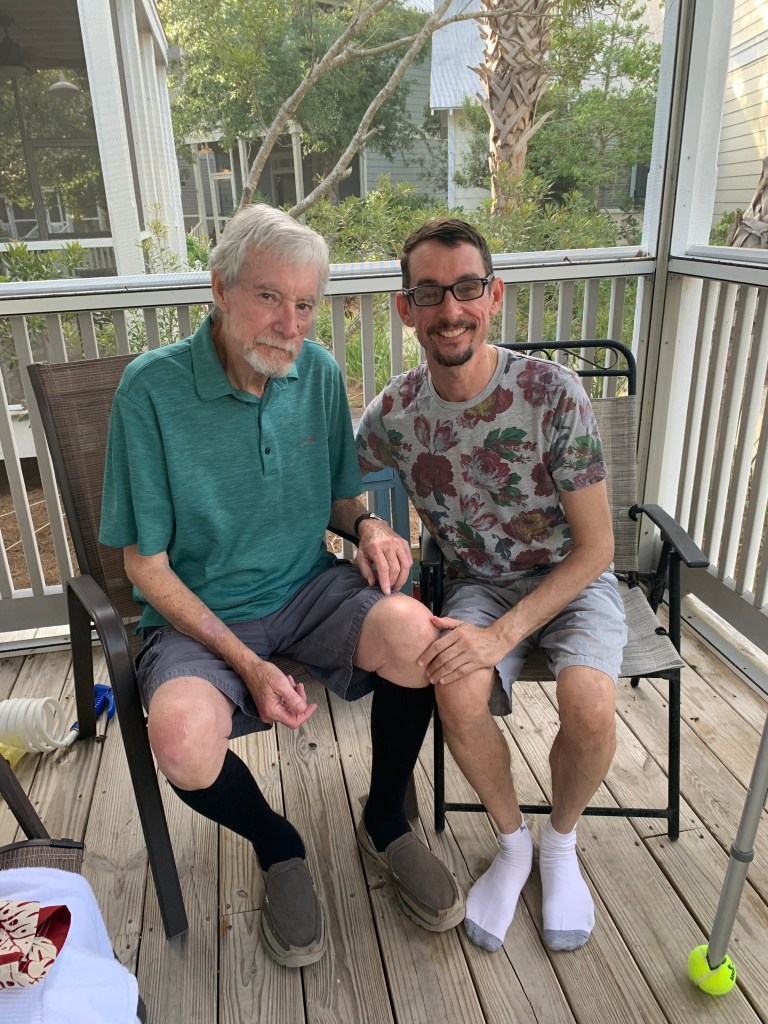
When my aunt told me, “Your dad has never been an easy man,” there was an entire history folded inside those words—his upbringing, his hardships, the stoicism expected of Southern men, the unspoken wounds that harden into personality.
Dad didn’t want a memorial or service. It fits. Men like him didn’t believe in being publicly grieved. Instead, he asked that his ashes be scattered into the Apalachicola River, the water that first shaped him. A return to the beginning.
My last memory is from last summer: him smoking on the porch in the punishing Florida heat, the light hitting him in a way that made the pain visible. As I walked away, I glanced back. Our eyes met for a moment, and I knew — even then — that this might be the last time. And it was.
When he died, the surprise was not in the timing but in my own response: a brief indifference, followed by a deeper ache — for my brother and mother, who carried the weight of his long decline, and for the boy in me who had always wanted something gentler from him.
A part of me is gone with him. A part that learned discipline, work, and endurance. A part shaped by his silences as much as his words.
In the end, he deserved better. We all did.
But this was the life we shared, tangled and imperfect, marked by the culture that raised him and the quiet love he never could express.


 Slice of Good Ol Boy Life
beautifully written John. The memory of my Dad’s passing is clouding my eyes as I click my phone’s QWERTY key pad. I’m truly sorry for the loss of your Father.💙🫂