In Memoriam

30 11 2025

There are days you know are coming, and yet when they arrive, they catch you unprepared, as if you had misunderstood the terms. I had just bought a plane ticket to Alabama, picturing an ordinary visit: my mother in her new kitchen, my father settled into the small routines of a life that had narrowed but not yet vanished.

Then came the message from my brother: ‘Urgent, please call.’

When I did, he was crying.

“Dad’s gone,” Keith said.
Two words, and everything after them felt strangely suspended, as though spoken from another room.

My father went to sleep on Thanksgiving and did not wake up. The do-not-resuscitate order held back the paramedics from trying to undo what his own body had already begun. In its way, it was a mercy.

He had dwindled to ninety pounds. “Nothing but skin and bones,” my brother kept repeating, as if naming the truth could soften it. A year of strokes, Parkinson’s, diabetes — an accumulation of slow undoings. He had long been unable to walk, living in the narrow corridor between decline and endurance.

My mother moved him from Florida to Alabama so Keith could be close enough to help. “This is not how I wanted to spend our golden years,” she would say on the phone. No answer made any of it less true.

From across the country, guilt was easy to reach for. Anger too. Anger that I didn’t get to say goodbye, didn’t get the hug, the last talk about camping trips, the golf clubs he gifted me or the way he taught me to tie a necktie. His final message came in 2021: Happy Thanksgiving, John. I love you too. After that, the words no longer held their shape. His mind couldn’t steady them.

Watching him fade, even from a distance, was its own kind of grief — this man who had built a dream house with his own ambition, who traveled the country to watch the Seminoles play, who climbed the corporate ladder in the way men of his generation believed they were required to. He came from the deep South, from a world where tenderness was rationed, where men learned early to keep their guard high and their feelings unspoken. Toughness wasn’t just a personality — it was cultural instruction.

It is impossible to understand him without understanding that.

He was hard on me growing up. Hard in ways that left marks — some visible, some not. The hole in the drywall stayed for months after one fight, a quiet reminder of what happened when tempers ran too hot. Maybe he believed he was preparing me for a world he thought would be even harder. Maybe he feared what he didn’t understand about me. Maybe he was reenacting the discipline he had survived.

He wasn’t a saint, though he belonged to the Knights of Columbus. But he was also not a villain. He provided everything he knew how to provide. He earned status, built a life from almost nothing, raised two sons, and gave generously to his community. And like many men of his time and place, he struggled with the more fragile currencies — encouragement, softness, apology. If he withheld love, it was because no one had taught him how to offer it.

His marriage to my mother was a 55-year journey with its battles; divorce hovered more than once. I hated the way he treated her near the end, but even then, she stayed. Some loyalties in the South are stitched early and hold long after they fray.

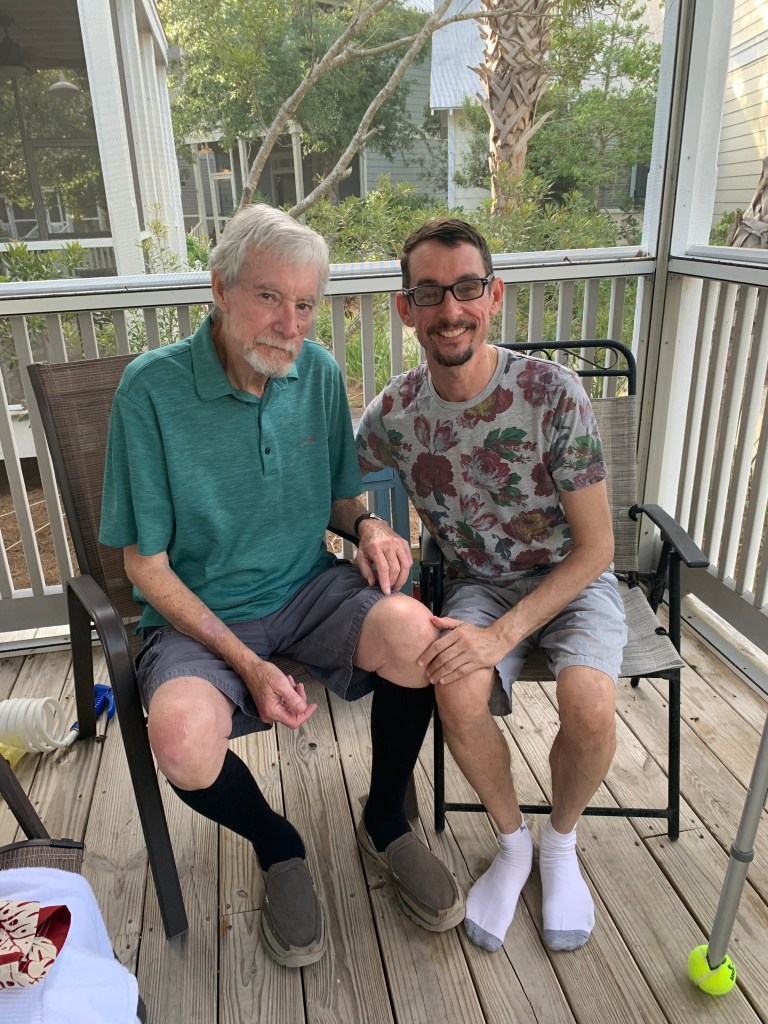
Mike & John, circa 2021.

When my aunt told me, “Your dad has never been an easy man,” there was an entire history folded inside those words—his upbringing, his hardships, the stoicism expected of Southern men, the unspoken wounds that harden into personality.

Dad didn’t want a memorial or service. It fits. Men like him didn’t believe in being publicly grieved. Instead, he asked that his ashes be scattered into the Apalachicola River, the water that first shaped him. A return to the beginning.

My last memory is from last summer: him smoking on the porch in the punishing Florida heat, the light hitting him in a way that made the pain visible. As I walked away, I glanced back. Our eyes met for a moment, and I knew — even then — that this might be the last time. And it was.

When he died, the surprise was not in the timing but in my own response: a brief indifference, followed by a deeper ache — for my brother and mother, who carried the weight of his long decline, and for the boy in me who had always wanted something gentler from him.

A part of me is gone with him. A part that learned discipline, work, and endurance. A part shaped by his silences as much as his words.

In the end, he deserved better. We all did.
But this was the life we shared, tangled and imperfect, marked by the culture that raised him and the quiet love he never could express.


The Dream Derailed

9 08 2025

It wasn’t the sirens. It wasn’t the alarms or the strobe of red light flaring against a sleeping city.

It wasn’t even the man collapsed on the floor of my train, lips slack, the color gone out of his skin like a tide receding. No, what undid me was the quiet afterward.

That winter night, I stopped the train at the platform as protocol required, keyed out, radio in hand and made my way to the trailing car. I found the man unconscious, his companion kneeling beside him in frantic disbelief. The evidence — needles, foil, the sour chemical reek — was all there, as it always is.

I followed the instructions we all know by heart: check for breath, check for pulse, check for signs of life. He had one. Just barely.

This wasn’t new. This was becoming ritual. I had imagined trains as vessels of order, of precision — steel-bound promises running on time. Instead, I found myself driving a shelter. A triage center. A dim, clattering corridor of last resort.

Back at the break room, I told the others. “Probably just wanted a warm place to pass out,” a colleague said without looking up. And he wasn’t wrong.

This is what it had become: a moving refuge for the discarded. Those too sick, too high, too cold, too far gone. They boarded without fare and without malice, most of them. And we — the drivers, the operators, the ones who still believed in timetables and track switches and clean fluorescent platforms — we bore the brunt.

Alarms blared at random intervals. The emergency stop cord yanked not out of panic, but curiosity or confusion, sometimes spite or to simply be recognized by a world that had passed them by. Delays cascaded like dominoes. And always, I returned to the cab a little more frayed, a little more unmoored.

So yes, the irony was sharp, almost comical. When I was called into the manager’s office and told I was being let go — for failing to run on schedule — I almost laughed. Not out of disrespect, but recognition.

How does one maintain a schedule when the job requires you to stop, literally and figuratively, to deal with overdoses, breakdowns, psychic collapse? How do you keep to time when you’re forced to become both conductor and caretaker, when the cost of returning to the rail is a few stolen minutes to breathe, to collect yourself, to remember what part of the city you’re even in?

Those minutes, those necessary silences, were not inefficiency. They were recovery. They were sanity. And they were, in the end, my undoing.

“Egress there, sir,” the security guard said as I walked out of the yard that once held my dream.

A dream not crushed, but dismantled piece by piece, like an old train car scrapped for metal. A dream damaged, yes. But not dead. Just waiting, maybe, for a different track.

Safety First


The Dream That Carried Me

18 07 2025

When I was a boy in the Florida Panhandle — where the heat made any breeze that cut through the pine trees feel like a gift from heaven — I used to press my ear to the railroad tracks and wait.

For what, I wasn’t sure. A rumble. A tremor. A sound that confirmed something was coming. Trains moved through our coastal town, carrying paper from the mill. They moved like ghosts, urgent and unbothered, and I wanted, more than anything, to be the one driving them.

That was the dream: steel, speed, the illusion of control.

And now here I am, fifty-two years old, riding in a single-car light rail train into Hillsboro, Oregon, cloaked in the dark hush of a December morning. I am the one pulling into an empty platform, the one with hands on the lever. My left brings her into braking. My right taps the bell. The train stops clean.

“You don’t need to have a death grip,” Jorge tells me. “Be gentle with her.”

We were halfway through our training program and on the overnight shift. There are nine of us left, split into three teams. Jorge, all Cuban warmth and exacting calm. James, slower, quieter — Los Angeles cool, but alert beneath it. They don’t teach you how to handle the machine as much as they teach you how to be with it.

“Relax, take your time,” Jorge advised. “Do each step individually and it’ll all tie together and become natural.”

Sage advice. Slow your roll, essentially.

Before the yard-to-yard test — the one that moves you from theory to real track — I got sick. A stomach virus that left me wrecked and sweating through nights I couldn’t remember. I missed one day. James let me make it up. Another trainer might not have. I passed. Just barely. I passed.

“Watch your intermediates,” James told me as we walked through the Beaverton yard.

Signals, I learned, are prophecy. Intermediates tell you what’s coming — when to slow down, when to stop. Ignore one and anything can go sideways. Signals, switches, speed. There is no room for sentimentality out here. Only precision.

Oregon’s light rail system is complicated. Beautiful, yes. Ingenious, even. But also dangerous. Tracks run through intersections, weave alongside bike paths, share spaces with cars, pedestrians, skateboarders, scooters and dogs on leashes. You are constantly negotiating with chaos.

After the test, we entered line training. Three weeks of shadowing operators who knew too much, but said very little. They spoke in glances, in warnings you felt more than heard. This was no longer the dream. This was the reality.

You learn quickly: revenue service is where romance goes to die. Where you stop seeing yourself in the story and start seeing everyone else — angry passengers, lost time, bullying supervisors and the thousand ways things fall apart.

Still the horn cuts through a sleeping city, something stirs in me. That boy on the tracks, listening for the future. He never imagined what the job would cost. But he’d still want it.

So do I.


Purpose & Alignment

20 06 2025

I left Japan with confidence and purpose.

Keita had been an excellent host and travel partner. Our shared interest in history, arts and logistics was a good match.

As we said our goodbyes at the airport, for some reason, it felt like I would be back someday. There is still so much of the country to see, including Mount Fuji, which was shrouded in clouds on the day we traveled to Fuji Kawaguchiko for a hike.

Mt. Fuji hiding in the clouds

“Take care of yourself,” he said, before giving me a long hug, its squeeze a sign of the tight bond we had developed through the years.

Our embrace was a rare demonstration of public affection from this quiet and reserved man. There were no performative bows as we departed, just a respectful energy exchange. Equal parts love and admiration.

I slept most of the flight to Hawaii. With a three hour layover in Honolulu, I found a seat at a crowded bar and sipped on a crisp IPA, while scanning through backlogged emails on my phone.

Above the beer taps, cable television networks broadcast the latest developments from the presidential campaign. It was all but over at this point. A disastrous debate performance had felled President Biden. Trump 2.0 was on the way.

Even Keita was sold on the strongman schtick.

“Trump will keep you safe,” he told me one night over soba noodles in a trendy Tokyo restaurant.

Turning away from the news, I found an email from my recruiter about the train conductor program. From a pool of nearly 900 applicants, my number was one of 50 chosen. I felt lucky indeed.

The program would run for 12 weeks, from late November to early February. Several hurdles needed to be cleared to begin training.

A cognitive test, which included basic math, reading and writing was first followed by a panel interview with questions like: ‘Think of a difficult situation you experienced and how did you solve it?’

Then came the physical tests, making sure you could get in and out of the train, throw a switch and raise the pantograph (the part of the train that connects to the overhead wire) on your own. After that it was on to the classroom, where I joined a group of external hires just out of CDL training.

This would be my new family for the next three months and I couldn’t have asked for a more down to earth and kind hearted group. No more insensitive comments from immature assholes trying to one up each other on the toxic masculinity scale.

In my new setting, we applauded each other’s wins, sent encouraging text messages and genuinely wanted to see each other succeed.

That’s what made this group special. I could let my guard down and not have to worry about someone looking for a weakness to exploit.

Because of my previous experience in maintenance as a shop helper, I had a leg up on the early weeks as we learned about reading switches and the geography of the yards. Out on the mainline is where the big challenge would come as we were introduced to signals and system maps — known as the ‘alignment’ in work lingo.

“The alignment always wins,” one of my line trainers told me. “It’s like a casino. The house always wins.”

“But, why are we competing with the alignment in the first place?,” I asked.

Silent for a couple of seconds, the trainer shook his head and sighed.

“You’re not, John. That’s the point.”


In Hot Water

29 05 2025

What left an impression on me about Japan was its culture of cleanliness and respect, qualities that were ever apparent as we traveled the country.

Admittedly, there was a sense of embarrassment for my homeland. Japan’s trains and stations were clean, riders were considerate of fellow passengers and there was nary a whiff of smoke — much less illegal drugs in the air.

Most of the platforms had vending and recycling machines, which would be impossible to maintain in a vandal plagued Portland.

To my surprise, some train cars were designated for women only. I found this a bit odd, considering the country’s reputation for male chauvinism.

Keita’s mother, on the other hand, was not one to be subjugated. An octogenarian who was still driving — a stick shift car no less — she fetched us from the train station and always made sure we ate a big breakfast each morning.

After a long bus ride from Tokyo we arrived in Kusatsu, where you are greeted instantly by the rotten eggs smell of sulfur from the hot springs.

In the town square sits the Yubatake, a field of water, where people gather particularly at night to socialize. Some believe the minerals from the hot springs have healing properties. If true, I was more than ready for a soak.

“Let’s do the Onsen after we check in,” Keita said to me as we hiked through the narrow and curved streets up to our hotel.

Donning our yukatas (robes), we entered the male side of the Onsen. Inside, phones and cameras are strictly forbidden and it is custom to bathe naked. To set the mood, relaxing zen music played overhead as I stepped into the tile enclosed pool.

Life takes unexpected twists and turns and here I was, the lone Western figure at a remote hot springs resort tucked away in the mountains of Japan’s Gunma prefecture.

And the water was wickedly hot!

It’s heat pulsing as I stood knee deep and naked in the Onsen’s large pool. The convection like an attack on my nervous system.

While the temperature stymied me, others were easily submerged in the mineral waters.

“John, are you okay?,” Keita politely asked, noticing my hesitation to take a deeper plunge.

“Yeah, it’s just very hot,” I replied, thinking there was no way I could go any further.

Then I heard what sounded like a frog noise beside me. I turned to see an older man, sitting in the pool, with no expression on his face. Then suddenly, that sound again:

Ribbet, Ribbet.”

I smiled at him, but knowing very little Japanese, did not speak. Keita engaged the man in friendly banter, translating for me.

“He says you’ll get used to the temperature,” Keita told me. “And he thought you were French.”

The metaphor could not have been more fitting.

After that exchange we waded away from the man and I did eventually work up the courage to go completely under. This being the first step in my transformation. I was washed and exposed and felt no shame.

I slept good that night. The Onsen brought my Misogi challenge more into focus. I was determined to become a train conductor and upon returning home would enroll in a program to begin this process, leaving behind mundane janitorial duties.

Yes, this frog had escaped the boiling water.

Ribbet, Ribbet.

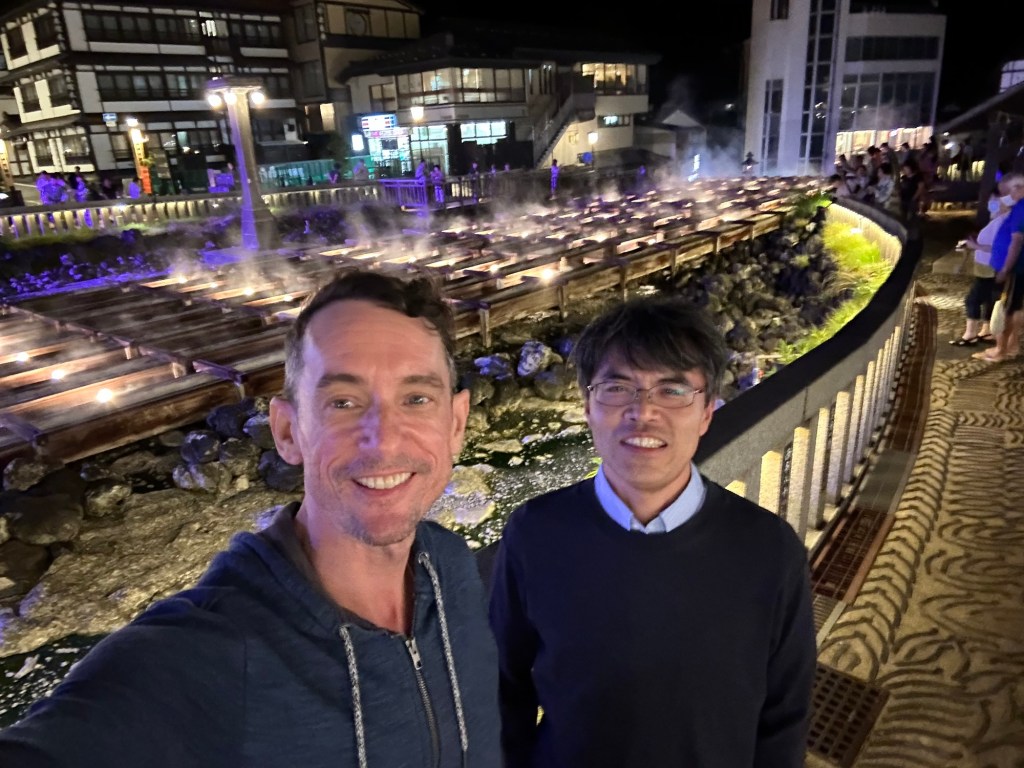
John & Keita at the Yubatake in Kusatsu, Japan


My Misogi Challenge

4 05 2025

In Japan they have a concept that is designed to create profound personal growth through very difficult situations.

Undertaking a challenge like this will likely result in failure, but the higher purpose is for the process to test your limits and ultimately change you for the better.

This concept is called the Misogi Challenge and is rooted in a traditional water cleansing of the mind, body and spirit. Before accepting my assignment, I traveled to Japan to visit an old friend, whom I had not seen in nearly 15 years.

Keita and I met in New York City. It was the summer of 2009, when I naively tried to move to the Big Apple with just a few bucks in my pocket and big dreams floating around in my head.

Keita offered to help — giving me a place to sleep for a few nights. That’s when I first learned that mattresses are not a necessity in Japanese culture.

Keita did return the visit to Florida, flying into our brand new airport in Panama City Beach. He took a real shine to me and I was flattered by such exotic attention.

We kept in touch over the years, thanks in large part to Facebook. When the pandemic hit, Keita returned to Japan to live with his mother, a recent widow. There wasn’t much a classically trained violinist could do at that time.

For me, traveling to Japan was also a test to see if I still had the bravery to venture out of my comfort zone and explore unknown territory. I was also aware that I would need to demonstrate diplomatic skills as to not come off as an ugly American.

After a long flight from Portland, with a layover in Hawaii, our Airbus A330 landed safely at Tokyo’s Haneda Airport. There was a long line for customs as Japan was one of the last countries to reopen post-COVID and had quickly become a popular travel destination.

Once cleared, I entered the landside area and there was Keita waiting for me. He was easy to spot in the crowd, eagerly anticipating my arrival. As I approached, an expression of relief washed over his face.

John, welcome to Japan,” he said, with a quick bow of his head while enthusiastically reaching to assist with my luggage.

Keita had aged well. He was lean and fit, a few inches shorter than me with slightly more gray hair. We took the train to his hometown of Hamura, where arrangements had been made for me to stay in a hotel. In the morning, we would depart for the mountain resort town of Kusatsu.

That night as I laid in bed, in a room the size of a luxury closet, I thought about how fortunate I was to be here — and how far I’d come professionally. When I first met Keita, I was a destroyed man in survival mode, aimlessly wandering the New York streets, foolishly thinking charisma and the ability to write would propel me to success.

As hard as that stage of my life was, the adversity helped shape me into the stoic, can do person I am today. It toughened me up for harder times in South Florida and the Pacific Northwest.

I was prepared for my Misogi challenge. The next day would come the water.


Can Do

20 01 2025

One word convinced me. Actually, it was the concept behind the word.

That concept took me to another level — snapping me out of a cautious funk of settling for the easy way out or crumbs along the path of least resistance.

The word is CAN.

It first came to my attention through a sticker on the back of my cousin’s jeep. Come to find out a Hawaiian man, battling depression, decided to defeat the doubt and negativity in his life by changing his mindset.

CAN defeats Can’t. Simple as that, right?

Well, it’s not as easy as it sounds. As those who have accepted a challenge can attest, half the struggle is just getting started.

I have been fortunate enough to accomplish certain things in life that seemed impossible as a youngster. The list of achievements include running for public office, hiking the Grand Canyon, publishing a book, covering a presidential election and getting married.

Some would say that’s a life well lived.

But I know there is more to experience. Who wants to be mopping trains forever? Not this guy. Could I operate them? You bet, I can.

There was also a not so subtle desire to start a family. This is something Stanley picked up on in our therapy sessions, particularly when it came to my attachment to River.

“You want to be needed,” he said.

Who doesn’t, I thought.

David still needs me and we had a lovely time in Hawaii. The hospitality Rob & Shelley extended to us was above and beyond.

It’s amazing how fast the time goes. I still vividly recall summers on St. George Island and Apalachicola with Rob and all my other cousins. I now realize how precious those moments were.

Looking back, was there anything that could have altered my path? Would a different decision at a critical juncture turned out for the better?

Second-guessing now seems silly.

Changes did await on the mainland. A new work assignment, on the other side of town, would free me from the graveyard shift, challenge my thinking and provide the opportunity to put my new ‘CAN DO’ attitude on display.

For the first time in years, checking on my folks in Florida seemed both doable and desirable. My father’s health continued to deteriorate and mom’s cries for relief were like a broken record.

An old friend from Japan was also on my mind. Like many of the international friendships forged during my younger days traveling, promises of reunions now seemed possible.

CAN was already at work in me.

Fear no longer had a grip on my emotions. Failure, I had come to realize, was just part of the process — not the end result.

I was ready to enter the arena again. To dare greatly while speaking my truth softly. To strive valiantly without coming off overconfident and cocky.

I think I CAN. I think I CAN. Choo-Choo!

All Aboard!


Hawaiian Reset

12 12 2024

Heeding Stanley’s advice, I began to distance myself from River.

And the therapist wasn’t the only one delivering this message. Kieran — my loyal friend all through the pandemic and beyond — was uncharacteristically blunt. He had been observing a disturbing change in me.

“He’s using you and he’ll take you down with him,” Kieran warned. “A narcissist with addiction issues is a dangerous combination.”

River had a lot of drinking buddies so replacing me in his rotation would be no problem. My sympathies for him remained and as Stanley had predicted, it hurt as I cut off communication.

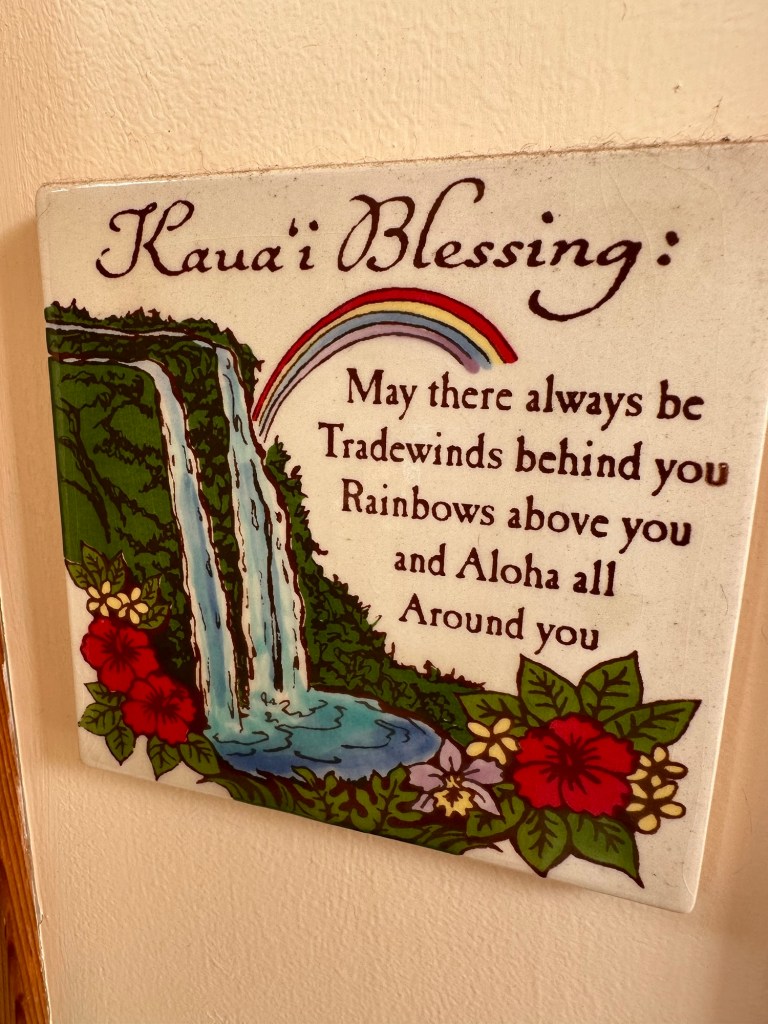
Luckily for me, I had some vacation time coming that would chase my blues away. Not long after the new year, David and I traveled to Hawaii to see my cousin Rob and his wife Shelley. Empty nesters, with both kids recently graduating from college, they had graciously offered to let us stay with them during our visit.

We left Portland just as a big winter storm approached. David’s brother chained up the tires on his SUV and navigated along frozen back roads to get us to the airport. On the tarmac, crews worked hard to de-ice the plane, enabling our takeoff in what felt like a true escape from winter’s clutches.

We flew directly to Kauai, one of the less populated islands, known for its lush greenery. It had been years since I last saw Rob and Shelley. Rob grew up in Miami, went to UF and worked as a defense contractor on the technical side, even living abroad for a time in the Middle East.

Rob picked us up at the airport in his blue jeep with a orange Florida Gators logo on the side door. He had long hair and was wearing shorts, flip flops and a T-shirt. It was the classic beach bum look.

Aside from the heat, one of the first things I noticed as we left the airport, were the chickens. They were everywhere and their cock-a-doodle-dos could be heard all over the island.

Rob took us to lunch at a waterfront restaurant where at night herds of sea turtles crawled to shore.

“How’s your dad?,” he asked.

“Not good,” I replied.

My brother had recently sold dad’s truck. He was never going to drive again. The Parkinson’s was progressing and dad refusing his medications didn’t help.

After lunch, we drove on Kauai’s one main road to the southern side of the island, where Shelley welcomed us into their cozy cedar home. They had two dogs and a big backyard full of colorful flowers, plants and trees.

Fritz House

It was so peaceful and serene. Just what we needed.

“Make yourself at home,” Shelley said as she showed us to the downstairs guest room.

The walls were covered with pictures of their wedding, children and travels. You could feel love resonating through the frames.

I slept soundly that night in paradise. Something was stirring inside of me. As we would soon find out, it was the power of CAN.


Blood Brothers

21 11 2024

“All I saw was blood…blood everywhere. On the ground, all over my clothes. It was gushing out of my nose,” he said.

River’s nose had puffed up to clown size and purple bruises surrounded his left eye. He never saw it coming — walking home, listening to music with his headphones on and suddenly out of nowhere:

Shabam!

The stick smacked him across the face, knocking him to the ground and busting his nose wide open. The culprit was gone before he knew what hit him.

And yet somehow, River mustered the courage to come to work that week and clean trains in horrible pain with a fractured nose. I felt a tremendous amount of sympathy for him, knowing full well that could have been me.

But why would someone do that?

Despite my insistence, River refused to seek medical attention or file a police report. As I was quickly discovering, he seemed to detest health screenings and absolutely did not trust the police.

The attack drew me closer to River. I wanted to be there for him and I told this to Stanley, my next door neighbor psychiatrist. Stanley reminded me that I was supposed to be seeking more joy in my life and yet here I was trying to play a rescuer role.

“You can’t ‘save’ someone who does not want to be saved or feel there is a problem,” Stanley reminded me.

River liked to party and at his age who could blame him. He was quite the playboy, handsome and confident. Going out with him felt like riding shotgun with a celebrity because every bar we entered, someone there knew River.

While I reserved social outings for the weekend, River was going out nearly every night. I tried to sound the alarm about work, but he didn’t seem to care.

The job may stink now, I told him, but there were many paths within the organization that would lead to secure livability.

“You’re wasting your breath,” Stanley told me.

Stanley had been in this situation before and knew the ending.

“Why are you attracted to him?” he asked.

That was the billion dollar question.

Aside from having a savior complex, I saw a lot of my old self in River. Two decades earlier, I left my job as a sportswriter in Alabama to move to Houston, Texas to be with my first lover, Dennis.

I have never written about this time in my life. I did some things that I am not proud of. Things I wish that I had never done.

Dennis introduced me to a completely different lifestyle. A lifestyle of endless nightclub parties, rampant drug use and survival sex work.

Unpacking and acknowledging this time is important and so too is letting it go.

I saw River as a shot at redemption. He was living the same life I did and I wanted desperately to lift him out of it.

“You’re going to get hurt,” Stanley warned.

Sticks & Stones


Rolling with River

27 10 2024

With Stanley’s words ringing in my ear, I set out to find a little joy in my life.

Working the graveyard shift in the train yard made doing things on my days off a challenge. When I was up and ready to go, most people were sound asleep.

So while David slept, I put on headphones and watched a lot movies in our little studio apartment. I did some writing and cooking too and worked out in an empty gym.

But I was lonely. Very lonely.

Then one night, I came to work and everything changed.

I walked into the cleaners’ shack to find a new guy sitting at the table, staring intensely at his phone with a big backpack by his side.

A young man in his late 20s, tall and lanky with curly hair and a smooth skin tone that showed he had recently spent some time in the sun.

I sat down beside him as the other workers filed in and prepared for another tedious shift of cleaning trains. He looked up from his phone, nodded his head at me and immediately turned his attention back to the phone.

“Are you new here?,” I asked.

“Yep, first day,” he replied, without looking up while pecking away at his phone.

“Well, welcome aboard, I’m John.”

“Hey buddy, I’m River.”

I felt good energy between us. Positive vibes for sure.

After our crew meeting, the supervisor pulled me aside. A highly intelligent Navy mechanic, the sup knew how to communicate with me with little words or explanation.

“Look out for River, will ya,” he said.

“Sure thing,” I replied.

Model Cleaners

The sup informed me River would be taking the train to work too, which gave me a little more peace of mind on the commute. There was always some sort of drama on the train not to mention it had basically become a rolling homeless shelter — another casualty of Portland’s laissez faire attitude.

River’s attitude, on the other hand, was upbeat and cheerful.

He gave compliments without hesitation, was quick with a joke and talked frequently of his bold plans for the future.

“I want to own a house in different places all the world,” he told me one morning on our ride home.

“How are you going to do that?,” I asked.

“Oh, I have connections,” he grinned.

Those connections came from his previous work. It was a lifestyle that I was quite familiar with, albeit buried deep in my past.

“I was a dancer before I got this job,” he said. “Made a lot of money too, but I spent it just as fast as I made it.”

“What kind of dancing?,” I naively asked, already decided that I was going to play dumb for a while.

“Strippin’ at the bars downtown.”

As I listened, memories of my very first relationship with a man came flooding back into my consciousness like a tidal wave of emotions.

He went on, “There’s videos and pictures of me all over the internet.”

Before he could say any more, the train reached my stop and I wished River a good day.

“Get some sleep and I’ll see you later,” I said.

But I wouldn’t.

That was the night River was attacked.