Kushed Out in Hollywood

30 03 2013

I do admit to leading a pretty charmed life. Sure, there have been highs and lows throughout, but the summer of 2012 has to be one of the best ever. I was high in every sense of the word that mid July night, sitting rooftop of our Hollywood apartment. We all were, having just gamed the California medical system by scoring some marijuana during our visit to Venice Beach. I was amazed at how easy it was and how openly corrupt the entire process appeared.

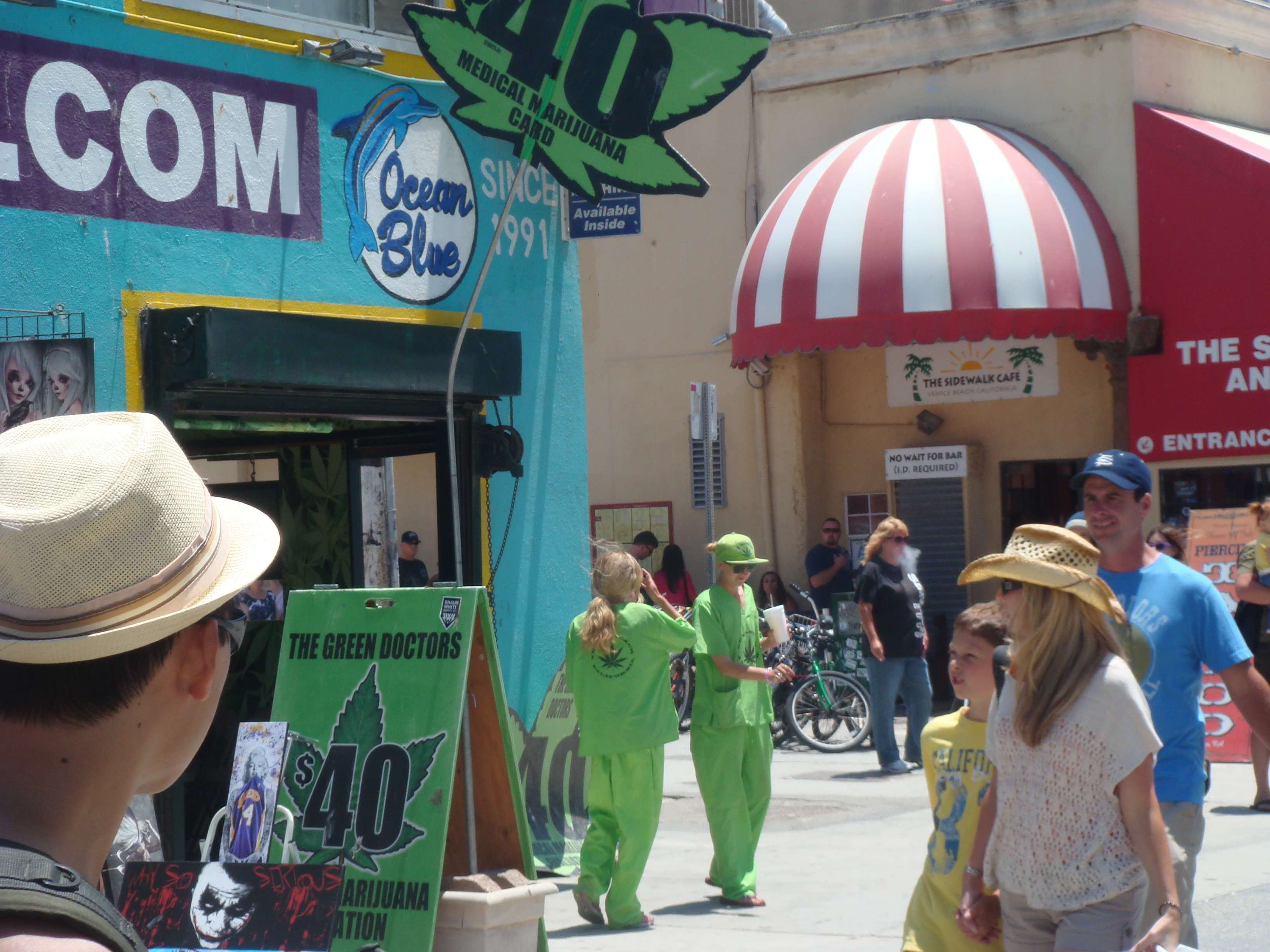
Marijuana doctors on duty in Venice Beach, California.

Marijuana doctors on duty in Venice Beach, California.

But as we shared a puff of premium grade OG Kush, one thing was for sure. Nobody was hurting.

The view from the roof was amazing at night. Smog circles drifting overhead, the lights of Griffith Observatory shining from the nearby hills and in the opposite direction stood the skyscrapers of downtown Los Angeles.  Normen, Cheng Yew, Jastine and I went up to the top — with joints and beers — to indulge in our vices. Joel stayed in the apartment. Someone, after all, had to remain responsible. As twin brothers go, Normen and Jastine could not be more opposite. Jastine the steady, calculating planner, Normen the fashionable performing artist. I had gotten to know Jastine much better as we spent time discovering the Grand Canyon while he recuperated from a collapsed lung suffered upon arriving in America. I guess you could say we bonded over adversity. I, wounded ego, in self-imposed political exile and he a wounded stranger in a strange land.

Normen worked at a different location so we rarely hung out, but he had the same job only at a much higher volume store. His shop, at Bright Angel Lodge, was right on the rim and he would work eight hour shifts — sometimes never stepping away from the cash register. Meanwhile, further into the village at Maswik Lodge, Cheng Yew and I would go hours without recording a sale. Based on those negotiating skills and his hipster looks, Normen became our point man for securing the weed.

“That doctor was a joke,” he said, emerging from the Venice Beach “Green Doctors” office with prescription in hand.  There were more medical marijuana operations in Southern California than McDonald’s, or at least it seemed. Green crosses, denoting clinics and dispensaries, were everywhere you turned. For a hick from North Florida and exchange students from Singapore, this was indeed a whole new world.

Jastine pressed his brother for answers, “What did the doctor ask you?”

“What I needed marijuana for,” Normen replied.

Keep in mind, Normen is a picture of health. Young, firmly built and agile. He would never be mistaken for a cancer stricken patient or someone suffering from AIDS. The week before arriving in LA, he had hiked the Canyon, rim to rim during the height of the summer’s scorching heat.

“And what did you tell him?,” Jastine asked.

“That I had insomnia,” said Normen. “And then he wrote me a prescription.”

Just like that. We were all amazed. Of course, there was a catch. You paid forty bucks up front for the initial evaluation and after the doc cleared you, the next hurdle was finding the right pharmacy. As Normen quickly found, everyone had a hand out along the way. The dispensaries were protected like banks, only with meaner looking security. We all waited patiently as Normen went inside to select his “medicine.” He ended up with the OG Kush and Sativa and after dinner on our first night in LA, we passed the joint around and marveled at our surroundings.

Our headquarters in Hollywood, California across the street from Paramount Pictures.

Our headquarters in Hollywood, California across the street from Paramount Pictures.

The weed certainly helped my sunburn. I had gotten roasted pretty good at the beach, but the more I toked up the less pain I felt. This had been the first time in a long time, I had smoked marijuana. It was, without a doubt, available in the Canyon, but I never pursued it. I was intent on projecting leadership and didn’t want to fall in with the stoner crowd. But here, on a mini vaca in California, it was time to experiment.

With each puff, I found the kush to make me a tad over analytical. Were those helicopters in the distance coming for us? Were they even there?? The kush hit Cheng Yew like a ton of bricks, so much so that Normen had to help him down the narrow flight of stairs back to the apartment. Jastine and I followed and eventually we all passed out. Insomnia cured.


Catching the Chief to California

15 03 2013

We waited by the train tracks in the pitch black of the night.

“This is like a third world country,” Joel remarked as the shuttle bus dropped us off. It was anything but glamorous. Those who catch the westbound Amtrak Southwest Chief at Williams Junction, Arizona do so as if they were hobos hitching a ride. You wait by the tracks in the middle of a quiet pine tree forest and sometimes the wait can be long — “hours long” — confessed the shuttle bus driver, who stayed in radio contact with the train. Luckily for us, the Chief was running just a few minutes behind on this night, but it was still quite eery to be waiting in the woods with no sign of civilization for miles. No station, no depot, no benches, not even a single overhead structure for shelter.

On the opposite tracks, heading east, freight trains whizzed by as we looked down the tracks in hopes of spotting Amtrak’s oncoming lights. It would be almost 11 p.m. before the train finally arrived. We wearily climbed aboard and took the first available seats we could find. The train was fairly full and I was surprised by the roominess of coach seating. There were sleeper cars available, at a higher cost, but the standard seating was more than adequate and plenty spacious. Joel drifted off to sleep not long after we got settled in. I dosed off for a while and awoke when the train stopped in Needles, California. I tried to go back to sleep after that but couldn’t, the excitement of Los Angeles was building.

There were several more stops before we made it to our final destination of Union Station. I was amazed at the urban sprawl, picturesque mountains and the appearance of largely latino communities as we rolled through the San Bernardino Valley. By the time we reached Los Angeles, the sun was rising and most of the train had emptied out. Joel slept the entire way. At Union Station, we met up with the other guys — Jastine and his twin brother Normen and Cheng Yew, who had assumed the driving responsibilities. I snapped a few photos of Union Station, the lobby area in particular had a nostalgic feel to it. You could sense this was a bustling place before air travel became the norm.

The guys appeared surprisingly refreshed for having just bused in from Las Vegas. Jastine was the leader and he had arranged for a rental apartment in Hollywood. And it was pretty sweet. Not overly luxurious, but definitely a cut above the Holiday Inn and if location meant anything, our headquarters for the week was prime real estate — situated directly across the street from Paramount Pictures Studios. We stopped at the apartment just long enough to unload our luggage and then it was off to Venice Beach. Cheng Yew managed the traffic well and we arrived early enough to get a pretty good parking spot. Right away, I noticed this would not be like a Florida beach experience.

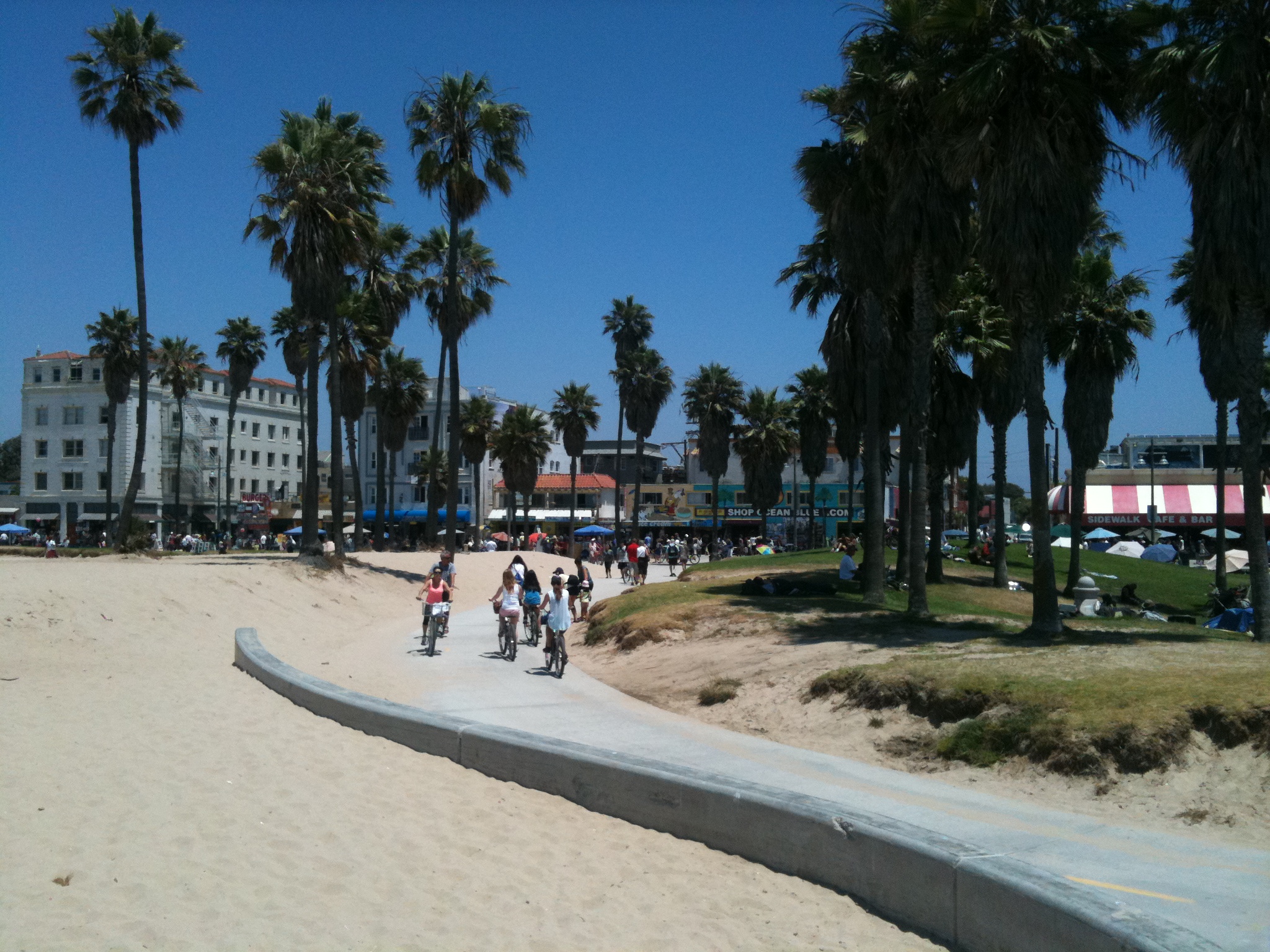
Cyclists enjoy the ride at Venice Beach, California.

Cyclists enjoy the ride at Venice Beach, California.

Unlike Panama City, where greedy developers built towering condominiums that block much of the public access and views of the water, Venice Beach was obviously designed with the pedestrian in mind. Nestled by the beach is an athletic oasis of basketball, tennis and handball courts, gyms, skateboarding pits, bicycle routes and jogging paths. And not to be left out, American consumerism lined the nearby streets with shops from high-end retail to fly-by-night gypsies waiting to capitalize. And we were eager to dive in, starting with a quick bite to eat at Jody Maroni’s hot dog stand, but before we could finish our dogs, a foul smelling panhandler approached and asked for some money. I offered to buy him a Maroni dog, but he said he wasn’t hungry. Guilted, I parted with some spare change, while the guys ignored him and he meandered on.

“You’re going to get that a lot in New York, fellas,” I warned them.

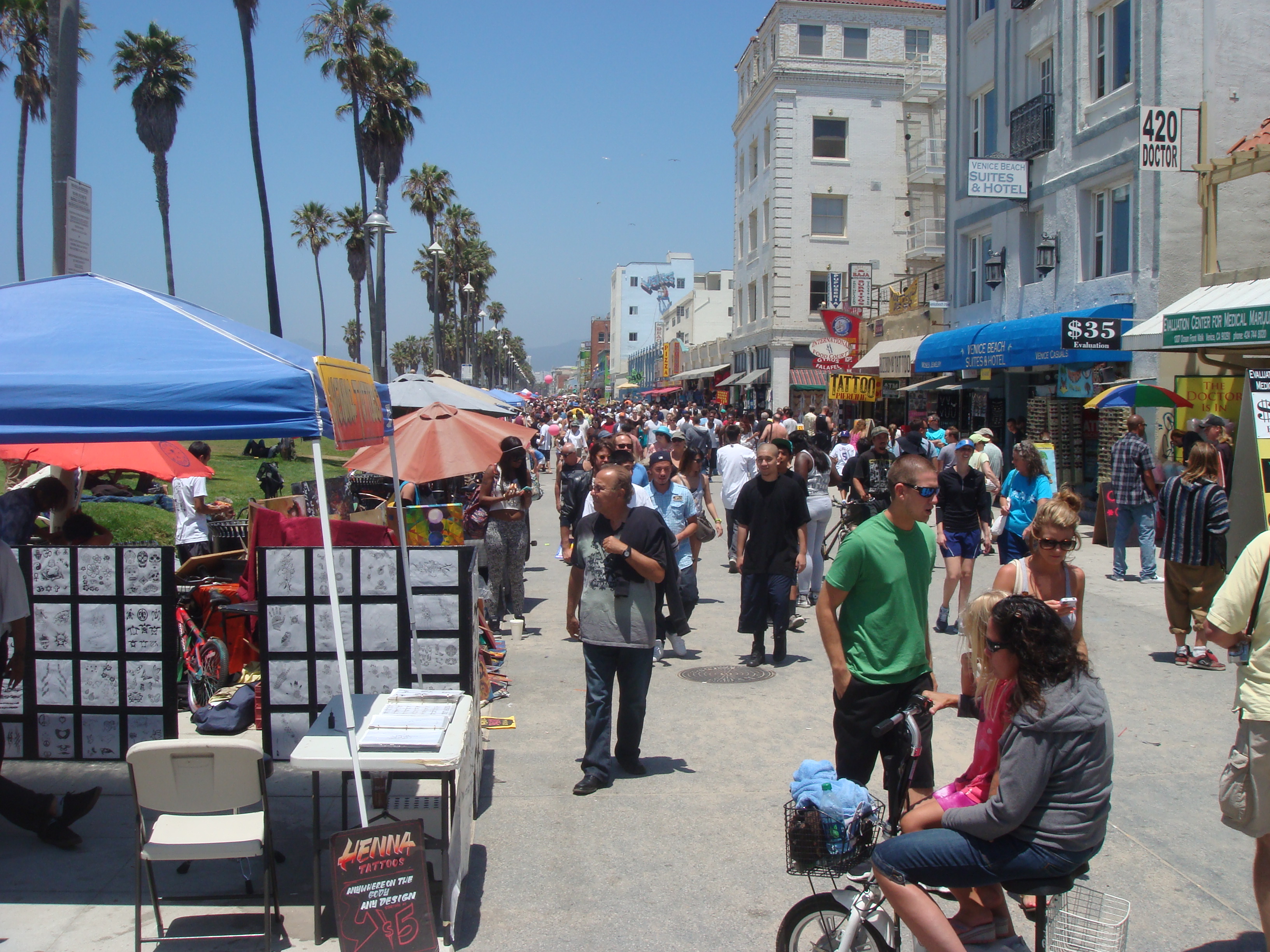
Refueled, we continued down the ocean front walk, snapping pictures and soaking in the atmosphere. It was a beautiful Sunday afternoon. Under clear skies, throngs of people from all walks of life had converged on Venice Beach for some fun in the California sun. It was hard to believe just 24 hours ago, Joel and I were in the Grand Canyon. The others didn’t say much about Las Vegas, honoring the code of what happens there, stays there. But as we made our way down the boardwalk, an odor engulfed us all. I knew right away what it was and Normen did too.

“I smell weed,” he said.

And then, as if on cue, a young man appeared out of the crowd, dressed in green surgeon’s scrubs. He handed Normen a business card, which read “The Green Doctor” with a Marijuana leaf in the background and then smiled and said, “Welcome to California, boys.”

Venice Beach Boardwalk

Venice Beach Boardwalk


Joel’s Ring of Fire

26 02 2013

This would not be my first trip to California, but it had been some time since setting foot inside the Golden State. One of the fringe benefits of working at the Grand Canyon was an opportunity to explore the Southwest either through trips offered by the employee rec center or independently. The group from Singapore had planned an impressive tour of the US before returning home — Las Vegas, LA, San Francisco, Yosemite and New York. I requested to tag along for the LA part, provided I could get there. This was part of the challenge and, as most travel agents will tell you, part of the fun.

Since noticing the Amtrak station in Flagstaff, I had been intrigued by the train and what it was all about. Rail passenger service in the South is almost nonexistent. Hurricanes have decimated tracks along the Gulf Coast and the states there seem to have no interest in restoring routes. Most of the poor and those without a vehicle travel primarily by bus in the South. Having experienced Greyhound before, I was in no hurry to ride the dirty dog again.

So in figuring out the way to LA, I decided to take the Grand Canyon train to Williams, Arizona where I could connect to Amtrak’s Southwest Chief and ride into Los Angeles just before dawn. It would be around a 15-hour trip and luckily I would not be making it alone. Joel, one of the Singapore entourage, would travel with me while the others went ahead to Las Vegas. Joel’s work contract called for him to stay a few more extra days in the Canyon and although he was not happy about it, he honored the deal and consequently missed out on the Vegas portion of the group’s American adventure. Of all the Singapore guys, Joel had the most uninspiring Grand Canyon job. He was a kitchen utility worker at Yavapai Lodge, where he cleaned cafeteria tables and loaded dishwashers.

“So much wasted food,” Joel would grumble when I asked about his duties. He cheerfully added, he would get me all the soda I could want when I was in the cafeteria. One of the few perks of his job.

I had gotten to know Joel better one afternoon when we hiked up the Hermit’s Nest Trail to watch a rare solar eclipse. A fierce soccer player, Joel described his matches as if they were all out war and revealed he was often at odds with his coach. He was also quite the romeo and not long after arriving in the Canyon, Joel began dating a cute Thai girl from housekeeping. As the solar eclipse got closer, it was Joel who found an awesome spot to view it. We climbed down from the rim — beyond the guard rail — and settled on a flat column of rock just past Hopi Point.

Hopi Point Solar Eclipse with Joel

Hopi Point Solar Eclipse with Joel

A solar eclipse occurs when the Moon passes between the Earth and the Sun and essentially creates a “Ring of Fire.” We had equipped ourselves with special viewing glasses and from our vantage point overlooking the Colorado River and the many chasms of Grand Canyon, the eclipse was indeed an awesome sight to behold. But staring too much into the sun is never a good thing. As we posed for pictures afterward, I remember Joel stumbling and damn near falling into the Canyon. I don’t think even he realized how close he had come to certain death.

Traveling by train to LA would be much less risky. As employees, the train ride to Williams was free, but it sure wasn’t fast. On average a 45-minute trip by car turned into a 2-hour slow descent through barren land. Joel had made the trip before, taking his girlfriend to Williams for an overnight excursion. He knew what to expect, right down to the super corny staged “holdup” by wild western outlaws. The entire train ride was geared toward children and families. We were merely taking advantage of our employee status and thus endured stale jokes for the free lift.

Once in Williams we had a few hours to kill before catching the Amtrak so Joel recommended grabbing a bite to eat at a nearby Thai restaurant. After months on a steady diet of National Park cafeteria food, I gladly agreed. The women working the restaurant remembered Joel from his previous visit and we were treated like kings. The food was flat out delicious. As we dined on Pad Thai and other recipes that I cannot begin to spell, Joel let loose frustrations of working with some of the Native Americans at the park. They were sentiments similarly expressed by the blunt Western author Edward Abbey in his great novel, “Desert Solitaire.”

I did not dispute any of Joel’s observations and served more less as his therapist when he told me how, on his last day, he had basically told this one older Indian woman to take a long walk off a short pier.

“She was always telling me what to do,” he said. “And she never did anything.”

After dinner, we returned to the train depot where a bus waited to take us to the Amtrak station, a few miles south of Williams. But as we would find out, there was no station and no train in sight.


Smoke them if you got’em

5 02 2013

After the hike to the river, the rest of my time in Grand Canyon seemed rather trivial. I promised to work for six months and intended to fully meet those obligations. I had been promoted to a leadership position and given keys to the shop, rising every morning at 6 a.m. to greet the tourists and fellow co-workers needing their cigarette fix.

The Bulgarians and Turks smoked like chimneys. I was amazed how they would go through a pack, sometimes two, a day and wondered if they were saving any of the money they were making, not to mention having any left over to spend on food. Cigarette prices, like everything else in the Canyon, were ridiculously high and halfway through the summer, they raised the prices even higher. And yet, the workers still bought them. They were, after all, trapped by their isolated surroundings and strong addiction. And I was their enabler.

“Mah-bah-row,” they would utter, one by one, striding into the shop to begin another day of work. The Native American women I worked with would always get a good chuckle at my ability to master the exact foreign pronunciation of Marlboro. The laughs were a welcome diversion from the everyday drudgery of dusting pottery and folding t-shirts.

Away from work, my friendship with the Singaporeans was strong and we began planning a trip to Los Angeles. My roommate, Brian, the sports fanatic, was still battling depression and a turbulent relationship, but managed to eek out a smile when I would report on the day’s proceedings at the gift shop.

“Did ya dust today, John?,” Brian would ask, adding just the right amount of comedic touch. “Because, I was in there today and I think you missed a spot.”

I was glad Brian was able to find joy in my situation. There is something comically humbling about underemployment, if you can bring yourself to overlook the negative. Here I was, a college educated, award-winning professional journalist who had just run for the Florida House of Representatives on my hands and knees dusting Grand Canyon coffee mugs made in China.

The fact that half of our merchandise was made in China really struck a nerve with some guests. Many times a guest would have their gift in hand ready to buy only to discover the tiny words “Made in China” inscribed somewhere and this would immediately change their mind. I was also impressed with how Cheng Yew, my Singaporean colleague, would handle this blatant contempt. To the average observer, he looked quite Chinese and with Cheng Yew displayed on his name tag, he was obviously not a Native American.

Cheng Yew working hard

But Cheng Yew’s salesmanship was anything but foreign. It was, rather, quite remarkable. Polite and helpful at all times, Cheng Yew never got mad. He never protested. And he never called in sick. Time and time again, he was able to send the rudest customer on their way with a smile. I was amazed at this ability and so too was upper management. In just 10 weeks of service, Cheng Yew racked up more accolades and special recognition than people who had worked there for years. When selling memories, attitude is everything and Cheng Yew certainly had the right one.

I was, undoubtedly, going to miss my Singaporean friends. Our trip to LA would be the culmination of cultures coming together and living in harmony. I had learned much from our short time together and I’m sure they had too. I managed to request just enough time off to make a quick dash to Southern California and back. I would travel the train, experiencing a new part of America via an old mode of transportation.

California here we come.


Grand Champions

26 12 2012

The final section of the trail was brutal, people were moving at all kinds of paces. Desmond was clear out of sight. My knee was killing me so I stopped and sat on a rock. It was dusty just like me. The wind was whipping now and earlier I had gotten an eye full.

Previously, we had stopped at the last rest area to escape the high afternoon sun and its covered benches were packed with people — many who were not budging. I found that a little odd. Could they not tell we were distressed?

‘They are coming from the other side, John,” Desmond said.

Some of them looked familiar from our time at Phantom Ranch, others had trekked down from the rim. We stood under the middle of the shelter, hoping for someone to give up their seat. Fat chance. After a while, I retreated outside and found shade under a nearby cottonwood tree. Desmond followed, but did not want to rest. He signaled for me to continue up the trail. I signaled back that I needed a break. He then began hiking without me.

At this point I started to think why was I here. What possessed me to do this and why oh why had I moved across country and placed myself into extreme isolation? Jokingly, I had referred to my time in Grand Canyon as a period of exile. But was it really a joke? Having made the leap from journalist to politician, my career was indeed at the crossroads. I saw the Canyon as an opportunity for a fresh start in an environment where I would have no trouble clearing my head.

Whenever I would feel depressed, all I had to do was take a short walk up to the rim and gaze into the grandness of nature. No pharmaceuticals could take me away like a look into the vast and magnificent Canyon. I was sure there was someone up there right now looking down at me … a tourist, park ranger perhaps or even the All Mighty. Slowly, I began to climb again, placing more weight on the good knee as I hiked into the evil Coconinos.

The stops became more frequent, just to catch my breathe and rest my knee. It was at this before mentioned rock where I would have my last chat with a fellow hiker. Here I was sitting on this rock, dusty and damn near beaten, when all of the sudden an energetic Canadian appeared. He was a little older than me; a family guy on vacation from somewhere north of Spokane. I told him I worked in the park and this was my first rim to river and back excursion and he, seemingly unimpressed, asked why I had come to work in a place like this.

“How can you move so far away from your home?,” he asked.

“Work,” I replied.

We then went into the inevitable political discussion to which I listened much more than I spoke. You know the lines. America is going to hell and all that crap and I’m from Canada so naturally I am superior to you. Finally, he hiked on. I waited for him to get a lengthy head start and then followed, dodging mule poop and chomping on the last of my power bar. Surprisingly, I found Desmond waiting at the final water stop a long with a hearty company of hikers, many I had seen throughout the climb. I mustered a smile and continued to hydrate. I was glad Desmond waited for me. It clearly demonstrated his patience.

We hiked the last part together. In stride and overjoyed. The closer we got to the trailhead, the more people would stare. We were exhausted and disheveled, but seeing the trailhead and its bustling tourist activity gave us that final incentive to sprint to the top. We did it. Almost 12 hours and 18 miles of intense mountain hiking that no park ranger would recommend. It was my greatest athletic achievement. I was never good enough to play football, basketball or baseball in school. My body was undeveloped in those years and my confidence hidden behind chess pieces.

The pain from my knee was almost forgotten as we declared victory at the trailhead. There was a group of French tourists posing for pictures nearby and I asked them if they would please take our picture — as evidence of this amazing journey. A nice woman happily agreed and I was sure to say, ‘merci.’ An incredible feeling of accomplishment came through me as she took our picture. The fear and uncertainty I felt as we barely caught the bus earlier that morning had been defeated by a successful hike to the river and back. It was then that I truly believed there were Bright Angels amongst us.

2653


Pain sets in

14 11 2012

As soon as we arrived at Indian Gardens, I headed straight for the outhouse. I had been holding in pee for a good while and just too prudish to stop along the trail. Traffic had begun to pick up as there were several groups of people resting underneath the massive Cottonwood trees. We were still three miles deep into the Canyon.

It was after my outhouse visit that a sharp sting shot out of my left leg. It was severe and it damn near knocked me off my feet. I was surprised by the pain and could only surmise that it was caused by my brief stop of motion. Whatever the case, it hurt. Bad.

I was afraid to let Desmond know just how much it hurt. He had joined a dozen or so other weary hikers around a small water fountain encased in stone. Everyone looked beat. It was still plenty hot and most were battling dehydration. Some took off their hiking boots and rubbed their feet relentlessly, while others laid near comatose alongside their life-sized backpacks.

Desmond was eating his last sandwich when I limped up to the fountain for a sip of water. Nobody said a word. Damn, my leg hurt. Finally, an older woman with a British accent spoke up.

“Are you alright?,” she asked.

“Yes ma’am,” I replied.

She was British to a certain extent. She actually declared her independence from the Crown by stating she lived in some obscure island off the coast of France. She wore dark, large rounded sunglasses. Exhausted, I could not find her eyes.

Nevertheless, it was a pleasure to speak with a fellow hiker. She had hiked down from the Village, leaving her husband along the way. “He can’t make it down here anymore,” she said. “His knees gave out a long time ago.” But here was this woman, significantly my senior, huddled around the water fountain telling her story. Her knees were fine. One of mine was damn near killing me. After about 15 or so minutes, Desmond was ready to go again. He wanted to make it out by sunset and we were losing daylight.

The pain was tempered by the fact I was now hiking into familiar territory. I had hiked this part of the trail before, returning from Plateau Point where I communed with a condor. Surely, he was circling somewhere, I thought. Desmond, meanwhile, began to open up a sizable lead as we neared the dusty redwall limestone part of the hike. The sun still beating down, I lingered in shade every chance I got.

Most hikers will tell you that everyone has their own pace. And almost all will admit to having been part of some race. Desmond was viewing this as a competition. Initially that is. We would go on other hikes where time was not so much a concern, but for the rim to river excursion, Desmond was looking to break records. At this point in the hike, I was just trying to keep up.

I tried to keep him in eye range. It became more difficult as we climbed and with eager tourists appearing at every turn. You could tell the hikers from the tourists by the simple fact that NO ONE would try to hike the Grand Canyon in flip flops. And yet they appeared more frequently as we neared the rim. There were a few times where I stopped to catch my breathe and I would see Desmond on a cliff in the horizon waving his arms for me to catch up. The sun was beginning to disappear as the trail took to one corner of the massive canyon. The climb out was underway.


The Hike Back

24 10 2012

High noon and the sun is directly overhead. There is little shade along the river and for the first time on the hike I’m starting to feel the heat.

We cross another narrow suspension bridge and pick up the Bright Angel Trail on the other side, where after a few minutes, we encounter another mule train. This one had people on it, being carried to Phantom Ranch from the rim. We let them pass, squeezing against the trail’s rock wall. On the other side, a steep drop to the river.

The mules appeared miserable, their skulls sunken in from the intense heat and yet they carried on. When I first arrived in the Canyon, I was fascinated by the mules and would visit them quite regularly at their stable next to Victor Hall. This only added to the dorm’s unique smell. Riding one of these beasts of burden from rim to river was never something I desired to pursue. I was more than healthy enough to make the trek on my own and as the wranglers can attest, a mule ride is not the most comfortable way to travel.

As the mules passed, Desmond used the break from hiking to look for small rocks. They were everywhere. We both took one each, as a memento of sorts. Mine was a mix of red and black with shiny quartz sprinkled in. Taking rocks out of the Grand Canyon, of course, is against park regulations, but since the Grand Canyon was damn near taking all of the life out of us, what’s a couple little rocks going to matter.

As we left the river side and began a steeper climb up the Bright Angel Trail, I found it harder and harder to keep up with Desmond. He was much younger and had recently competed in a marathon. This was by far the most physical activity I had taken on since roaming the streets of New York City a few summers back.

Desmond was steady and he began to distance himself from me. We were no longer talking. We were hiking up a mountain. A Grand mountain.

The switchbacks were damn near murder. Every time you rounded another corner there was a steep stretch of trail awaiting and a steeper one after that. The vegetation was disappearing and so too was the water. There was hardly a soul coming from the other direction. It was early afternoon and most were taking shelter from the unrelenting sun.

Finally, after an hour or so of steep switchbacks and heavy breathing, the trail began to level out and I recognized the rock formations from my previous hike to Plateau Point. This is when I felt totally consumed by the Canyon. One small piece to the puzzle.

Yucca and blooming century plants appeared more frequently as we pressed on, up the Bright Angel Trail toward Indian Gardens. Tiny lizards began to scurry across the path and sounds of birds chirping from the brush filled the air. It was during this stretch of the hike where I felt like stopping, making a camp and just hanging out for a while. That would be so nice, but we both had to work the next day. The summer season was upon us and soon the park would be overrun by tourists.

“It will look like a giant ant hill’s been stirred with a stick,” was how one bus driver referred to the peak summer  season.

Deep inside the Canyon, however, was another story entirely. Only a tiny percent of visitors to the park actually enter the Canyon and even a smaller percentage make the hike to the river and back. We were a good three-fourths of the way to completing this super challenging endeavor when the swaying Cottonwoods of Indian Gardens came into sight.

And little did I know, pain was waiting.


Reaching the River

24 09 2012

We dipped our feet in the river and the cold water was a welcome relief. Having hiked downhill nearly seven miles to the bottom of the Grand Canyon this was the payoff… the reward and hypothermia be damned.

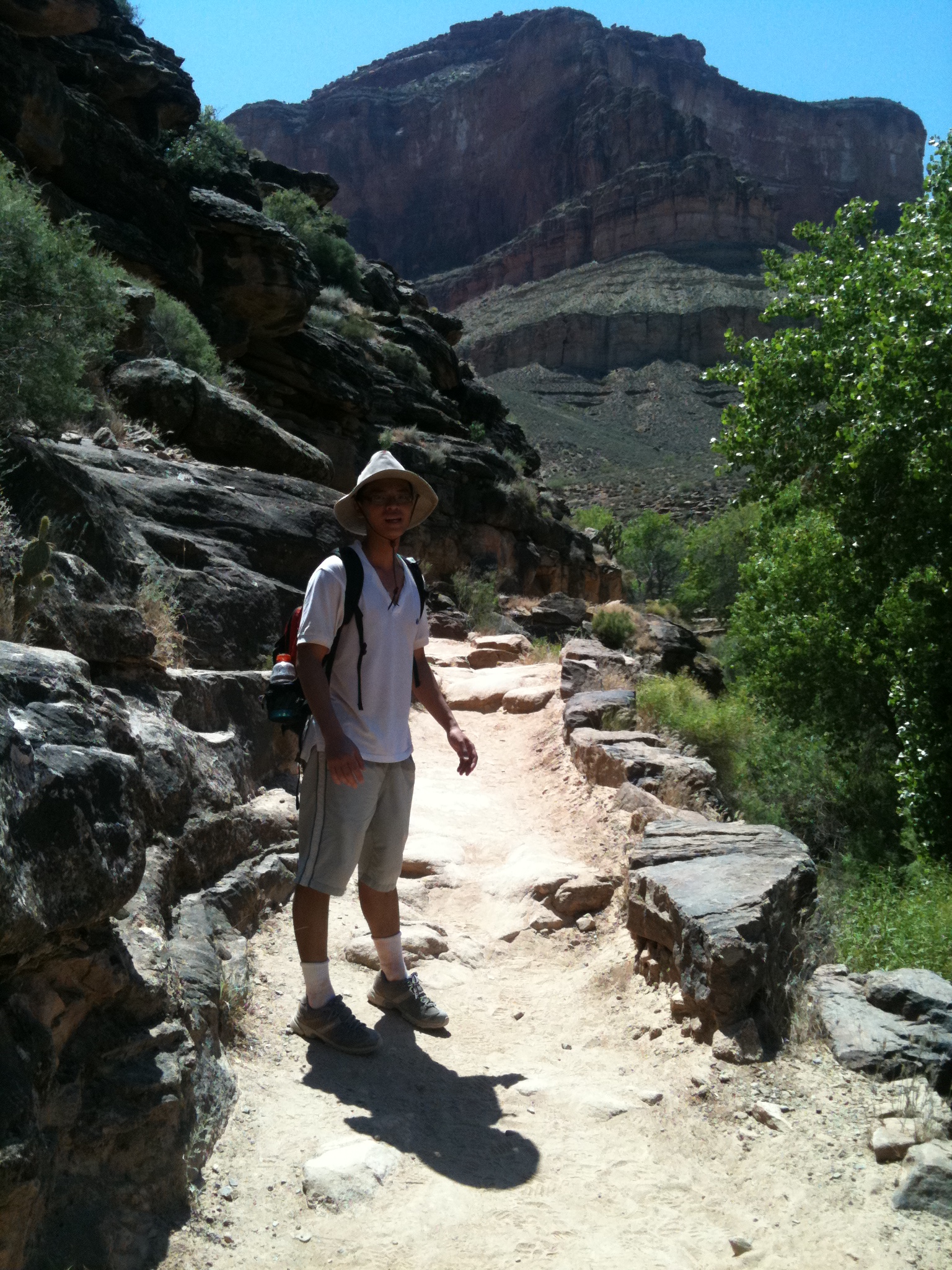
When you first set eyes on the Colorado River, it gives you pause. Desmond and I made it to the river just before high noon and we immediately started to snap pictures. This was an accomplishment to take note of. Before reaching the river, there is a small tunnel drilled out of a huge boulder just before you cross a narrow suspension bridge. The tunnel was dark, but the midday sun kept it from being too scary. I also felt safe with Desmond.

We walked through the tunnel, across the bridge and down to the river bank, which was guarded by a maze of prickly pear and Beavertail cactus. And it was hot. Mid May at the bottom of the Canyon brought near 100 degree temperature with not much of a breeze. But we weren’t the only ones at the river bank, gazing up at the Kaibab Bridge and the mountains all around. There were about a half a dozen college aged kids soaking their feet in the river and just as we joined them, a large rafting group floated up to the beach-esque bank and unloaded for lunch.

Phantom Ranch was nearby and that’s where we would have lunch and, more importantly, shelter. Sitting on the river bank, we didn’t say much to each other, instead basking in the fact that we had reached the halfway point. The water was extremely cold. You could put your feet in for a couple minutes but then they started to get hard and hurt. And no one dared go more than ankle deep, except for one of the rafting hands who had to jump in and tie up the raft.

From the river we wet our shirts for the first time, a tip Desmond picked up from reading some travel guide, and headed towards Phantom Ranch. It’s a short hike up the North Kaibab Trail and one that is teeming with life, from deer resting by the stream, ravens flying overhead and campers singing songs and playing music. As we approached the ranger station, a large American flag welcomed us to Phantom Ranch, prompting Desmond to remark how much we as a nation loved to wave the stars and stripes.

“There is not a lot of this in my country,” he said.

Americans, Desmond had quickly learned, are very patriotic in addition to their love affair with fried foods and beer.

We went inside the canteen, unloaded our packs and chowed down. My sub sandwich was pretty disgusting. It had damn near deteriorated on the hike down, but I ate it anyway. The canteen was about half full. It’s a simple setup with long cafeteria type tables and a cash register near the door. They had some souvenir T-shirts and hats for sale, but we just bought postcards. I told the clerk I worked at Maswik Lodge up on the rim and he immediately tried to recruit me to come down and work on the ranch.

“We work hard and we play hard,” he said. I had kind of gotten that vibe earlier when I was eating my sandwich and one of the employees came out of the kitchen to reload the napkin dispenser. He was a young, hipster type with a full beard and tight jeans. He looked me straight in the eyes and smiled.

“It’s a great place to work if you like to hike,” the clerk continued, making his best sales pitch. “We make good tips here too.”

This I did not dispute, but the reality of living in a place that was a hard 8-hour hike from civilization, and a partial one at that, was too daunting to consider. Being nice, I told him I would think about it.

We refilled our water bottles and soon were on our way again, this time hiking up. As we departed the canteen, the clerk reminded us to wet our shirts before crossing the river. We had not yet experienced the day’s full heat.


The Tipoff

27 07 2012

We talked a lot on the way down the trail, mostly about international affairs, politics and why Americans are so fat.

I’m not sure if Americans realize that we have become the butt of the world’s fat jokes. In many countries, McDonald’s is comically referred to as the American embassy. I told Desmond that the American obesity rate was much higher in the Southern states because of an affinity for sugar and fried foods.

“Is not the South where your least educated and poorest population resides?” he asked.

It was an innocent enough question, but for a native son of the South, it stung like a sharp prick of a cactus.

“Yep,” I said.

“And they consistently vote Republican,” he continued.

“Yep.”

“Why?,” he asked, again with an innocent, inquisitive tone.

“Desmond, if I knew the answer to that, I would not be on this hike with you today,” I said.

He smiled and we continued to chat, not realizing how quickly we were descending the trail. The sun was still rising above the Eastern Rim as we reached Skeleton Point. The views here are breathtaking. Dark orange rock formations jutting out of the earth. We were certainly no longer in the pinyon pine tree forest of the South Rim.

Some of the folks from the bus were here resting and I spotted the woman who I had sat next to. I asked her if she would take a couple photos of Desmond and I and she gladly obliged. We put our arms around each other in a brotherly fashion. It had been quite a while since I had experienced this type of male bonding. It reminded me of college. It was refreshing.

After a short break, we pressed on and it was my turn to probe Desmond about his country’s politics. I was, admittedly, igonorant as to Singapore’s culture. I did know it was a former British colony, which put me ahead of most Americans. It had become quite comical when the American tourists would remark how good the Singaporean workers spoke English, always assuming they would be producing a Chinese accent.

Desmond was quite proud of his homeland. He boasted of Singapore’s high GDP level, zero homeless population and alluring tax policies. He is, after all, a business student.

Most of the Americans — or Ang Mohs — as they are referred to by locals, come to Singapore not for pleasure, but rather for business.

“We encourage free market capitalism,” Desmond said.

But if there is one aspect of his homeland that Desmond would like to see changed, it is the media. The press, he said, is run by the government and never questions authority.

In other words, it’s like MSNBC today and Fox News circa 2004.

Meanwhile, we continued to descend at a healthy pace, stopping for a quick rest at the junction to Tonto Trail just before what is called “The Tipoff.” It is at this point where hikers get their first glimpse of the Colorado River — looking down into the massive gorge that resembles a scene out of Tolkien’s Lord of the Rings.

At the Tonto Trail junction we encountered the mule train coming up from Phantom Ranch, carrying mail and supplies. I marveled at the stamina and strength of these beasts of burden. It was starting to get hot and they had one steep climb awaiting. Amazing that they do this everyday.

We took a few pictures as the wranglers tied them up to a man-made steel rail in the middle of nowhere.

“Don’t get too close,” one of the wranglers shouted at Desmond. “They kick.”

The Tonto Trail Junction is a flat area surrounded by nothing but knee-high scrubs and prickly pear cactus for miles. The trail runs horizontal between rim and river and at this junction, with the South Kaibab, there is a rail to tie up the mules and a small outhouse for human waste. Desmond used the facilities, while I used the shade that it provided. I wasn’t the only one who sought escape from the sun. Sitting next to the outhouse was a tall middle-aged man who had been hiking the Tonto Trail from the east.

“I’m headed to the Bright Angel,” he said. “What about you?”

“The river,” I replied.

“Well, you’re close,” he said.

I plopped down next to the man and started swiggin’ water and eating peanuts and raisins. Desmond, having finished his business in the outhouse, joined us and the three of us chatted while fending off hungry squirrels. The man was from New York and an experienced hiker.

“I come here once a year,” he said. “Never gets old.”

It was definitely a different picture than New York. As I looked around, I felt so small. Just a blip inside a vast desert canyon. Far, far away from civilization.

“Shall we?,” Desmond asked.

He was ready to continue, knowing the rewarding part of our adventure was close.

“Good luck,” said the New Yorker as we parted ways. This was one part of the hiking culture that I had come to appreciate. Nearly everyone acknowledges each other on the trails and checks to see how you are doing, especially at rest stops, and always offers tips, provisions and well wishes.

I would likely never see that man again, but for a few brief moments we shared in each other’s extreme outdoors experience. Conversely, Desmond and I were just getting to know each other as the most strenuous stretch of our adventure loomed.

The rising sun set to test our stamina.


And away we go

12 07 2012

One of the best investments I have made in Arizona is hiking shoes. Sure, once properly broken in and caked with desert dust, they are hardly worthy of a night out in the city, but without them there is no way I would be making any trips into the Canyon.

The blister from my trek to Plateau Point forced me to abandon those trusty adidas running shoes. They were long past their expiration date anyway. In their place, I bought a pair of Columbia low top hiking shoes during a rare weekend getaway to Phoenix with Thomas. Thomas doesn’t want me to mention him in my blog anymore so that weekend in Phoenix will remain a mystery.

I did get some hiking shoes though, a full size bigger for the steep trails I would be traversing — the most challenging of which was yet to come. We would take the South Kaibab Trail to Phantom Ranch. It’s the shortest route to the river and has some of the more spectacular views of the inner canyon. We would then hike back to the South Rim via the Bright Angel Trail, a popular return route because the trail has ample shade and water.

Desmond wanted to meet at 4:50 a.m. at Maswik Lodge so that we could take the hiker’s shuttle bus directly to South Kaibab Trailhead. The bus left the lodge at 5:10 a.m. and I woke up at 5 a.m.

“Dude, where are you?!?” was the text message I received, which stirred me from my slumber.

Crap. I had overslept. Luckily, I had packed my backpack before going to sleep and all I had to do was grab it and race for the lodge in time to catch the bus. I climbed aboard the bus at exactly 5:10 a.m. It was full of eager hikers ready to hit the trail before the blistering sun climbed high in the sky.

Although we had just met, I could tell Desmond was a little peeved with my tardiness. If he only knew my history, then perhaps he would understand this was par for the course. Early mornings have always plagued me. I remember an 8 a.m. journalism class at Troy that I was serially late for and finally the professor decided to lock the door. When I knocked to enter at around five past the hour, he opened the door, looked me in the eye and promptly shut it right in my face —  to cheers and laughter from the rest of the class.

But Desmond wasn’t laughing. He didn’t say a word on the bus ride to the trailhead. Instead, I listened to a chatty woman from Alaska describe her many hiking experiences. She was headed all the way to the North Rim and her pack was double the size of mine.

When we reached the trailhead, the bus unloaded and the more serious hikers took off in a sprint. Before descending the trail, I stopped at the water spicket and filled my bottles. I asked Desmond if he needed any water and he said he was already carrying quite a lot of liters.

“Do you have enough gallons?,” I asked.

This made him smile. The ice was broken.

We snapped some photos at the trailhead and then began the adventure. The sun was just beginning to peak over the eastern rim as we started our descent, creating a soft shade of blue in the sky. The air was crisp and there was a slight breeze. As we set off, Desmond underscored what we were about to attempt.

“Remember,” he said. “Going down is optional, Coming up is not.”