The goal is

5 07 2012

It’s a dusty day in mid June and I haven’t seen a raindrop in months. Welcome to summer in the high desert of Arizona.

My new roommate, Brian, has been working in the Canyon for going on five years now and is exhibiting some of the tell-tale signs of burnout. He’s about five years younger than me and there are times when I feel as if I’m watching myself five years ago. He’s in a problematic relationship, running up big amounts of credit card debt and sleeping a lot.

When I ask him about transferring to another national park or changing careers, he casually shrugs off the suggestion — comfortable, so it seems, in his misery.

Brian and I struck up a friendship around sports, while working together at Maswik Lodge. Brian has a superior knowledge of athletics and is what I was once — a walking encyclopedia of sports. He knows all the coaches, players and records for baseball, basketball and football — both college and pro, watches SportsCenter religiously and has an extensive wardrobe of his beloved Boise State Broncos.

Plug in Florida State for Boise State and this guy IS me circa 2001.

When Brian’s roommate quit his job and moved home, I was asked to fill his spot in a cozy one room, one bath efficiency apartment. If Brian didn’t find a suitable new roommate, the company would have stuck him with the next random guy they hired or worse — three internationals. They really deal the internationals a rough hand here. Sometimes placing as many as seven of them in one room.

The move doubled the rent I was paying at Victor Hall, but my recent promotion covered it and having a more private bathroom, small kitchen and Direct TV was an added bonus. And Brian is clean guy who likes to keep things tidy. Another selling point.

With my living accomodations settled, I could concentrate on hiking more, specifically making it to the river. That was, after all, the goal of my time here. A physical challenge to myself and a spiritual journey only a tiny percentage of the population complete.

That’s when Desmond came into the picture.

Desmond was one of the new arrivals from Singapore, although for some reason he was not on friendly terms with the other Singapore guys. This surprised me, but I didn’t press the issue. He came into the gift shop one day searching for a long sleeve white shirt, which for some strange reason we did not carry. The request, however, prompted a conversation — Desmond wanted to go hiking. I told him I had already made the trek to Plateau Point and back.

“How long did it take?,” Desmond asked.

I hadn’t really timed it, so I estimated, “about seven hours,” I said.

“Wow, that’s good,” he responded.

I hadn’t given it much thought, but I guess it was a decent time. Later, I would find out that Desmond is quite the ambitious fellow, who has run a few marathons back home in his native Singapore.

“Do you want to hike to the river and back,” was his next question.

Of course I did, but I wondered privately if I was ready. And yet, here standing in front of me, was my chance. Finding a partner for the journey had been one of my biggest obstacles until Desmond walked into the store. Most of the Americans I had befriended could barely hike out of their dorm rooms and Brian, bless his heart, was unable to hike because he has multiple sclerosis.

“Let’s do it,” I said.

“It’s 17 miles,” Desmond said, cracking a smile.

“Yes, and your point is,” I replied.

We then exchanged phone numbers, became friends on Facebook and set the date and time for our hike. I was excited and nervous at the same time. I knew if I waited much longer, the heat would be unbearable. It was now or never.

To the River!


Saving grace from Singapore

19 06 2012

As I sit down to type another blog entry, it has occured to me that life is indeed grand.

I was down for so long and had been trying to climb out of a hole, that admittedly, I dug for myself. In the process of working diligently to rebuild bridges, repair relationships and regain status, I failed to realize that I might have climbed higher than ever before.

“Is it difficult to accept someone so young as your boss?” was the question posed to me recently by one of my newest Grand Canyon friends, Justin, a university student from Singapore.

This is where humility pays off. As difficult as the last four years of my life have been, my walk through humility has made me a stronger, wiser and all around better person. Of this, I am convinced.

So, yes, I can take orders from a 21-year-old glamour girl who hasn’t the slightest idea which countries are in the European Union or what austerity means.  When she asks me to fold t-shirts or mop the floor, I oblige because all work is honorable and as the old saying goes, “be nice to the people on your way up because you’ll see them again on the way down.”

This I know all too well.

Justin and his fellow Singaporeans have become my saving grace in the Canyon. They arrived at a time when I was considering heading back to Florida, unable to find anyone who I could connect with beyond the usual pleasantries of “Good morning” and “Nice weather today.” Much to my surprise, I found camaraderie with a group of college kids from Southeast Asia.

The Singaporeans, hailing from a former British colony, speak the Queen’s English, albiet with their own distinct dialect — Justin calls this “Singlish” — and even more impressive is their thirst for knowledge and success. We connected early through the social networks of Facebook and Twitter and soon I was hanging out with Justin and his friends every day — meeting for breakfast at the employee cafeteria, going on day hikes into the Canyon and riding the bus to the general store for groceries.

Justin was intrigued about my run for office, particularly challenging the establishment. Apparently this is rare in Singapore — as is any sort of objective media. Still, the country is prosperous and it was quite easy to tell upon their arrival that the Singaporeans were a cut above the rest of the international workers at the park.

Most of the internationals are placed in the kitchen, housekeeping or as cafeteria line servers, where their contact with the public is limited. But of the five Singaporean guys who dared cross the Pacific Ocean to reach American shores for the first time, two were rewarded with retail jobs in gift shops.

I can’t begin to imagine how hard it must be to cross the globe into a different culture, a different climate and then learn to count a different currency.

But Justin and his crew have done just that and in impressive fashion no less, reinforcing stereotypes of strong mathematical skills and loyal work ethic that are often associated with the Asian community.

They also figured out how to get out of Victor Hall much quicker than I did, convincing the Housing Dept. to placed four of them in a cabin. As one of company’s human resources managers noted, “They are very good negotiators.”

They are also very good friends and I am grateful to have met them. I only hope my future is half as bright as theirs.


Vans & Victory

30 05 2012

Arthur hadn’t made it out of Arizona before they stuck a new warm body in my room. My new roommate was another veteran, this one with a snowy white beard and a much friendlier disposition. His name was Marvin and there was no doubt in my mind that he was homeless.

“I’m going to sleep in my van,” he informed me after our first meeting. “Nothing against you, I just prefer it that way. I got all my stuff in there.”

I could tell right away this new guy wasn’t playing with a full deck. During my run for public office, when I decided to make poverty the central theme of the campaign, I became quite familiar with the plight of the homeless and mentally ill. One thing I was surprised to learn — it is a lifestyle some do indeed choose.

And Marvin was that way.

Like a lot of folks who work the National Park circuit out west, Marvin had bounced around from state to state, never settling too long in one spot. Park consessionaires are rewarded with government incentives for hiring veterans so Marvin was never too far from a paycheck. At the Grand Canyon, he found work as a dishwasher in the Bright Angel Lodge.

“For a lot of us, this is the last stop before skid row,” he quipped.

Marvin camping out in his van was just fine by me, although the Victor Hall proctor seemed slightly confused by the whole thing.

“It’s going to get hot in the summer in that van,” the proctor warned Marvin.

But Marvin didn’t care and probably had no plans of hanging around that long. Nevertheless, just two months into my Canyon tenure, I suddenly had a room all to myself. The only things Marvin kept in the room were the towels and washcloth provided by housing. Items he never used.

Occasionally, I would run into Marvin at the employee cafeteria and we would have a nice chat. Marvin loved to talk about mushrooms. I got the feeling he had ingested too many over the years.

Not long after Marvin “moved in,” I was presented with an opportunity to move into an apartment with a co-worker from Maswik. Although I had a pretty sweet deal going with an absentee roommate, the chance to get out of Victor Hall was all I needed to hear so I jumped at the offer and said adios to the Canyon’s Animal House.

No more fire alarm drills at three in the morning, no more drunken brawls over the remote in the TV room and no more funky aromas lingering throughout the dorm.  Initially, it was kind of fun to relive your college days. But the conditions got old fast.

Marvin took the news of my departure in stride. When I tracked him down in the kitchen of the Bright Angel Restaurant to tell him to expect a new face behind door No. 50, he didn’t seem to mind. He was having his own issues with Park Service. Apparently, the rangers were on to his game of camping out in the van.

“I parked up at the visitor’s center the other night,” he said. “There’s a nice big pinyon pine up there with good shade. So I parked there and, low and behold, I’m woken up at around four in the morning by a ranger knocking on my window.”

Marvin was the only one surprised by this development. He got off with a warning, but it sounded as if his days in the Canyon were numbered.

He was obsessed with the levels of bleach used to clean the plates and silverware and always talked as if there was a health epidemic about to be unleashed in the kitchen.

Meanwhile, my time at Victor Hall was over. Moving out … and moving on … or as they say in the Canyon — Victory!

Grand Canyon’s Animal House


Rooming with Arthur

26 05 2012

Nearing the 90-day mark of my Grand Canyon tenure and things are going quite well. I have been promoted at my job, met a great group of friends and moved out of Victor Hall.

I had almost forgotten what success felt like.

The cold and unfriendliess that I encountered when I first moved here has melted away with the winter snow. I think a lot of that frosty attitude comes from the fact that so many people don’t make it through the first week.

As my roommate Arthur attested, “I’ve seen people pack up after the first couple hours.”

Arthur was leery of me at first. A Vietnam veteran, Arthur fit the classic description of one of those cranky, crusty old white guys. The kind of guy that Clint Eastwood captured magnificently in Gran Torino. He is also an avid surfer and semi-practicing Mormon. It had been suggested by the folks at housing, that Arthur would make a good roommate, not because of any shared ideals or interests, but because the other people with no roommates looked like, “serial killers.”

So they placed me with Arthur, Victor Hall’s own brooding Clint Eastwood, and we got along just fine. Arthur worked the early shift at the El Tovar dining room as a waiter. By the time he got off, I was just starting my gig at the gift shop. We were like ships in the night. A perfect deal. And neither of us had to worry about the other getting drunk and doing something stupid.

Arthur has been working the National Park circuit for some time, with stops at Yellowstone, Death Valley and Zion just to name a few. Recently, he settled into a routine where he works Grand Canyon in the winter and transfers to Crater Lake, Oregon for the summer.

“This place is way too busy in the summer for me,” he said of Grand Canyon.

Sometimes we would have philiosophical discussions about culture and world events and he would usually make a crack about my higher learning.

“I’m not college edumacated,” he’d say.

Arthur is in good shape for a man well into his 60s and he took full advantage of living in the parks. He was also a great resource for hiking and day trips. But he did have his prejudices. He didn’t care too much for all of the international workers in the park.

“Unemployment on the Navajo reservation is 14 percent and they’re bringing in these Flips and Thais,” he said. “And most of them can’t even speak English.”

In the hospitality industry, the employment of international workers on J1 Visas has become quite the norm, although during a time of high unemployment among Americans the practice of bringing in foreign labor doesn’t come without criticism. I experienced the same situation back in Panama City Beach during my futile attempts at finding work. There were times, especially when applying for resort jobs, that it felt as if being an American was a liability.

Conversely, for as many Americans whining about losing jobs to internationals, there are those who quit before their first paycheck. Maybe that’s the reason for the importing of labor. Once they’re here they have no where to go and they must fulfill their contract.

Once the locals realized I was going to stick it out, conversations were easier to strike up and people began to smile.

Before Arthur left for Oregon, he bestowed a rare complement on me, “You’ve been a good roommate,” he said.

But he also offered some parting advice about Victor Hall.

“Watch your back,” he said. “Even when you’re in the shower … because nobody here is your friend.”


Pause & Reflect

9 05 2012

The pain from my right foot was getting harder to ignore. As I approached Indian Garden, I knew it was time to take a look and survey the damage. I found a quiet section of the creek to stop and rest and take off my shoes and socks. Sure enough, it was a blister on one of my middle toes and it was a big one. So I soothed my foot in the cold creek waters and tried to calculate just how much daylight I had left.

I had made it from the rim to Indian Garden in a little over three hours, but the return trip would not be as quick. I would be hiking up a mountain some 3,000 feet in the late afternoon hours — with a nagging blister no less. This is where the real work begins.

At the Three Mile Reststop, I encountered a fellow hiker who I had met upon my arrival to Indian Garden. He was a middle-aged man, overweight and with a huge backpack. He was hiking up from the river and had stopped for food and rest at Indian Garden. I remember asking him about the trek to Plateau Point and he offered a less than enthusiastic reply.

“It’s ok, you can see the river, nothing too special,” he said.

I’m so glad I didn’t take his review to heart.

But here was this man again, resting and browsing through his backpack. I had already hiked to Plateau Point, witnessed the awesomeness of the inner gorge and majestic river, communed with a baby California condor and caught back up with him.

“Are you alright?” I asked.

“Yes,” he said, rather defiantly. “Why does everyone keep asking me that? Do I look that bad??”

He looked a lot like the late English comedian Benny Hill and his backpack had to weigh 100 lbs. There was, without a doubt, an air of misery about him.

“Just checking,” I said.

I unloaded my pack inside the covered rest house, gulped down some water and took off my shoe again to examine the blister. It was still there and getting bigger.

“Got a blister, huh” the man said.

“Yeah.”

“I may have a bandaid for you,” he said, as he began to pillage through his pack again. Then he began to get incredibly honest.

“I’m carrying too much weight,” he said. “And I’m old and weak. I should’ve let the mules haul some of this up. They didn’t tell me about that until it was too late.”

I began to have sympathy for the man, knowing the hike ahead of him and the dwindling daylight hours.

“You have a flashlight, right?” I asked.

“Yeah, got one of those,” he said.

But he didn’t have a bandaid. I thanked him nevertheless for the thought and decided to continue onward and upward toward the rim.

“You going to be alright?,” I asked one more time before departing.

“I’ll make it,” he said, again with an abrupt tone. “I’ve got my own pace.”

Continuing on, I passed several more hikers coming up through what the locals call the “evil coconinos” —  a geological rock formation found near the rim of the canyon. Along the Bright Angel Trail, the coconino is home to a series of tight switchbacks which can and will take your breath away.

I finally climbed out of the canyon around 7 p.m. just before sunset, completing a 12-mile journey covering 3,100 feet in elevation. Surprisingly, I didn’t feel too worn out. The blister hurt, but the adrenaline of having accomplished such a strenuous hike kept me moving toward the Bright Angel Lodge where I sought to reward myself with a steak dinner.

No such luck.

The lodge was packed with tourists. There wasn’t even a seat to be had in the bar. The hostess said they were running at a 35-minute wait. That would not do. I needed fuel pronto, so I took the bus to Maswik Lodge and devoured a chilli burger and fries at the cafeteria in record time.

With a full belly and only a nagging blister for the effort, it was time to pause and reflect. I was pretty darn proud of myself. Four years ago, just after my spectacular crash out of journalism, I could barely walk around the neighborhood back in Panama City.

Now I am climbing mountains.


Flight of the Condor

4 05 2012

The ladies advised me against going down to the river, whether they knew it or not.

“If you don’t mind hiking in the dark, go for it,” one of them said, in an exhaustive sort of way.

That was all I needed to hear. I did not bring a flashlight and wasn’t about to hike in the pitch black. So I decided to take the trail to Plateau Point instead. After all, I did have all summer to make it to the river.

The hike from Indian Garden to Plateau Point does not involve steep inclines or switchbacks, but is completely exposed to the elements and on this day, the sun was shining bright with sparse clouds in the sky. Again, I probably should have gotten an earlier start. Had I left at dawn I would be soaking my feet in the river by now.

There was hardly a soul on this trail and the only signs of life came from the sprouting yuccas and flowering cacti. Every once and a while, a spiny lizard would scurry across the rocks and puff up at me. Like the squirrels before, these little lizards have ample amount of moxie.

As I approached Plateau Point, a figure emerged from the rocky ledge. As they got closer I discovered it was a park ranger, her head and face completely covered with bandanas and sunglasses. If this were a Star Wars movie, she would be a perfect Sandperson. The ranger informed me there was a baby California condor nearby and then asked me for a favor.

“Sure thing,” I said, always willing to help out a woman in uniform, even if she looked like a Tusken Raider.

“If the condor comes at you, I want you to chase him away — wave your arms, yell and scream and do whatever it takes to scare him away, OK?,” she said.

“Got it,” I replied.

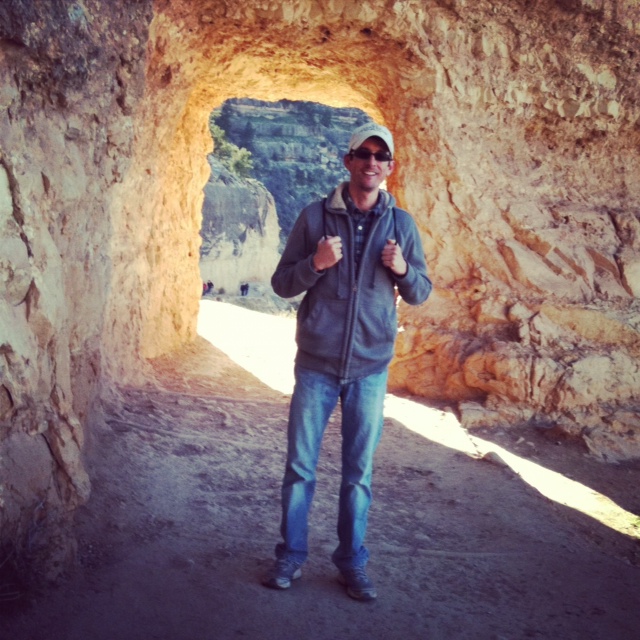
I then asked the ranger if she would snap some pictures of me for evidence of my excursion. She gladly complied and even remarked that the last one was, “beautiful.” Then she hiked away. It was just after three o’clock. I guess it was time for her to clock out. I was all alone at what seemed like the end of the world. As I took the final steps toward the edge, I was not prepared for what I would see next. I don’t think anyone ever is.

From Plateau Point, the Colorado River is a sight to behold. With a blue-greenish tint — from all the minerals — the river flows between towering gorges of rock. Looking down, I could see rafters making their way through a gauntlet of rapids as their cries echoed off the rock walls. I took my backpack off and found a shady spot under one of the overhanging rocks. Then I had my victory meal: a bag of raisins, peanuts and chocolate balls. As I munched on my trail mix, I stared down into the gorge. It was mesmorizing.

And dangerous.

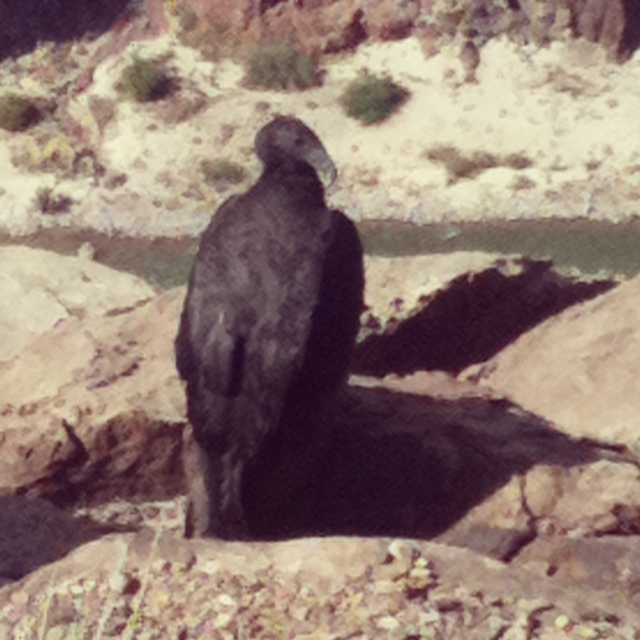
The wind had begun to pick up and my backpack had attracted a lone raven. Ravens are very smart birds and this one was intent on pecking its way into my backpack, hoping to score some more trail mix. This forced me to abandon my shady perch and chase the raven away. And just as I did, I came across the condor the ranger had told me about. Much larger than the raven and just as black, the condor was indeed an infant and he didn’t know what to think of me.

Whereas the raven beat a quick retreat, sqawking as I chased it away from my backpack; the condor never flinched. The sight of this endangered bird stopped me in my tracks with the ranger’s request still fresh on my mind.

“We want him to be scared of humans,” she said. “Or else he’s going to die.”

There are roughly 400 California condors remaining in the wild and around 80 of them call the Grand Canyon home. At full maturity, condors can reach a 9-foot wingspan, making these scavengers easily the largest bird in North America.

So I screamed and yelled at the top of my lungs, jumped up and down and waved my arms like I just didn’t care. And the condor never moved. He just stared at me from his perch a few feet below from where I had enjoyed my victory meal.

Then I pulled out my trusty i-phone and snapped some pictures and only then as I lowered myself for that perfect shot, did he flap those big black wings and take flight, catching a burst of wind and soaring along the top of the gorge.

Farewell, young fella. May you survive and thrive.

The wind was so strong that it convinced me to get off the rocky cliffs and start my journey back to the rim. I had accomplished so much on this hike already and now was not the time to get greedy — or to be blown into the gorge.

The last thing I needed was to meet the rest of the condor’s family.


Trailblazing

26 04 2012

It was a Wednesday morning and I awoke ready to tackle the day. I had renewed energy, knowing a trip to Phoenix — and civilization — was on the horizon. I also had caught the hiking bug.

Intent on making progress into the Canyon, I resumed my descent along the Bright Angel Trail, making it to the mile-and-half reststop much quicker than I had before. I carried more water with me this time and less clothes. The weather was getting warmer and the sun was out and the deeper I went into the Canyon the hotter it would get.

The trail was packed with tourists, some coming up and others going down. At the three-mile reststop, shade was in high demand. The covered benches were full of people swigging electrolyte water and lathering themselves in sunscreen. With no room to spare under the reststop roof, I found a nearby tree, plopped down under its shade and quinched my thirst. It didn’t take long for the squirrels to notice. Grand Canyon squirrels are an aggressive breed and from what the rangers say, the squirrels have become one of the biggest threats to man.

As cute as these little critters look, they will bite and their bite has sent many to the Canyon clinic. Watching the squirrels pander to each passing hiker was amusing and their total lack of fear in humans was equally suprising. With the squirrels dancing around for crumbs, I could hear the discussions from inside the reststop as to how much further should we go. It was the thought on everyone’s mind.

It was just a few minutes after noon and the sun was beating down on the Bright Angel Trail. I decided to shed my long pants and thanks to the Northface brand, all I had to do was unzip the lower end and my legs were free to breathe. As I continued my descent from the three-mile reststop, the number of hikers coming up began to greatly outnumber the ones going my direction. I probably should have gotten an earlier start, I thought.

Indian Garden was the next stop and from the rim, it truly did appear to be like an oasis along the trail. The hike began to level out as I approached this oasis and the Canyon also began to open up and display more of its beauty. I was now almost completely alone on the trail and a subtle pain began to emerge from my right foot. I ignored the pain and pressed on, heading straight for the lush greenery of Indian Garden.

The tall waving Cottonwood trees were a sight for sore eyes indeed and as I entered the Garden their fuzzy white blooms were floating everywhere in the air. It was almost, dare I say, magical.

With its ideal location halfway between the river and the rim, many hikers use Indian Garden as a camping site. It has an ample supply of water, campgrounds and a ranger station. As I wandered into one of the covered rest areas, I encountered two female hikers sunburnt and exhausted, one laying across a picnic table and the other hovered over a water spicket. We exchanged pleasantries and I asked them how they were doing.

“Hot, very hot,” said one of the ladies. They had just hiked up from the river, a narrow stretch of the trail with not much air flow.

I asked them what it was like down there. They said the river was very cold, that there were some idiots who jumped in and were swimming around, but it did feel good on their bare feet. This made me think about my foot and the pain that I was too afraid to confront. I also began to think long and hard about how much further I should go. At the beginning of my hike, Indian Garden had been my destination, but now that I was here and not nearly as tired as I thought I would be, I desired to go deeper into the Canyon.

Just before you leave Indian Garden and cross over its trickling creek, there comes a fork in the trail. You can hike west to Plateau Point and Tonto Trail or head east and down to the Colorado River and Phantom Ranch. For a brief moment, I thought of the Robert Frost poem about the road less traveled, a piece of work which could be used to characterize my travels. This next decision, would indeed, make all the difference.


Searching for Friends among Victims

16 04 2012

Making friends has been much harder here than I had originally thought.

For starters, most people in the Canyon work a lot of hours so there is very little free time for social activities. You may meet someone briefly in the employee cafeteria that you click with, but if they work in another part of the park and your schedules do not match up, well then, you probably won’t see that person very often.

Take Thomas, the man who paved my way here, for example. We’ve met for breakfast on a couple of occasions, but he works nights at the El Tovar while I’m folding T-shirts at Maswik. To his credit, Thomas did warn me about this.

“You won’t see me that much,” he said. “You’ll make your own set of friends at Maswik.”

And I have tried, but it hasn’t been easy. I’m living just across the railroad tracks from Maswik Lodge in the all male dormitory Victor Hall, or as the locals like to refer to it — “Victim Hall.” Legend has it, there was a murder there a few years back.

You won’t find Victor Hall on any map provided to tourists. It’s almost like the Park Service doesn’t want people to know the place exists. And for good reason.

I’ve lived in dorms before, back in college and Victor Hall is everything you could imagine when you think of a smelly, old, cold brick and mortar building. The nice old Native American ladies I work with at the gift shop get a good laugh out of calling the place an “Animal House.”

And oh are they right.

On the lower level of Victor Hall is what is known as the TV room. There’s soda and snack machines inside, couches and tables, a bookcase full of books no one reads and the television set perched high in the corner. If you are lucky enough to get to the room first or outlast the previous inhabitants, then you get possession of the remote control — A position of great authority at Victor Hall.

Most of the time, the TV is tuned to an action movie with a lot of gunplay, fast cars and faster women or some sort of sporting event. The news is never on.  As I have come to find out, half of the people who live in Victor Hall are in their own little fantasy land so the news has little bearing on them. The other half are foreign workers who cannot understand what Anderson Cooper has to say.

Among the regular visitors to Victor Hall are the fine men and women of NPS Fire and Security. They usually arrive at night, especially on weekends, when things tend to get rowdy. Last Saturday night, just after midnight, the fire alarm went off and we all had to pile outside with snow coming down and temperatures near freezing just because some bozo decided he was going to light one up in the bathroom.

It was my second fire drill at Victor Hall since I got here and it won’t be my last.

Most of the long term employees at the Grand Canyon get out of Victor Hall as soon as they can. One of the more popular sayings is, “I did my six months at Victor.” It’s kind of a sympathetic solidarity amongst the male workers.

Thankfully, I have a stable roommate and the hot water works so I’m in no hurry to abandon Victor Hall just yet. As a writer, the material here is priceless. However, I doubt very seriously I will find a hiking companion in the TV room.


The Initial Descent

7 04 2012

Starting to get settled in here with the initial shock of moving across country and into a completely different climate now fading away. I got a couple of paychecks under my belt too which helps in the confidence department.

And I finally descended into the Canyon, bringing clarity and perspective to the big picture. I have always enjoyed hiking, whether it be the backcountry of Arizona or the concrete jungle of Manhattan. Hiking — which is walking essentially — can tell you a lot about yourself.

As I hiked down the Bright Angel Trail, my mind raced with thoughts dominated by fear. Had I brought enough water? Were my shoes appropriate?? Would I go too far down and not be able to make it back up???

All indeed valid questions. The Park Service does not supply the trail with water until the summer months, but it is in the spring — if the wind cooperates — when conditions are best to descend into the Canyon. The difference in temperature between the bottom, where the Colorado River flows, and the top of the South Rim is usually between 25-30 degrees. The deeper you go the hotter it gets.

On this day the trail was full of hikers and tourists disguised as hikers. I have been surprised by the large numbers of foreign tourists that come here. I have engaged in more conversational French in one month than I had in 10 years in Panama City. This substantial presence of not only Europeans, but Asians has made me realize how foolish I was to believe that I was living in an international tourist destination in Panama City. That was a lie floated by the power brokers to build a new airport. Panama City may get a handful of international tourists, but it is far from an international tourist destination. It is a regional tourist destination at best and will remain that way until a better strategy of attracting visitors is implemented.

Back on the trail, hikers had to make sure they not only avoided mule droppings, but also watched their step for loose gravel and leftover snow and ice. I wore my trusty adidas running shoes, the same pair I bought at the Ross discount store back in Panama City a couple years back. I have a habit about wearing shoes for a long time and this pair of adidas felt good on my feet. They may not look hiking professional, but they were light and comfortable and I was able to make my way down the trail without any missteps.

There were a few tense moments like when the wind would gust up as I approached a narrow overlook with oncoming hikers headed my way. Fortunately, most of the people who hike are considerate and will always ask how you’re doing. I was relieved to make it to the first rest station, one and half miles down. Coming back was much tougher and required a couple stops to catch my breath and hydrate.

What I learned about myself on this foray into the Canyon was I’m in better shape than I thought, but still have a ways to go to make it to the river. That is the goal during my time here — To hike to the bottom and back. It will take more than an afternoon to do it and I will have to be well prepared for the trip.

And I probably shouldn’t go it alone.


Isolation sets in

1 04 2012

I’ve only been here a month, but it seems like a year.

I thought I knew what isolation was like, living in Panama City. That was nothing. The Grand Canyon is remote. It is a National Park, after all, on the edge of a cliff, some 7,000 feet up. It’s a good place to go into exile.

Many of the workers here are older people who have retired from their career jobs or military service and are now enjoying a little extra cash in a natural setting. There are also a large number of Native Americans working in the park. The Navajo, Hopi and Apache reservations are close by and their numbers are well represented inside Grand Canyon. And then there are the foreign workers, brought in from countries like Ecuador and Thailand for a three month stay and usually made to clean rooms and bus tables.

I have been assigned to work inside the gift shop at the Maswik Lodge, where my retail experience has helped tremendously. Running a cash register is kind of like riding a bike, you never forget how to do it. My first cash register work came as a high school teenager at the Port St. Joe Piggly Wiggly and now, more than 20 years later, I’ve never been robbed and my drawer has never come up majorly short. Knock on wood. Big ponderosa pine wood.

But I’m not selling necessities at Maswik. I’m selling souvenirs — from t-shirts and jewelry to pottery and greeting cards crafted out of mule dung. Of the dozen or so gift shops in the park, Maswik is the only one designed to be a “green store” and by “green” I don’t mean money. The Maswik gift shop is an example in environmental stewardship and United States ingenuity. Almost all of the merchandise is designed and distributed within the United States and this manufacturing is carried out with strong regard to softening the environmental impact.

It’s a refreshing change from the Wal-Marts and Targets of suburban America, supplied by China.

However, aside from the store’s feel good eco-friendly message, I have noticed some of our top sellers are Tylenol, Advil and Tums. The elevation catches many tourists off guard. So many assume Arizona is the desert and the Grand Canyon is on a river. And while they are right on both accounts, Northern Arizona is not Phoenix or Tucson and very few visitors to the park actually make it to the bottom of the Canyon.

I haven’t ventured in yet, although I do plan on making an initial hike tomorrow, weather permitting. So far, it has been very cold and windy on my off days. The second week I was here, a huge winter storm blew in and dropped 18 inches of snow on the Canyon. Needless to say, I am very much looking forward to warmer conditions.

And as difficult as the isolation can be, I am thankful to be working a lot and saving money. I had a plan in mind when I accepted this assignment. You might call it a mission in discipline and capitalism. The early going, as they say, is always tough. If I can stick it out, the rewards will be great.