Winter, After the Silence

11 02 2026

It has been a while since I’ve written.

Not because nothing has happened. Quite the opposite. Life has been arriving in waves, and I have been standing in the surf without quite knowing how to describe the undertow.

Winter has hit harder this year.

In the early morning hours, walking home from the train station, I navigate mobs of crows clustered in the trees overhead. They cry out before they let loose, peppering the sidewalk with their droppings — a crude warning system. I walk carefully. There is something about the darkness at that hour, the industrial quiet broken only by wings and wind, that feels both ancient and immediate.
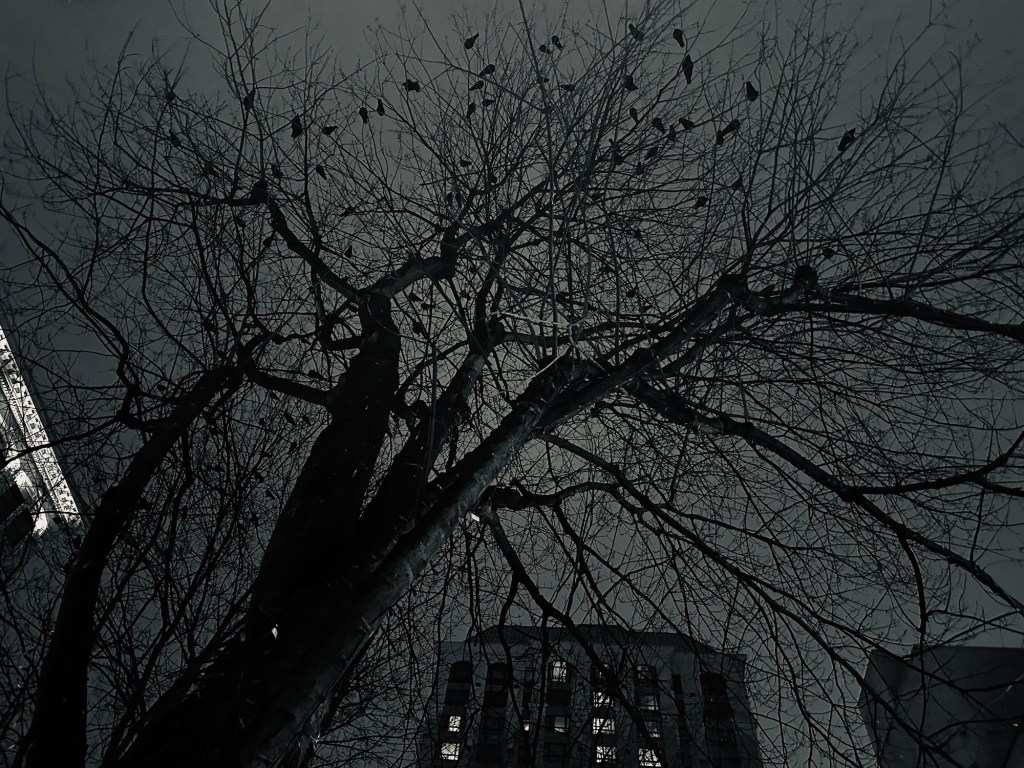
Crows Overhead

Along the way I pass people sleeping in doorways. Sometimes there are dogs curled beside them, wrapped in blankets, loyal in ways the rest of us struggle to be. The city breathes differently at that hour. Stripped down. No pretense. Just bodies trying to endure until daylight.

“You’re a very empathetic person,” my therapist friend once told me. “You give so much. Most people aren’t like that.”

I didn’t know what to say then. Empathy feels less like virtue and more like exposure. You feel everything. You absorb it. And lately, there has been a lot to absorb.

The people I looked up to most of my life are dying now. My father included. I have tried to memorialize them the best way I know how — in words — but grief does not move in tidy lines. It comes in waves. Regret rides in with it. Regrets, I’ve had a few. Some small. Some seismic.

The transit agency job keeps my writing afloat. I’m taking a college course in electricity, too. Dad would have liked that. There is something solid about learning how currents move, how power is transferred. It makes the invisible visible.

When I was disqualified from the rail operator position, the union stepped in and saved my job. That was the good news. The bad news was the overnight shift — outside, in winter — moving, coupling, and decoupling trains for the next day’s service.

The yard is all steel and breath and repetition. My fifty-year-old body has begun to protest. I sleep more. I battle colds and congestion. I’ve run out of sick time. With budget cuts looming, I pray for health the way some people pray for miracles. Just get me to spring. Let me sign up for a day shift. Let light return in some practical way.

David remains my rock. At his age, working forty hours a week in retail is no small thing. I wish he didn’t have to, but it keeps him moving. That’s the trick, isn’t it? Motion as survival. My step count has never been higher since taking the yard hostler role. A coworker told me, “I have no desire to be caged in that cab for ten hours a day.” I understood what he meant. Movement feels like proof of life.

Still, I miss the sun. I miss Florida’s warmth, even though there have been days colder there than here in the Pacific Northwest. It isn’t just temperature — it’s the rain. The gray. The way it seeps into the psyche. After eight years, I sometimes think I have battled depression to a draw. Not defeated it. Not surrendered. A stalemate.

I try not to get pulled into politics. I am a public servant. But the news some days is unbearable. The cruelty. The speed with which outrage ignites. Digital life has given us constant connection and constant combustion. It is hard not to look. Harder to look away.

I think often of the summers when I worked in the parks. The disconnection. The way nature set the pace. I fell in love in Yellowstone. It was, without exaggeration, the best summer of my life.

There are alternate versions of me that sometimes feel more vivid than the one I inhabit. The version who eloped to Italy with Ann. She loved me. It was true. I often wonder what that life would have been.

But there was a secret then. A stigmata I carried too long. It shaped my choices, narrowed my courage. Decades pass in the space of one unresolved truth. And just like that, the realization lands: I will never be a father. The sting comes sharp and sudden, like a Georgia yellowjacket on a hot afternoon. You don’t see it coming. You just feel the burn.

At my annual physical, I learned I have high blood pressure. Dad had it too. I ask myself why I cannot relax. Am I still trying to prove something? Am I restless because some part of me believes another life-altering opportunity has slipped by? Is this as good as it gets?

I flew to Alabama to see my mother and brother. I won’t write more about that. Empathy again — the instinct to protect, to soften edges, even when they cut me.

Tomorrow night, I will return to the train yard. The crows will still be there. The cold. The coupling and uncoupling of cars. The small prayers whispered into the fog.

My spirit is not broken. But it is bruised.

And I am hopeful — stubbornly, irrationally hopeful — that this static feeling will pass, that something in me is still recalibrating, that winter, like grief, like regret, like love withheld and love remembered, is not the whole story.

It is only a season.


Still Here

10 07 2020

I’m still here and if you’re reading this so are you.

That’s a good thing. I hope you are not ready to throw in the towel. This has been one ass kicker of a year. I have aged and matured at a much faster rate in 2020 — that I can tell you.

There are still special moments. Those should be mentioned.

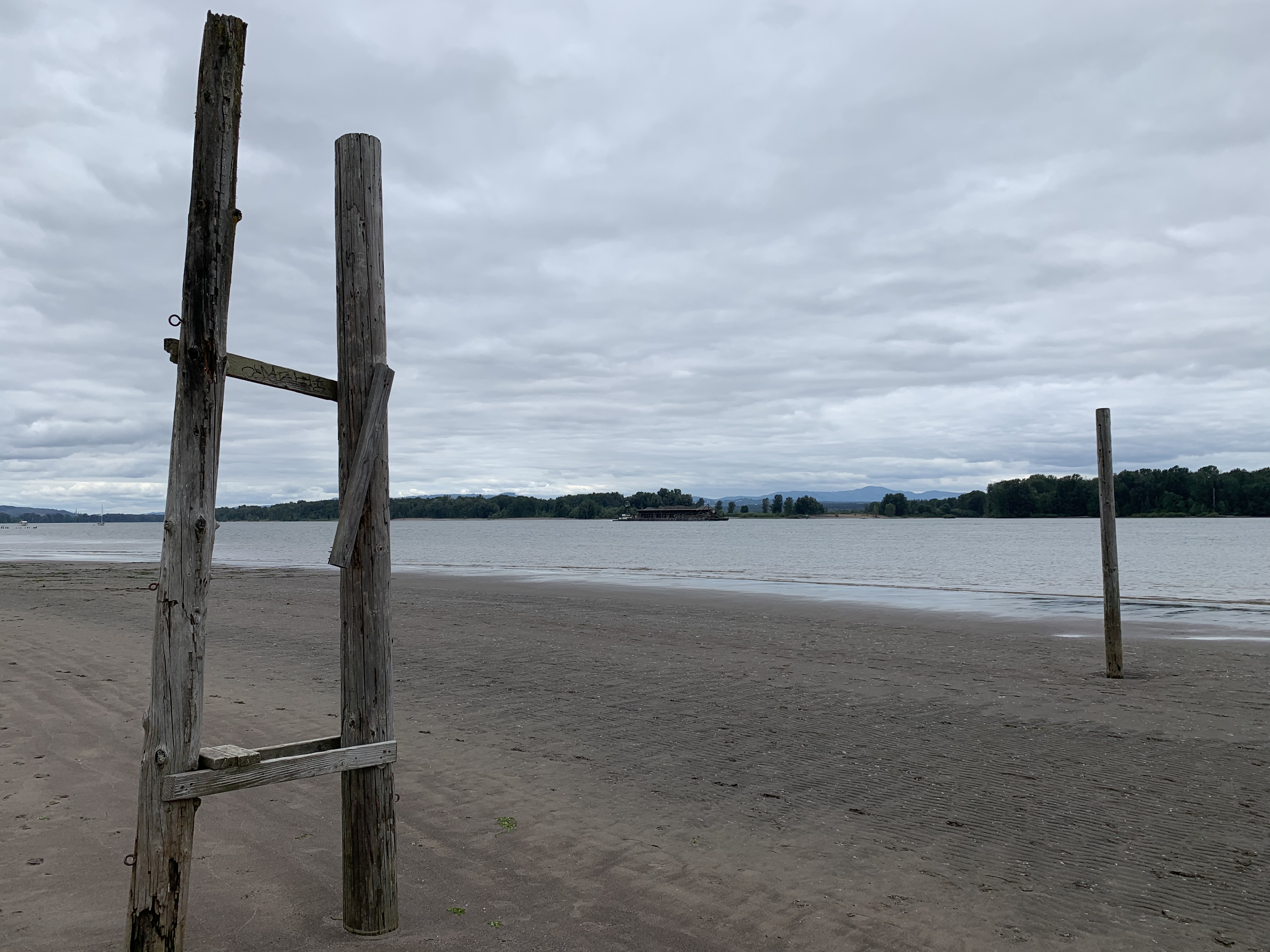
David and I drove out to Sauvie Island the other day. Gorgeous scenary just outside Portland. It’s early July and the sun is concealed by the clouds. This is a reality of living in the Pacific Northwest, along with the rain. I’m at acceptance with this.

SauvieIsland

There were not many people on the beach and of those we saw all, respectfully, kept their distance.

The wildlife here is amazing. Huge bird nests sit atop poles near the island’s northeast shores. Watching these sea hawks soar is interesting. We saw ospreys and eagles on our most recent visit. I shared an awesome moment with an osprey, it was one of pure synchronicity.

The bird flew over the Columbia River, letting the wind fill its strong wings. I stood on the river’s edge, upright at attention. I lifted my arm slowly above my right shoulder and held it in the air, palm open. The osprey responded with a cry.

It was beautiful.

Later, a plump bad eagle burst from a tree behind our spot. Taking off over the river, the bald eagle stretched its talons above the river’s waters, showing off it’s capable talents. Was this an exercise or serious salmon hunt, I wondered.

The visit to Sauvie Island was a relaxating, soul-restoring trip. Nature has always been my great healer. So many fond memories of those summers working in the parks. Yellowstone’s Wolf Lake will always be special to me.

Back to reality and urban city life during election year in America amid a pandemic and racial tensions. Tear gas, rioting, vandalism — have all come to town. Unbelievable. Even if the videos are being distorted to intenionally provoke an emotional element of society, it’s despicable.

Are we great yet?

I have a few questions for those of you who still care: What’s it gonna take for you to be happy? To be satisfied and content?? How hard is it to be considerate of others???

That’s all for now, folks. I’ll try to update ya next month.

Peace,

John


Flight of the Condor

4 05 2012

The ladies advised me against going down to the river, whether they knew it or not.

“If you don’t mind hiking in the dark, go for it,” one of them said, in an exhaustive sort of way.

That was all I needed to hear. I did not bring a flashlight and wasn’t about to hike in the pitch black. So I decided to take the trail to Plateau Point instead. After all, I did have all summer to make it to the river.

The hike from Indian Garden to Plateau Point does not involve steep inclines or switchbacks, but is completely exposed to the elements and on this day, the sun was shining bright with sparse clouds in the sky. Again, I probably should have gotten an earlier start. Had I left at dawn I would be soaking my feet in the river by now.

There was hardly a soul on this trail and the only signs of life came from the sprouting yuccas and flowering cacti. Every once and a while, a spiny lizard would scurry across the rocks and puff up at me. Like the squirrels before, these little lizards have ample amount of moxie.

As I approached Plateau Point, a figure emerged from the rocky ledge. As they got closer I discovered it was a park ranger, her head and face completely covered with bandanas and sunglasses. If this were a Star Wars movie, she would be a perfect Sandperson. The ranger informed me there was a baby California condor nearby and then asked me for a favor.

“Sure thing,” I said, always willing to help out a woman in uniform, even if she looked like a Tusken Raider.

“If the condor comes at you, I want you to chase him away — wave your arms, yell and scream and do whatever it takes to scare him away, OK?,” she said.

“Got it,” I replied.

I then asked the ranger if she would snap some pictures of me for evidence of my excursion. She gladly complied and even remarked that the last one was, “beautiful.” Then she hiked away. It was just after three o’clock. I guess it was time for her to clock out. I was all alone at what seemed like the end of the world. As I took the final steps toward the edge, I was not prepared for what I would see next. I don’t think anyone ever is.

From Plateau Point, the Colorado River is a sight to behold. With a blue-greenish tint — from all the minerals — the river flows between towering gorges of rock. Looking down, I could see rafters making their way through a gauntlet of rapids as their cries echoed off the rock walls. I took my backpack off and found a shady spot under one of the overhanging rocks. Then I had my victory meal: a bag of raisins, peanuts and chocolate balls. As I munched on my trail mix, I stared down into the gorge. It was mesmorizing.

And dangerous.

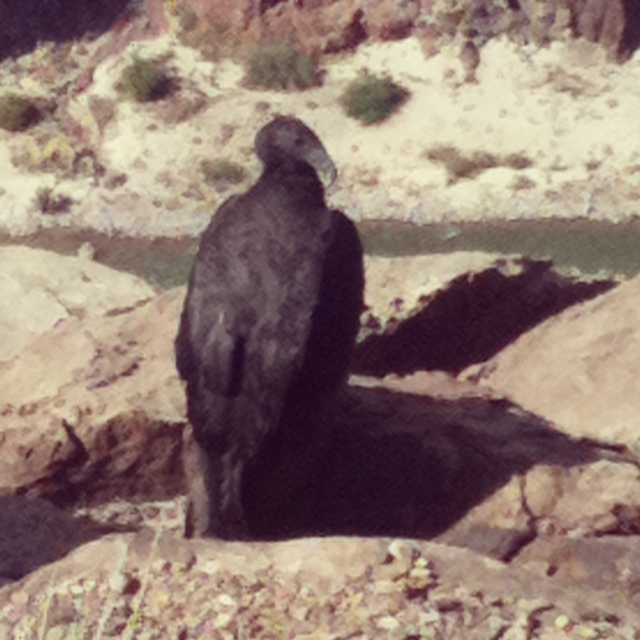
The wind had begun to pick up and my backpack had attracted a lone raven. Ravens are very smart birds and this one was intent on pecking its way into my backpack, hoping to score some more trail mix. This forced me to abandon my shady perch and chase the raven away. And just as I did, I came across the condor the ranger had told me about. Much larger than the raven and just as black, the condor was indeed an infant and he didn’t know what to think of me.

Whereas the raven beat a quick retreat, sqawking as I chased it away from my backpack; the condor never flinched. The sight of this endangered bird stopped me in my tracks with the ranger’s request still fresh on my mind.

“We want him to be scared of humans,” she said. “Or else he’s going to die.”

There are roughly 400 California condors remaining in the wild and around 80 of them call the Grand Canyon home. At full maturity, condors can reach a 9-foot wingspan, making these scavengers easily the largest bird in North America.

So I screamed and yelled at the top of my lungs, jumped up and down and waved my arms like I just didn’t care. And the condor never moved. He just stared at me from his perch a few feet below from where I had enjoyed my victory meal.

Then I pulled out my trusty i-phone and snapped some pictures and only then as I lowered myself for that perfect shot, did he flap those big black wings and take flight, catching a burst of wind and soaring along the top of the gorge.

Farewell, young fella. May you survive and thrive.

The wind was so strong that it convinced me to get off the rocky cliffs and start my journey back to the rim. I had accomplished so much on this hike already and now was not the time to get greedy — or to be blown into the gorge.

The last thing I needed was to meet the rest of the condor’s family.