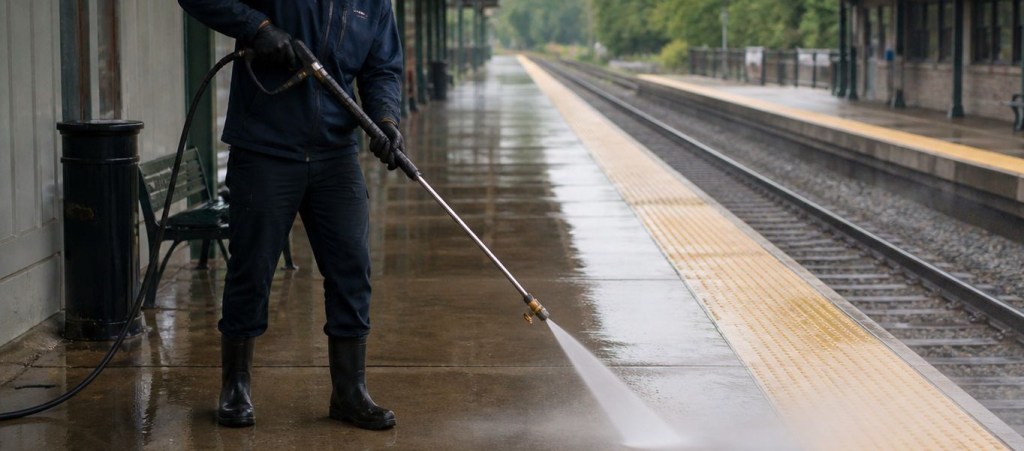
Pressure washing train platforms in the daylight has become, for me, an exercise in force and patience, the body leaning into the resistance of a hose alive with heat and pressure, the water cutting through grease, grime, and the residue that settles where thousands of strangers pass through without a thought.
There is a rhythm to it, almost meditative, moving around benches and columns, tracing the edges of what accumulates in public spaces, stripping away what has hardened there overnight. Some mornings, standing in the spray and steam, it occurs to me that much of life is not so different — that adulthood, for all its grand ambitions, becomes less about building than maintaining, less about arrival than repair.
By day, I clean platforms. By night, a few evenings a week, I sit in classrooms studying electricity and industrial maintenance, learning the architecture of systems — how things hold together, where they fail, what it takes to bring them back to life. There is something unexpectedly satisfying in it, this practical education, this late return to the mechanics of repair. I made a B in electricity and moved on to industrial maintenance, and what surprises me most is not the difficulty but the familiarity, as though these skills were waiting somewhere beneath the surface all along, buried under years of other pursuits.
For years, my life ran on schedules, machinery, and the restless movement of trains — the strange nocturnal rhythm of graveyard shifts and stations that never really sleep. There was a kind of order in that world, harsh but reliable, the machinery of transit moving people toward destinations while I remained in motion myself, orbiting the lives of others. When I gave up that shift for daylight, it felt like a small reclamation, a return to ordinary time — dinners at reasonable hours, afternoon walks in the spring light, the possibility of living inside the rhythms most people take for granted.
Spring in the city has a way of making renewal feel possible. The light lingers longer in the evenings, trees begin their annual insistence on resurrection, and the air softens just enough to make you believe that change can be gentle. At this stage of life, that feeling carries its own seduction, because renewal is never as simple as the season suggests. It asks something of you — a letting go, perhaps, or the willingness to see clearly what once seemed promising.
It was during this season, in the midst of learning how to repair machines and reclaiming daylight, that a close friend invited me to dinner at a new private club in the city. I had heard of it, of course, one of those carefully designed spaces meant to gather the creative and connected, but I had never imagined myself there. That first evening, the place seemed alive with the easy vitality of belonging. The dining room glowed with conversation, small clusters of people leaning toward one another in laughter, their gestures loose with familiarity. Upstairs, the rooftop pool shimmered against the darkening sky, music drifting through warm air, the city opening below in all its glittering possibility.
It was not the luxury that struck me. It was the atmosphere, the sense — or the appearance — of connection. These days, friendship is no longer something you stumble into but something you work to sustain and that kind of atmosphere exerts its own pull.
I was surprised when they accepted my application. Places like that carry their own invisible codes, their own assumptions about who belongs. I have spent most of my life working, earning my place through labor rather than access, and stepping into that world felt, at first, like crossing into another version of life.
But first impressions have a way of collapsing under repetition.
What had seemed open began, over time, to reveal its boundaries. The friendships there had long been formed, their circles tightened by history and habit, and moving among them felt less like entering a community than brushing up against one. There were rules, too, some spoken, some not, and I learned them awkwardly, by breaking them — small mistakes met with correction, moments of embarrassment that reminded me how easily a person can feel out of step in a place built on social fluency.
None of it was dramatic, but it accumulated.
And slowly the illusion thinned.
What I had mistaken for community was, in many ways, the performance of it: the visible signs of connection without its deeper invitation. That recognition was disappointing, though clarifying. It reminded me that community cannot be manufactured by architecture or atmosphere, however persuasive the setting. The appearance of welcome is not the same thing as welcome itself, and the performance of connection is not connection. Real belonging remains mysterious that way. It forms slowly, often without announcement, through time, repetition, and the small, unremarkable acts by which people come to trust one another.
So I canceled the membership, not in anger but in recognition. Not because I had changed, but because the promise had revealed itself as something else.
There is a peculiar freedom in seeing through an illusion, even one you wanted badly to believe.
These days, what I want feels simpler, though perhaps it always was. Work that teaches me something. Friendships that unfold naturally. Time spent in sunlight. A body strong enough to carry me where I need to go. The quiet dignity of learning new things, even now.
Standing on those platforms in the wash of hot water and steam, watching the grime lift and run toward the drains, I think often about how much of life becomes this very act: not accumulation, but discernment. Not gathering more, but learning what can be released—washed away, let go of.


 Slice of Good Ol Boy Life
Leave a comment