The Cost of Belonging

5 05 2026

Pressure washing train platforms in the daylight has become, for me, an exercise in force and patience, the body leaning into the resistance of a hose alive with heat and pressure, the water cutting through grease, grime, and the residue that settles where thousands of strangers pass through without a thought.

There is a rhythm to it, almost meditative, moving around benches and columns, tracing the edges of what accumulates in public spaces, stripping away what has hardened there overnight. Some mornings, standing in the spray and steam, it occurs to me that much of life is not so different — that adulthood, for all its grand ambitions, becomes less about building than maintaining, less about arrival than repair.
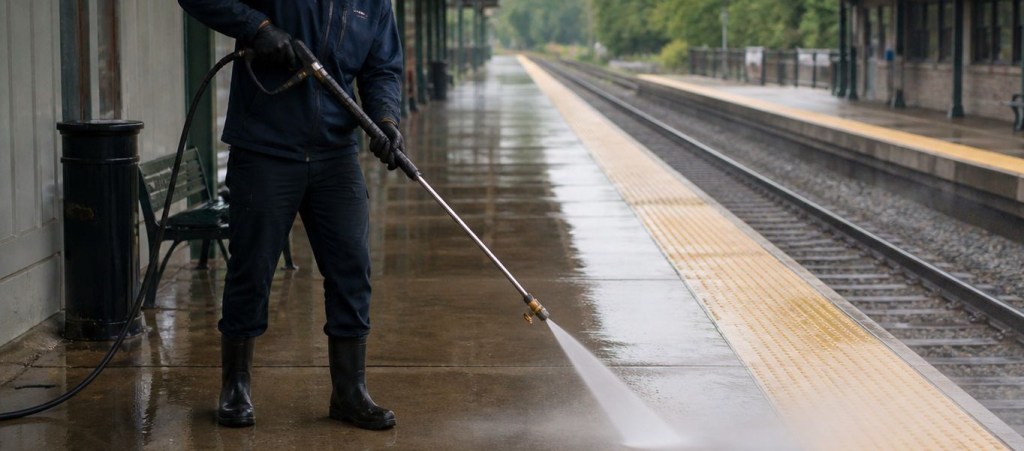
By day, I clean platforms. By night, a few evenings a week, I sit in classrooms studying electricity and industrial maintenance, learning the architecture of systems — how things hold together, where they fail, what it takes to bring them back to life. There is something unexpectedly satisfying in it, this practical education, this late return to the mechanics of repair. I made a B in electricity and moved on to industrial maintenance, and what surprises me most is not the difficulty but the familiarity, as though these skills were waiting somewhere beneath the surface all along, buried under years of other pursuits.

For years, my life ran on schedules, machinery, and the restless movement of trains — the strange nocturnal rhythm of graveyard shifts and stations that never really sleep. There was a kind of order in that world, harsh but reliable, the machinery of transit moving people toward destinations while I remained in motion myself, orbiting the lives of others. When I gave up that shift for daylight, it felt like a small reclamation, a return to ordinary time — dinners at reasonable hours, afternoon walks in the spring light, the possibility of living inside the rhythms most people take for granted.

Spring in the city has a way of making renewal feel possible. The light lingers longer in the evenings, trees begin their annual insistence on resurrection, and the air softens just enough to make you believe that change can be gentle. At this stage of life, that feeling carries its own seduction, because renewal is never as simple as the season suggests. It asks something of you — a letting go, perhaps, or the willingness to see clearly what once seemed promising.

It was during this season, in the midst of learning how to repair machines and reclaiming daylight, that a close friend invited me to dinner at a new private club in the city. I had heard of it, of course, one of those carefully designed spaces meant to gather the creative and connected, but I had never imagined myself there. That first evening, the place seemed alive with the easy vitality of belonging. The dining room glowed with conversation, small clusters of people leaning toward one another in laughter, their gestures loose with familiarity. Upstairs, the rooftop pool shimmered against the darkening sky, music drifting through warm air, the city opening below in all its glittering possibility.

It was not the luxury that struck me. It was the atmosphere, the sense — or the appearance — of connection. These days, friendship is no longer something you stumble into but something you work to sustain and that kind of atmosphere exerts its own pull.

I was surprised when they accepted my application. Places like that carry their own invisible codes, their own assumptions about who belongs. I have spent most of my life working, earning my place through labor rather than access, and stepping into that world felt, at first, like crossing into another version of life.

But first impressions have a way of collapsing under repetition.

What had seemed open began, over time, to reveal its boundaries. The friendships there had long been formed, their circles tightened by history and habit, and moving among them felt less like entering a community than brushing up against one. There were rules, too, some spoken, some not, and I learned them awkwardly, by breaking them — small mistakes met with correction, moments of embarrassment that reminded me how easily a person can feel out of step in a place built on social fluency.

None of it was dramatic, but it accumulated.

And slowly the illusion thinned.

What I had mistaken for community was, in many ways, the performance of it: the visible signs of connection without its deeper invitation. That recognition was disappointing, though clarifying. It reminded me that community cannot be manufactured by architecture or atmosphere, however persuasive the setting. The appearance of welcome is not the same thing as welcome itself, and the performance of connection is not connection. Real belonging remains mysterious that way. It forms slowly, often without announcement, through time, repetition, and the small, unremarkable acts by which people come to trust one another.

So I canceled the membership, not in anger but in recognition. Not because I had changed, but because the promise had revealed itself as something else.

There is a peculiar freedom in seeing through an illusion, even one you wanted badly to believe.

These days, what I want feels simpler, though perhaps it always was. Work that teaches me something. Friendships that unfold naturally. Time spent in sunlight. A body strong enough to carry me where I need to go. The quiet dignity of learning new things, even now.

Standing on those platforms in the wash of hot water and steam, watching the grime lift and run toward the drains, I think often about how much of life becomes this very act: not accumulation, but discernment. Not gathering more, but learning what can be released—washed away, let go of.



The Dream That Carried Me

18 07 2025

When I was a boy in the Florida Panhandle — where the heat made any breeze that cut through the pine trees feel like a gift from heaven — I used to press my ear to the railroad tracks and wait.

For what, I wasn’t sure. A rumble. A tremor. A sound that confirmed something was coming. Trains moved through our coastal town, carrying paper from the mill. They moved like ghosts, urgent and unbothered, and I wanted, more than anything, to be the one driving them.

That was the dream: steel, speed, the illusion of control.

And now here I am, fifty-two years old, riding in a single-car light rail train into Hillsboro, Oregon, cloaked in the dark hush of a December morning. I am the one pulling into an empty platform, the one with hands on the lever. My left brings her into braking. My right taps the bell. The train stops clean.

“You don’t need to have a death grip,” Jorge tells me. “Be gentle with her.”

We were halfway through our training program and on the overnight shift. There are nine of us left, split into three teams. Jorge, all Cuban warmth and exacting calm. James, slower, quieter — Los Angeles cool, but alert beneath it. They don’t teach you how to handle the machine as much as they teach you how to be with it.

“Relax, take your time,” Jorge advised. “Do each step individually and it’ll all tie together and become natural.”

Sage advice. Slow your roll, essentially.

Before the yard-to-yard test — the one that moves you from theory to real track — I got sick. A stomach virus that left me wrecked and sweating through nights I couldn’t remember. I missed one day. James let me make it up. Another trainer might not have. I passed. Just barely. I passed.

“Watch your intermediates,” James told me as we walked through the Beaverton yard.

Signals, I learned, are prophecy. Intermediates tell you what’s coming — when to slow down, when to stop. Ignore one and anything can go sideways. Signals, switches, speed. There is no room for sentimentality out here. Only precision.

Oregon’s light rail system is complicated. Beautiful, yes. Ingenious, even. But also dangerous. Tracks run through intersections, weave alongside bike paths, share spaces with cars, pedestrians, skateboarders, scooters and dogs on leashes. You are constantly negotiating with chaos.

After the test, we entered line training. Three weeks of shadowing operators who knew too much, but said very little. They spoke in glances, in warnings you felt more than heard. This was no longer the dream. This was the reality.

You learn quickly: revenue service is where romance goes to die. Where you stop seeing yourself in the story and start seeing everyone else — angry passengers, lost time, bullying supervisors and the thousand ways things fall apart.

Still the horn cuts through a sleeping city, something stirs in me. That boy on the tracks, listening for the future. He never imagined what the job would cost. But he’d still want it.

So do I.


In Hot Water

29 05 2025

What left an impression on me about Japan was its culture of cleanliness and respect, qualities that were ever apparent as we traveled the country.

Admittedly, there was a sense of embarrassment for my homeland. Japan’s trains and stations were clean, riders were considerate of fellow passengers and there was nary a whiff of smoke — much less illegal drugs in the air.

Most of the platforms had vending and recycling machines, which would be impossible to maintain in a vandal plagued Portland.

To my surprise, some train cars were designated for women only. I found this a bit odd, considering the country’s reputation for male chauvinism.

Keita’s mother, on the other hand, was not one to be subjugated. An octogenarian who was still driving — a stick shift car no less — she fetched us from the train station and always made sure we ate a big breakfast each morning.

After a long bus ride from Tokyo we arrived in Kusatsu, where you are greeted instantly by the rotten eggs smell of sulfur from the hot springs.

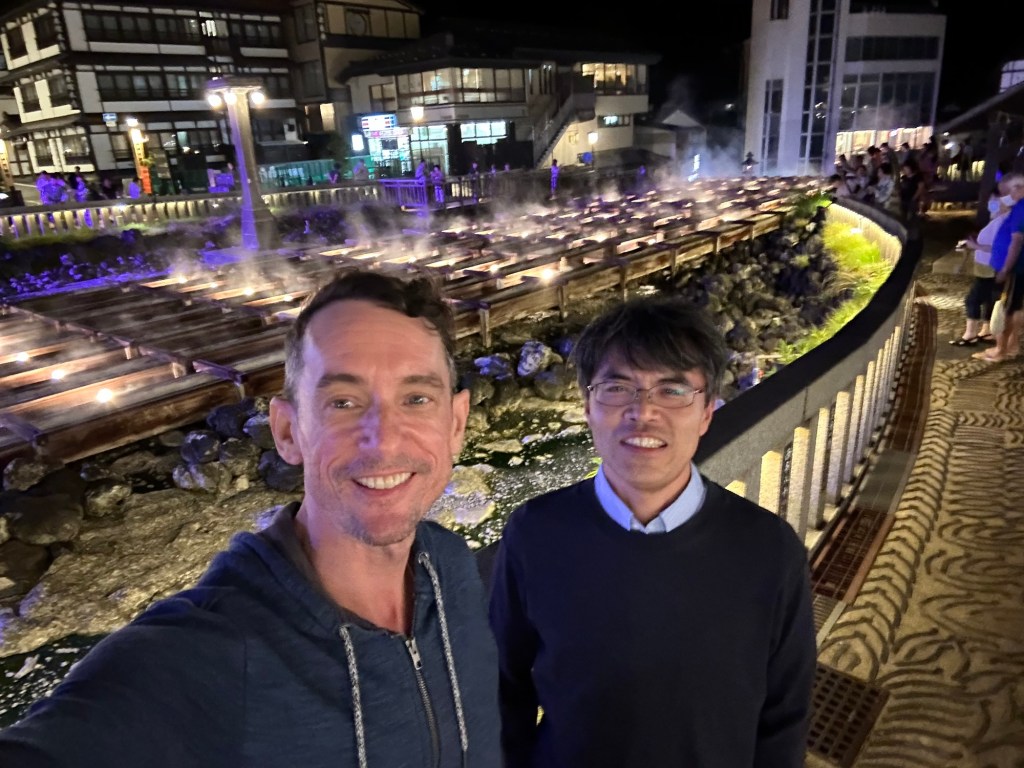
In the town square sits the Yubatake, a field of water, where people gather particularly at night to socialize. Some believe the minerals from the hot springs have healing properties. If true, I was more than ready for a soak.

“Let’s do the Onsen after we check in,” Keita said to me as we hiked through the narrow and curved streets up to our hotel.

Donning our yukatas (robes), we entered the male side of the Onsen. Inside, phones and cameras are strictly forbidden and it is custom to bathe naked. To set the mood, relaxing zen music played overhead as I stepped into the tile enclosed pool.

Life takes unexpected twists and turns and here I was, the lone Western figure at a remote hot springs resort tucked away in the mountains of Japan’s Gunma prefecture.

And the water was wickedly hot!

It’s heat pulsing as I stood knee deep and naked in the Onsen’s large pool. The convection like an attack on my nervous system.

While the temperature stymied me, others were easily submerged in the mineral waters.

“John, are you okay?,” Keita politely asked, noticing my hesitation to take a deeper plunge.

“Yeah, it’s just very hot,” I replied, thinking there was no way I could go any further.

Then I heard what sounded like a frog noise beside me. I turned to see an older man, sitting in the pool, with no expression on his face. Then suddenly, that sound again:

Ribbet, Ribbet.”

I smiled at him, but knowing very little Japanese, did not speak. Keita engaged the man in friendly banter, translating for me.

“He says you’ll get used to the temperature,” Keita told me. “And he thought you were French.”

The metaphor could not have been more fitting.

After that exchange we waded away from the man and I did eventually work up the courage to go completely under. This being the first step in my transformation. I was washed and exposed and felt no shame.

I slept good that night. The Onsen brought my Misogi challenge more into focus. I was determined to become a train conductor and upon returning home would enroll in a program to begin this process, leaving behind mundane janitorial duties.

Yes, this frog had escaped the boiling water.

Ribbet, Ribbet.

John & Keita at the Yubatake in Kusatsu, Japan