Winter, After the Silence

11 02 2026

It has been a while since I’ve written.

Not because nothing has happened. Quite the opposite. Life has been arriving in waves, and I have been standing in the surf without quite knowing how to describe the undertow.

Winter has hit harder this year.

In the early morning hours, walking home from the train station, I navigate mobs of crows clustered in the trees overhead. They cry out before they let loose, peppering the sidewalk with their droppings — a crude warning system. I walk carefully. There is something about the darkness at that hour, the industrial quiet broken only by wings and wind, that feels both ancient and immediate.
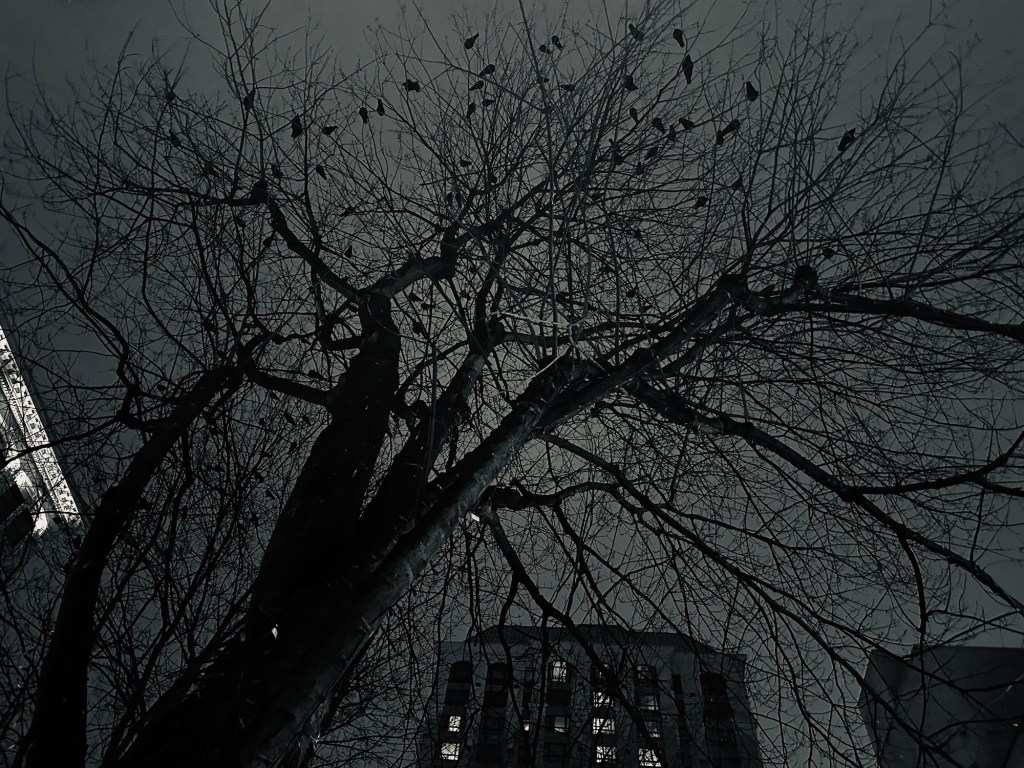
Crows Overhead

Along the way I pass people sleeping in doorways. Sometimes there are dogs curled beside them, wrapped in blankets, loyal in ways the rest of us struggle to be. The city breathes differently at that hour. Stripped down. No pretense. Just bodies trying to endure until daylight.

“You’re a very empathetic person,” my therapist friend once told me. “You give so much. Most people aren’t like that.”

I didn’t know what to say then. Empathy feels less like virtue and more like exposure. You feel everything. You absorb it. And lately, there has been a lot to absorb.

The people I looked up to most of my life are dying now. My father included. I have tried to memorialize them the best way I know how — in words — but grief does not move in tidy lines. It comes in waves. Regret rides in with it. Regrets, I’ve had a few. Some small. Some seismic.

The transit agency job keeps my writing afloat. I’m taking a college course in electricity, too. Dad would have liked that. There is something solid about learning how currents move, how power is transferred. It makes the invisible visible.

When I was disqualified from the rail operator position, the union stepped in and saved my job. That was the good news. The bad news was the overnight shift — outside, in winter — moving, coupling, and decoupling trains for the next day’s service.

The yard is all steel and breath and repetition. My fifty-year-old body has begun to protest. I sleep more. I battle colds and congestion. I’ve run out of sick time. With budget cuts looming, I pray for health the way some people pray for miracles. Just get me to spring. Let me sign up for a day shift. Let light return in some practical way.

David remains my rock. At his age, working forty hours a week in retail is no small thing. I wish he didn’t have to, but it keeps him moving. That’s the trick, isn’t it? Motion as survival. My step count has never been higher since taking the yard hostler role. A coworker told me, “I have no desire to be caged in that cab for ten hours a day.” I understood what he meant. Movement feels like proof of life.

Still, I miss the sun. I miss Florida’s warmth, even though there have been days colder there than here in the Pacific Northwest. It isn’t just temperature — it’s the rain. The gray. The way it seeps into the psyche. After eight years, I sometimes think I have battled depression to a draw. Not defeated it. Not surrendered. A stalemate.

I try not to get pulled into politics. I am a public servant. But the news some days is unbearable. The cruelty. The speed with which outrage ignites. Digital life has given us constant connection and constant combustion. It is hard not to look. Harder to look away.

I think often of the summers when I worked in the parks. The disconnection. The way nature set the pace. I fell in love in Yellowstone. It was, without exaggeration, the best summer of my life.

There are alternate versions of me that sometimes feel more vivid than the one I inhabit. The version who eloped to Italy with Ann. She loved me. It was true. I often wonder what that life would have been.

But there was a secret then. A stigmata I carried too long. It shaped my choices, narrowed my courage. Decades pass in the space of one unresolved truth. And just like that, the realization lands: I will never be a father. The sting comes sharp and sudden, like a Georgia yellowjacket on a hot afternoon. You don’t see it coming. You just feel the burn.

At my annual physical, I learned I have high blood pressure. Dad had it too. I ask myself why I cannot relax. Am I still trying to prove something? Am I restless because some part of me believes another life-altering opportunity has slipped by? Is this as good as it gets?

I flew to Alabama to see my mother and brother. I won’t write more about that. Empathy again — the instinct to protect, to soften edges, even when they cut me.

Tomorrow night, I will return to the train yard. The crows will still be there. The cold. The coupling and uncoupling of cars. The small prayers whispered into the fog.

My spirit is not broken. But it is bruised.

And I am hopeful — stubbornly, irrationally hopeful — that this static feeling will pass, that something in me is still recalibrating, that winter, like grief, like regret, like love withheld and love remembered, is not the whole story.

It is only a season.
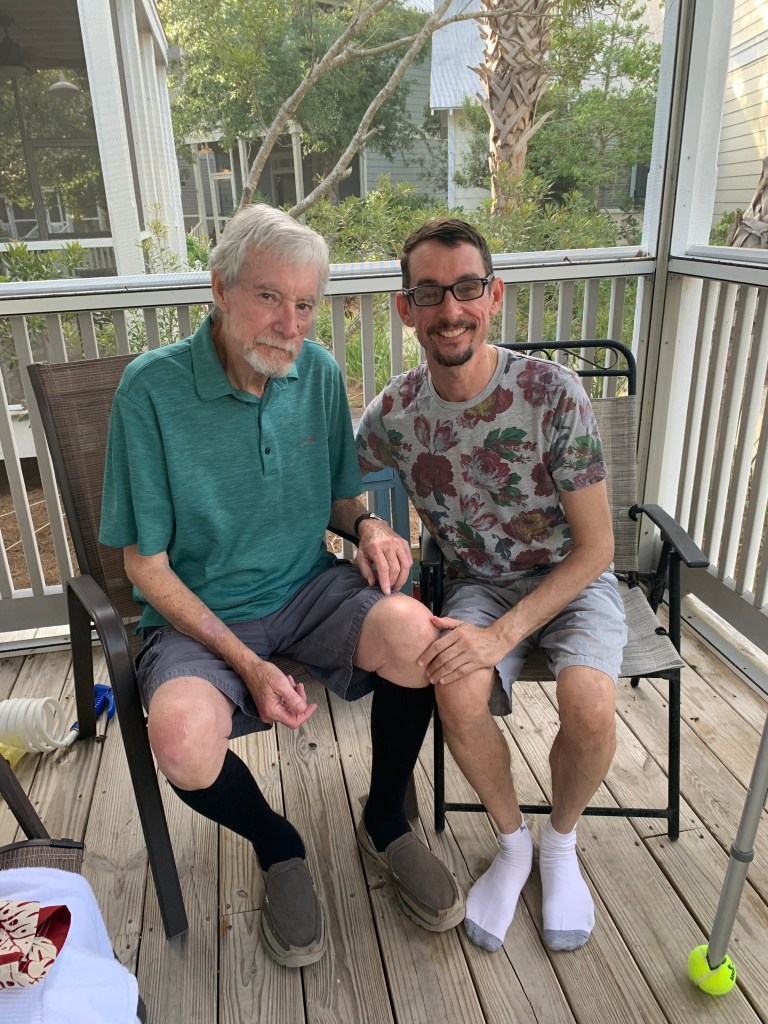


In Memoriam

30 11 2025

There are days you know are coming, and yet when they arrive, they catch you unprepared, as if you had misunderstood the terms. I had just bought a plane ticket to Alabama, picturing an ordinary visit: my mother in her new kitchen, my father settled into the small routines of a life that had narrowed but not yet vanished.

Then came the message from my brother: ‘Urgent, please call.’

When I did, he was crying.

“Dad’s gone,” Keith said.
Two words, and everything after them felt strangely suspended, as though spoken from another room.

My father went to sleep on Thanksgiving and did not wake up. The do-not-resuscitate order held back the paramedics from trying to undo what his own body had already begun. In its way, it was a mercy.

He had dwindled to ninety pounds. “Nothing but skin and bones,” my brother kept repeating, as if naming the truth could soften it. A year of strokes, Parkinson’s, diabetes — an accumulation of slow undoings. He had long been unable to walk, living in the narrow corridor between decline and endurance.

My mother moved him from Florida to Alabama so Keith could be close enough to help. “This is not how I wanted to spend our golden years,” she would say on the phone. No answer made any of it less true.

From across the country, guilt was easy to reach for. Anger too. Anger that I didn’t get to say goodbye, didn’t get the hug, the last talk about camping trips, the golf clubs he gifted me or the way he taught me to tie a necktie. His final message came in 2021: Happy Thanksgiving, John. I love you too. After that, the words no longer held their shape. His mind couldn’t steady them.

Watching him fade, even from a distance, was its own kind of grief — this man who had built a dream house with his own ambition, who traveled the country to watch the Seminoles play, who climbed the corporate ladder in the way men of his generation believed they were required to. He came from the deep South, from a world where tenderness was rationed, where men learned early to keep their guard high and their feelings unspoken. Toughness wasn’t just a personality — it was cultural instruction.

It is impossible to understand him without understanding that.

He was hard on me growing up. Hard in ways that left marks — some visible, some not. The hole in the drywall stayed for months after one fight, a quiet reminder of what happened when tempers ran too hot. Maybe he believed he was preparing me for a world he thought would be even harder. Maybe he feared what he didn’t understand about me. Maybe he was reenacting the discipline he had survived.

He wasn’t a saint, though he belonged to the Knights of Columbus. But he was also not a villain. He provided everything he knew how to provide. He earned status, built a life from almost nothing, raised two sons, and gave generously to his community. And like many men of his time and place, he struggled with the more fragile currencies — encouragement, softness, apology. If he withheld love, it was because no one had taught him how to offer it.

His marriage to my mother was a 55-year journey with its battles; divorce hovered more than once. I hated the way he treated her near the end, but even then, she stayed. Some loyalties in the South are stitched early and hold long after they fray.

Mike & John, circa 2021.

When my aunt told me, “Your dad has never been an easy man,” there was an entire history folded inside those words—his upbringing, his hardships, the stoicism expected of Southern men, the unspoken wounds that harden into personality.

Dad didn’t want a memorial or service. It fits. Men like him didn’t believe in being publicly grieved. Instead, he asked that his ashes be scattered into the Apalachicola River, the water that first shaped him. A return to the beginning.

My last memory is from last summer: him smoking on the porch in the punishing Florida heat, the light hitting him in a way that made the pain visible. As I walked away, I glanced back. Our eyes met for a moment, and I knew — even then — that this might be the last time. And it was.

When he died, the surprise was not in the timing but in my own response: a brief indifference, followed by a deeper ache — for my brother and mother, who carried the weight of his long decline, and for the boy in me who had always wanted something gentler from him.

A part of me is gone with him. A part that learned discipline, work, and endurance. A part shaped by his silences as much as his words.

In the end, he deserved better. We all did.
But this was the life we shared, tangled and imperfect, marked by the culture that raised him and the quiet love he never could express.


Can Do

20 01 2025

One word convinced me. Actually, it was the concept behind the word.

That concept took me to another level — snapping me out of a cautious funk of settling for the easy way out or crumbs along the path of least resistance.

The word is CAN.

It first came to my attention through a sticker on the back of my cousin’s jeep. Come to find out a Hawaiian man, battling depression, decided to defeat the doubt and negativity in his life by changing his mindset.

CAN defeats Can’t. Simple as that, right?

Well, it’s not as easy as it sounds. As those who have accepted a challenge can attest, half the struggle is just getting started.

I have been fortunate enough to accomplish certain things in life that seemed impossible as a youngster. The list of achievements include running for public office, hiking the Grand Canyon, publishing a book, covering a presidential election and getting married.

Some would say that’s a life well lived.

But I know there is more to experience. Who wants to be mopping trains forever? Not this guy. Could I operate them? You bet, I can.

There was also a not so subtle desire to start a family. This is something Stanley picked up on in our therapy sessions, particularly when it came to my attachment to River.

“You want to be needed,” he said.

Who doesn’t, I thought.

David still needs me and we had a lovely time in Hawaii. The hospitality Rob & Shelley extended to us was above and beyond.

It’s amazing how fast the time goes. I still vividly recall summers on St. George Island and Apalachicola with Rob and all my other cousins. I now realize how precious those moments were.

Looking back, was there anything that could have altered my path? Would a different decision at a critical juncture turned out for the better?

Second-guessing now seems silly.

Changes did await on the mainland. A new work assignment, on the other side of town, would free me from the graveyard shift, challenge my thinking and provide the opportunity to put my new ‘CAN DO’ attitude on display.

For the first time in years, checking on my folks in Florida seemed both doable and desirable. My father’s health continued to deteriorate and mom’s cries for relief were like a broken record.

An old friend from Japan was also on my mind. Like many of the international friendships forged during my younger days traveling, promises of reunions now seemed possible.

CAN was already at work in me.

Fear no longer had a grip on my emotions. Failure, I had come to realize, was just part of the process — not the end result.

I was ready to enter the arena again. To dare greatly while speaking my truth softly. To strive valiantly without coming off overconfident and cocky.

I think I CAN. I think I CAN. Choo-Choo!

All Aboard!


Hawaiian Reset

12 12 2024

Heeding Stanley’s advice, I began to distance myself from River.

And the therapist wasn’t the only one delivering this message. Kieran — my loyal friend all through the pandemic and beyond — was uncharacteristically blunt. He had been observing a disturbing change in me.

“He’s using you and he’ll take you down with him,” Kieran warned. “A narcissist with addiction issues is a dangerous combination.”

River had a lot of drinking buddies so replacing me in his rotation would be no problem. My sympathies for him remained and as Stanley had predicted, it hurt as I cut off communication.

Luckily for me, I had some vacation time coming that would chase my blues away. Not long after the new year, David and I traveled to Hawaii to see my cousin Rob and his wife Shelley. Empty nesters, with both kids recently graduating from college, they had graciously offered to let us stay with them during our visit.

We left Portland just as a big winter storm approached. David’s brother chained up the tires on his SUV and navigated along frozen back roads to get us to the airport. On the tarmac, crews worked hard to de-ice the plane, enabling our takeoff in what felt like a true escape from winter’s clutches.

We flew directly to Kauai, one of the less populated islands, known for its lush greenery. It had been years since I last saw Rob and Shelley. Rob grew up in Miami, went to UF and worked as a defense contractor on the technical side, even living abroad for a time in the Middle East.

Rob picked us up at the airport in his blue jeep with a orange Florida Gators logo on the side door. He had long hair and was wearing shorts, flip flops and a T-shirt. It was the classic beach bum look.

Aside from the heat, one of the first things I noticed as we left the airport, were the chickens. They were everywhere and their cock-a-doodle-dos could be heard all over the island.

Rob took us to lunch at a waterfront restaurant where at night herds of sea turtles crawled to shore.

“How’s your dad?,” he asked.

“Not good,” I replied.

My brother had recently sold dad’s truck. He was never going to drive again. The Parkinson’s was progressing and dad refusing his medications didn’t help.

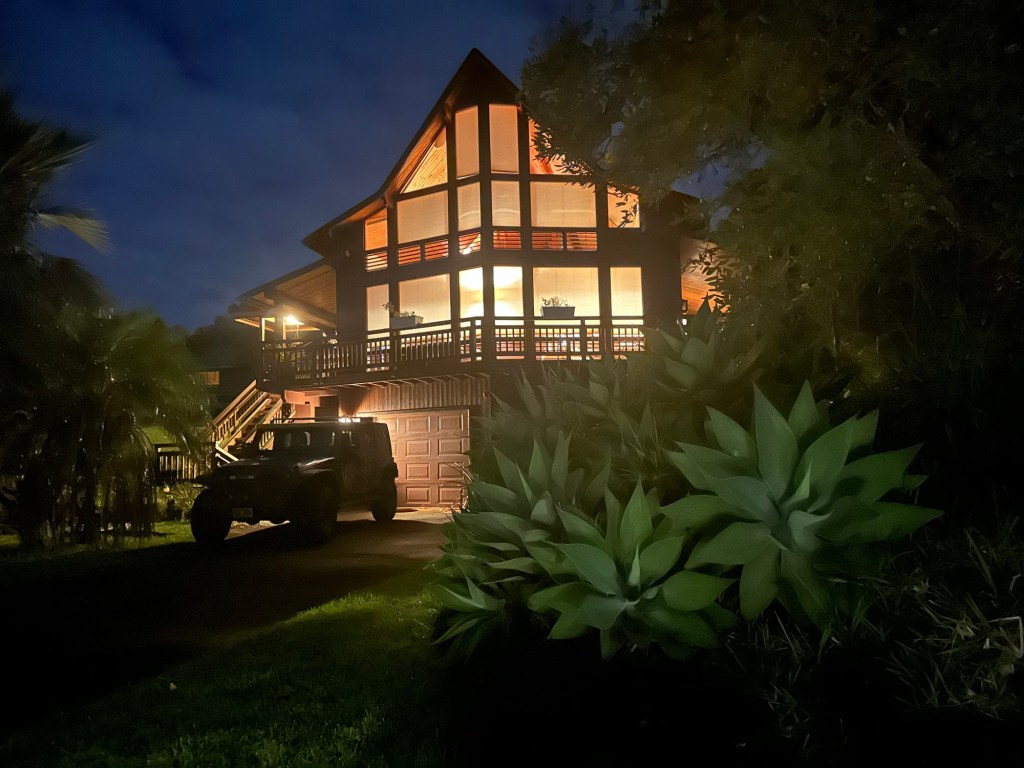
After lunch, we drove on Kauai’s one main road to the southern side of the island, where Shelley welcomed us into their cozy cedar home. They had two dogs and a big backyard full of colorful flowers, plants and trees.

Fritz House

It was so peaceful and serene. Just what we needed.

“Make yourself at home,” Shelley said as she showed us to the downstairs guest room.

The walls were covered with pictures of their wedding, children and travels. You could feel love resonating through the frames.

I slept soundly that night in paradise. Something was stirring inside of me. As we would soon find out, it was the power of CAN.


A Foot In The Door

25 06 2024

The most important trait my father instilled in me is a solid work ethic.

At 15, he pushed me to get a work permit and by the summer of my first year in college, I was holding down two jobs.

Dad’s philosophy is tried and true — play the law of averages and don’t fight the system, make the system work for you.

“You don’t always have to be the best, son, just keep coming back,” I remember him telling me in one of his rare tender moments.

Dawning of a new career

While there was a time in my life when jobs were scarce, that was certainly not the case in Portland, where COVID-19 restrictions dragged into 2022. People had grown accustomed to receiving a generous government check for sitting on the couch and logging into Zoom every now and then.

The druggie culture shrank the talent pool even further and in the back of my mind, I knew if given the opportunity I could outperform most of these mediocre White kids.

Even at the ripe ol’ age of 50.

In Alaska, I witnessed first hand how possessing a CDL (Commercial Driver’s License) elevated your career, so when the local transit agency held its annual job fair, I arrived with intent.

Looking back, this is the moment that I took the bull by its horns.

Having been to many job fairs before, I was quite familiar with the routine and upon entering the dreary Doubletree hotel it was easy to recognize the frontline stiffs, on the clock and simply going through the motions. My research indicated there was a path, made possible by organized labor, that got your foot in the door.

The folks handing out brochures at the front tables had all the glee of a middle school librarian. Bypassing them was the first step, although I noticed they were able to discourage other, less experienced job seekers.

Getting an endorsement was the big hurdle here and after sizing up a ballroom full of blue collar types, I was directed to sit with one of the bus mechanics.

A tall Black man, around my age with sprinkles of grey hairs sprouting from his chin that projected a sense of wisdom. He didn’t smile and didn’t want to hear any bullshit.

Just the basics: Why are you here? What are your expectations and what are you willing to do to get there.

“I don’t mind doing the dirty work, done it before,” I told him, signaling that I understood how seniority works in a union shop.

“I like your attitude,” he said, pulling a pen from his chest pocket.

We had a good conversation that flowed easily with mutual candor. At the end, he signed off as a reference, clearing me for the next stage, before offering one last piece of advice.

“Keep your head down and stay out of the drama and you’ll go far,” he said in a slow, matter-of-fact delivery.

With reference in hand, it was on to the DOT medical exam and written tests. Walking out of the Doubletree that day, I felt hopeful with a renewed sense of purpose and confidence.

I could do this.

I had to do this.

Most importantly, I was ready to do this.


Forgotten No More

8 07 2021

I’m back.

Nothing like a little adversity to push you to the keyboard. Life’s been tough but I have come to expect no less. I’m still at the warehouse. How my body has endured is a mystery, but if there is a silver lining from eight months of hard labor it’s that I’m damn sure physically fit for a guy my age.

Pushing tote tanks for 10 hours is still not something I want to be doing very much longer. On my own time, I am taking cloud computing classes. Learning new technical skills is exciting and I enjoy the challenge.

Last month I returned to Florida to see my father who had suffered a series of strokes. My mother is doing an admirable job caring for him even while she continues to work. My brother helped get Dad home from the hospital and I followed a week later to provide support in any way I could.

Mostly it was getting Dad up and down the stairs. I also sat with him as he watched old westerns at extremely loud volume on television. We didn’t talk much. He is still trying to regain basic functions. It was difficult to see him this way. As soon as I entered the house, I greeted him with a kiss to his temple to let him know I came with love.

It was nice to be back in the slow pace of the Florida panhandle again. Determined to leave politics and personal frustrations behind in Portland, I approached in a humble spirit. I was surprised to see the lingering damage of Hurricane Michael and realized the region is still very much in the recovery process. My time on the west coast had also sharpened insight for planning and engineering and I keenly took note of dimensions and intersections from the airport to my parents’ front door.

The humidity didn’t bother me as much as the string of unsequenced traffic lights on the main highway into Panama City. My rental car was a Toyota Prius which stuck out like a elite green thumb among all the loud full size pick-up trucks. It was a quiet ride to Port St. Joe and it took longer than the flight from Atlanta to Panama City.

Hence the nickname “Forgotten Coast.”

Coming back to where I spent my high school and college years was an emotional rush that triggered a lot of memories. Oddly enough, I was glad to be here, but wished the circumstances were different. I was optimistic Dad would survive but knew it was time for some difficult decisions to be made about care going forward.

I helped my mother bathe and dress him. He had done the same for me many years ago. Life’s unavoidable circle.


Sister Soothing House

14 05 2018

Julie was reading the book Sister Parish. We stayed with her for about month. The Oregon countryside was soothing.

We unloaded the Uhaul into a storage unit in the Portland suburb of Tualatin. The Jeep finally broke down on the way to the city so we had it towed to Corvallis for work. Julie graduated from Oregon State University with a degree in education. Corvallis, OSU’s home, reminded me of those small gritty college towns I had traversed as a sports writer early in my career. A small college town with a lot to prove.

The first week at Julie’s was tough. I had trouble breathing at night. It was cold. There were cats in the house and for some reason I began to have difficulty breathing. One night I was gasping for air so bad, David almost had to take me to a local hospital — none of which, he said, were highly rated online.

David prayed for me and the nerve attack subsided.

We prayed a lot at Julie’s. I started calling them ‘lift up’ prayers. It helped steel my resolve to our current situation. I continued to do phone interviews for writing work as we looked for apartments to rent in Portland, where the goal of landing a “real job” was the plan.

The weather was mostly wet and cold. “Welcome to Oregon, it rains a lot,” Julie said with a smile. Her house was surrounded by farms and timber. The neighbors had cows that would wander along the hills and moo loudly when feed trucks would arrive.

Seeing David connect again with his sister after all these years was special. Julie showed me family photographs from David’s youth that gave me joy and a new vision of the man I married.

Covered bridge near Scio.

The central Oregon farmlands were beautiful to these Florida strained eyes. Scio, Oregon is billed as the state’s covered bridge capital. The old wooden bridges were typically one-way quick bursts by vehicle. The farms near Julie’s sold eggs, milk and bison meat. I had never seen so many different farm animals. The children’s song, Old MacDonald Had A Farm sprung to mind.

At nights Julie would cook. David and I drove into Portland to look at apartments on most days. We said lift up prayers every morning. TBN disappeared from the cable television in our room, but David managed to find sermons on his smart phone app. One of the cats would tolerate my presence but they were still shy about touching. Maggie, the skinny calico, liked to sleep in our bed under the covers and would hiss if you got near.

We got lucky on the fourth place we looked at in Portland. The phone call message was surprising. A deal we had not previously heard — certainly not in Fort Lauderdale. We told Julie the good news and David’s brother Russ helped us load up the Uhaul again.

We spent about a month at that hilltop cottage with Julie. I learned how to breathe again. The quiet peaceful farmlands had provided time for reflection and rest. We were ready for a new challenge.


Twinkle, Twinkle Lucky Star

30 04 2018

From San Antonio we continued westward into the southwestern desert. The BMW got an oil change in El Paso and I pulled off the interstate in Tucson, Arizona to do a telephone interview with Crater Lake National Park. I talked for about an hour with a recruiter for the park’s lodging concessionaire. We had a delightful conversation and agreed nature is a great healer.

The Uhaul got an inspection upon entering California and was quickly cleared when no plants, fruit or tropical fish were found. In Blythe, we stayed at one of the scariest motels I have ever set foot in. It was so dirty, I slept on top of the bed fully clothed. You get what you pay for and $47 basically got us a roof. We hit the road before dawn and began a beautiful drive through mountains of wind farms. We bypassed Los Angeles and stopped in Bakersfield, staying at a much better hotel on a street named for the late country music legend Merle Haggard.

On our final night in Redding, California, I received an e-mail from the Crater Lake recruiter indicating they would be pursuing other candidates upon receiving an unfavorable reference from the concessionnaire at Glacier National Park. This stung greatly considering the dedication I demonstrated during that summer in Montana and the many friendships forged. I could only surmise there were some shenanegians at play and decided not to inquire further. I felt betrayed.

The final leg of the trip into Oregon was one of the lowest points in my life. I began questioning all of life’s moves and wondering why God had brought me to this point. I was filled with extreme sadness — not only for myself but for David. My inability to provide equitable financial support during our 10-year relationship was embarrassing and had placed us into a situation beyond hardship.

And then the cold hit. Temperatures dropped as we entered Oregon. David’s sister, Julie, lived on farm land near Scio in a lovely English style cottage house on top of a hill. Julie had come to our aid like no one else could or would. She gave me a big welcoming hug when we met. I needed that hug in the worst way.

Oregon farm land

Julie is a few years younger than David and a widow. Her husband passed away a few years ago. He was President of the federal metals credit union. Her house is the most organized and clean home I had ever seen. Julie lives with two cats — Maggie, a calico and Fergie, a plump ginger. The cats, however, didn’t take warmly to their new visitors. They hissed at me whenever I would attempt to pet them.

Julie laid down three rules as we unpacked:

“No politics, no preaching and no marijuana in the house,” she said. “I don’t think we should be a nation of stoners.”

I was ok with all three. Julie’s bookcase revealed she was a conservative thinker. She also differed from her brother on religion and did not appear to practice any sort of spirituality. Three thousand five hundred miles and eight days later, our trip was over. We were in a new house in new territory yet to be explored.


Bottoms Up

26 05 2017

Here we are starting over again. Looking for work after a brief flirtation with politics. In the gutter looking up at the stars, wrote Oscar Wilde.

The summer approaches again in Florida. I have become numb to the lasting heatrays and all of the complexities of urban dwelling. I rarely go to Miami anymore. I don’t have enough money to go many places.

David and some friends have encouraged me to get back in the gym. I’ve been playing golf and basketball again and swimming regularly. I’m surprised how well my body has held up.

I considered running again for the state house but after two months on the trial determined it was the wrong district and wrong role. I remain in contact with friends from the park service and maintain hope a position will open up. It would be nice to breathe fresh mountain air again.

Last week, David and I attended a presentation from the Sierra Club. Members of the executive committee discussed pollution of Florida’s waterways and various other environmental concerns. I asked one of the speakers if she felt South Florida had an overpopulation problem.

“The world does,” was her response.

The arrival of more and more people in Florida means draining the swamp to house them. There is another way, however, but it would take acts of kindness, sacrifice and generousity to get there. Not exactly known traits a keen political observer would recognize from current Republican leadership.

In many parts of the South Florida shoreline sit towering condominums and apartment buildings. For half of the year they operate at significantly less capacity due to retreating Canadians. There are quite a few old buildings on the east side of Interstate 95 in South Florida. Old properties, in some cases. In dire need of rehabilitation.

And condemnation.

After recognizing a problem, it takes a community — or village, if you prefer, — to improve a habitat fit for all humanity. Good deeds, Pat from Palm Beach tells me.

“You can only resist and be against everything for so long before it wears you out,” Pat said during our recent phone conversation.

Living positively with a can do spirit while avoiding the pitfalls negativity produces is the plan. This my inner call to action.

It won’t be easy. Florida is such a weird state. It’s diverse melting pot is, at times, exhausting.

I take comfort in the fact that periods of hardships strengthen resolve and make families better when they emerge from a struggle. My friend Geraldo is doing so much better. His recovery brings tears to my eyes. My brother is settling into life as a divorced father. I wish him patience and compassion to continue giving the girls a healthy upbringing.

And now I look to David, my loyal husband, an offer a humble plea. After rehabbing our reps in Florida, I hope we can visit your family on the West Coast. Our eight years together has not been equitable in meeting the in-laws. I’d like to change that.

For the better, of course.

Koreshan State Historic Site


Holiday Hibernation

13 12 2011

I’ve been sleeping a lot lately. Much more than even I am accustomed to. I’ve always had a passion for sleeping, which has aggravated my mother to no end.

“You’re sleeping you’re life away!, John!!,” she would declare when I would come home from college and stumble downstairs around two in the afternoon.

One year I spent the holidays with my aunt Tammy and uncle Doug in Montgomery, Alabama and took a job at the neighborhood Winn-Dixie, working the “graveyard” shift. I was part of a stocking crew that would arrive at the store as they were closing the doors to the public. We usually worked from 10 p.m. to 7 a.m. and, as I remember we had a supervisor who was a real joy to be around. Sarcasm fully intended.

Looking back, I can understand why he was such a jerk to me. I was the college kid, working a few months to have some spending money for the next semester. And he was a small man in stature, and having found a smaller person to boss around was surely a delight for him.

I do not remember his name, only his chain smoking habit and coke bottled glasses. This will be the last I write of him.

So after working the graveyard shift, I would come home and eat breakfast and then go to bed. This seemed to aggravate my aunt Tammy, who was pregnant at the time and experiencing the lonely housewife blues.

My uncle Doug even gave me the nickname “Rip” — short for Rip Van Winkle.

When people often remark how young I look for my age, I usually credit the complement with my many years of sleep.

“I’ve slept a lot,” I tell them.

And it is the truth. The last two months, I’ve no doubt been horizontal much more than I have been vertical.

David calls it a destructive pattern. He’s probably right.

I’m over living in Panama City, I’m over being unemployed, I’m over being broke and I’m over fighting losing political battles.

So I have gone inward and slept. And slept. and slept some more. Each day waking with dwindling hope for the future.

I realize only I can break this behavior and, thankfully, there is incentive. David and I will spend Christmas in Port St. Joe with my parents and little brother who is bringing his young and growing family down from Alabama. Being around his new baby girl should brighten the holidays.

And then there is a blast from the past arriving soon.

Bjork, a longtime friend, from my Texas years, is coming to visit at the end of the month. He lives in England now and is a college professor. We haven’t seen each other in nearly five years and it will be exciting to catch up as Bjork has arranged for a short sidetrip to New Orleans, providing a refreshing change of scenery.

And I shall be well rested for the occasion.