Winter, After the Silence

11 02 2026

It has been a while since I’ve written.

Not because nothing has happened. Quite the opposite. Life has been arriving in waves, and I have been standing in the surf without quite knowing how to describe the undertow.

Winter has hit harder this year.

In the early morning hours, walking home from the train station, I navigate mobs of crows clustered in the trees overhead. They cry out before they let loose, peppering the sidewalk with their droppings — a crude warning system. I walk carefully. There is something about the darkness at that hour, the industrial quiet broken only by wings and wind, that feels both ancient and immediate.
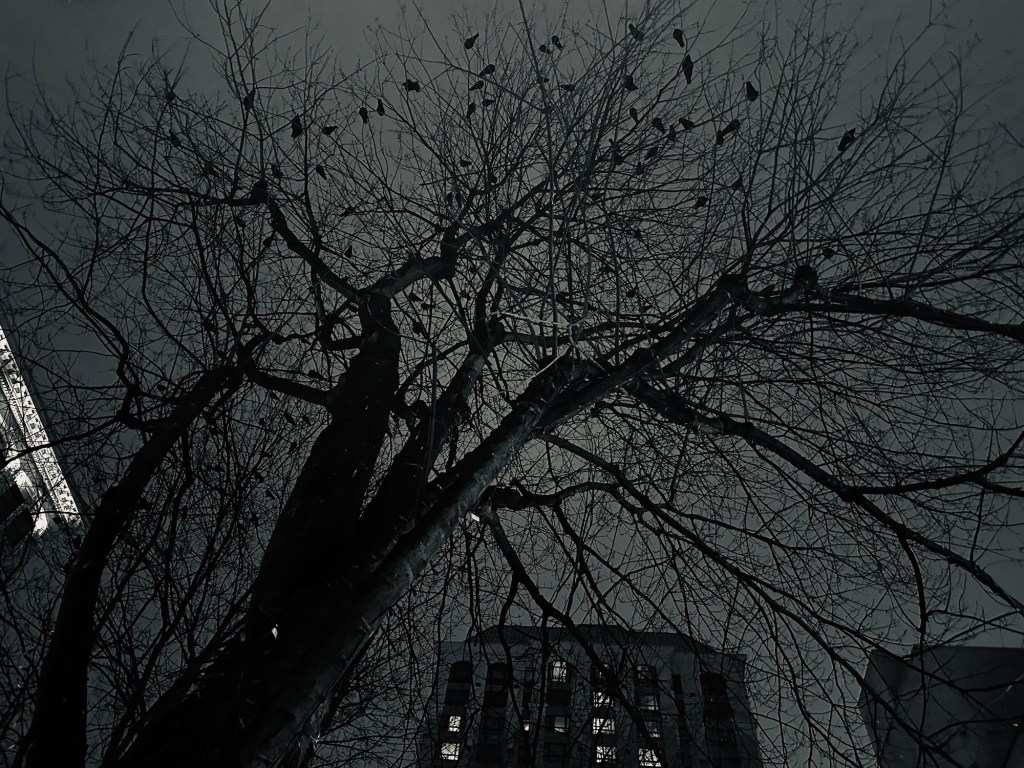
Crows Overhead

Along the way I pass people sleeping in doorways. Sometimes there are dogs curled beside them, wrapped in blankets, loyal in ways the rest of us struggle to be. The city breathes differently at that hour. Stripped down. No pretense. Just bodies trying to endure until daylight.

“You’re a very empathetic person,” my therapist friend once told me. “You give so much. Most people aren’t like that.”

I didn’t know what to say then. Empathy feels less like virtue and more like exposure. You feel everything. You absorb it. And lately, there has been a lot to absorb.

The people I looked up to most of my life are dying now. My father included. I have tried to memorialize them the best way I know how — in words — but grief does not move in tidy lines. It comes in waves. Regret rides in with it. Regrets, I’ve had a few. Some small. Some seismic.

The transit agency job keeps my writing afloat. I’m taking a college course in electricity, too. Dad would have liked that. There is something solid about learning how currents move, how power is transferred. It makes the invisible visible.

When I was disqualified from the rail operator position, the union stepped in and saved my job. That was the good news. The bad news was the overnight shift — outside, in winter — moving, coupling, and decoupling trains for the next day’s service.

The yard is all steel and breath and repetition. My fifty-year-old body has begun to protest. I sleep more. I battle colds and congestion. I’ve run out of sick time. With budget cuts looming, I pray for health the way some people pray for miracles. Just get me to spring. Let me sign up for a day shift. Let light return in some practical way.

David remains my rock. At his age, working forty hours a week in retail is no small thing. I wish he didn’t have to, but it keeps him moving. That’s the trick, isn’t it? Motion as survival. My step count has never been higher since taking the yard hostler role. A coworker told me, “I have no desire to be caged in that cab for ten hours a day.” I understood what he meant. Movement feels like proof of life.

Still, I miss the sun. I miss Florida’s warmth, even though there have been days colder there than here in the Pacific Northwest. It isn’t just temperature — it’s the rain. The gray. The way it seeps into the psyche. After eight years, I sometimes think I have battled depression to a draw. Not defeated it. Not surrendered. A stalemate.

I try not to get pulled into politics. I am a public servant. But the news some days is unbearable. The cruelty. The speed with which outrage ignites. Digital life has given us constant connection and constant combustion. It is hard not to look. Harder to look away.

I think often of the summers when I worked in the parks. The disconnection. The way nature set the pace. I fell in love in Yellowstone. It was, without exaggeration, the best summer of my life.

There are alternate versions of me that sometimes feel more vivid than the one I inhabit. The version who eloped to Italy with Ann. She loved me. It was true. I often wonder what that life would have been.

But there was a secret then. A stigmata I carried too long. It shaped my choices, narrowed my courage. Decades pass in the space of one unresolved truth. And just like that, the realization lands: I will never be a father. The sting comes sharp and sudden, like a Georgia yellowjacket on a hot afternoon. You don’t see it coming. You just feel the burn.

At my annual physical, I learned I have high blood pressure. Dad had it too. I ask myself why I cannot relax. Am I still trying to prove something? Am I restless because some part of me believes another life-altering opportunity has slipped by? Is this as good as it gets?

I flew to Alabama to see my mother and brother. I won’t write more about that. Empathy again — the instinct to protect, to soften edges, even when they cut me.

Tomorrow night, I will return to the train yard. The crows will still be there. The cold. The coupling and uncoupling of cars. The small prayers whispered into the fog.

My spirit is not broken. But it is bruised.

And I am hopeful — stubbornly, irrationally hopeful — that this static feeling will pass, that something in me is still recalibrating, that winter, like grief, like regret, like love withheld and love remembered, is not the whole story.

It is only a season.
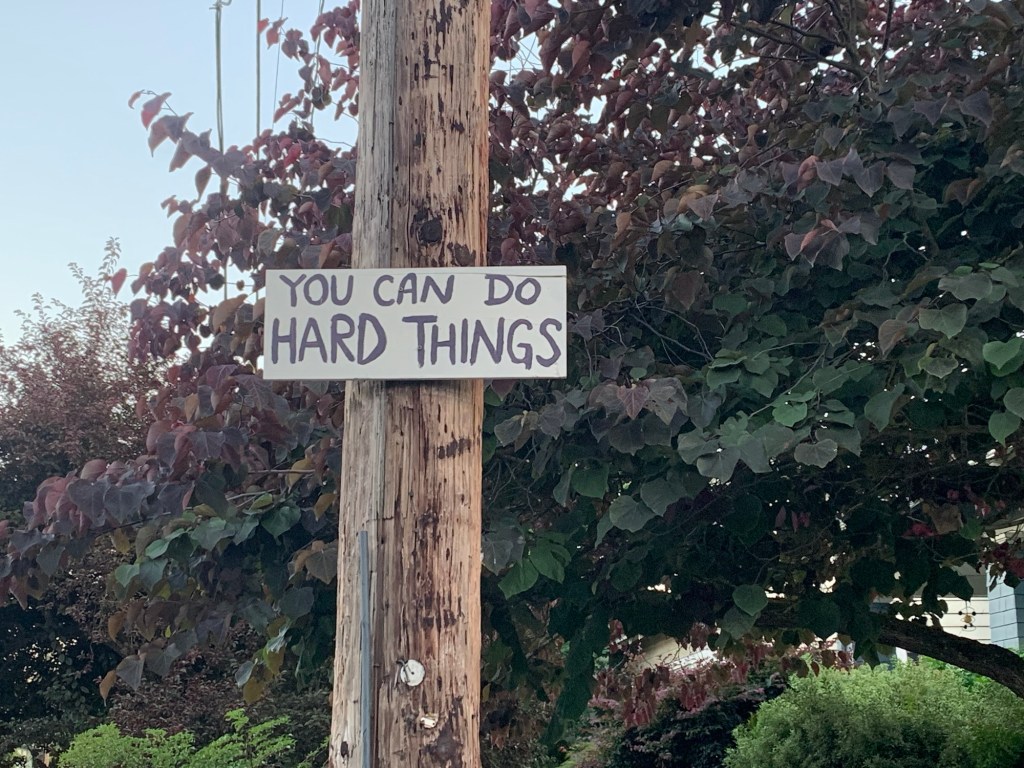


Curb Your Anxiety

30 07 2024

“If you hit the curb, it’s an automatic fail.”

And with those words in mind, we started bus training.

It was late April and the rain was socked in. There were eight of us in training class. We did classroom stuff for a few days, learning the basic parts of a bus and watched some badly acted HR videos.

I still had the TSA experience lingering inside my head. Would I fail another certification process? I tried to keep doubt at bay with every ounce of focus and discipline one could muster.

A great deal of gratitude goes to our onboarding supervisor, Danny. A Pacific Islander, Danny had worked at the transit agency for close to 30 years, starting as a service worker just like us.

He was broadly built, bald with a warm smile and cheerful disposition. I’ll never forget the words of wisdom he gave me inside the bus after I stumbled through a pre-trip inspection quiz.

“John,” he said, taking off his yellow high visibility vest before plopping down in the front row of the bus. “I can tell you’ve got a little anxiety there.”

He then leaned forward and lifted his eye lids slightly higher to deliver his diagnosis. “That’s natural…but once you settle down, you got this.”

That was the validation I needed. Danny knew I was trying too hard. He could see the fear inside my eyes. That fear came from our contract, which clearly stated that anyone who fails after two attempts at certification is automatically terminated.

Ramping up the tension was that it would be a month before I would get the first paycheck and my savings were rapidly dwindling with rent coming due soon. The stakes couldn’t be any higher.

So after two weeks, we ventured out of the yard behind the wheel of a 40-foot, Gillig bus. We practiced taking wide turns, traveled down narrow residential roads and up winding hills. We contended with all kinds of obstacles in busy downtown areas and congested Interstate traffic.

Learning to “borrow” enough space from the opposite lane at times is important and the ol’ bob and weave / rock and roll technique is critical to a smooth operation.

Keep your head constantly moving, scanning for whatever comes your way. Pay attention to changing red and green lights and God forbid, don’t hit the curb.

On testing day we had to correctly identify all of the critical components on the bus — from the brakes and engine to lights and tires. After that, we were to successfully complete three backing exercises and then take the road course with a state examiner riding along to give directions.

I had done a lot of praying that week and even went to church with David on the Sunday before the final exam. I remember becoming overwhelmed with emotions during one of the hymns. It was as if I was releasing months of pressure. They were joyful tears.

And then, with Danny’s encouragement nestled in my subconscious, I climbed into that bus and passed my driving exam — in the Portland rain no less. Our entire class passed. No curbs were hit. The job was now officially mine.

A long three-month hiring process had concluded and a new career path was unlocked. Going forward, I would be keeping both hands firmly on the wheel.


Trouble on the Doorstep

21 04 2024

Leaving Alaska wasn’t as hard as it could have been. I made sure to bow out gracefully, thanking everyone I worked with and letting those who treated me with respect know how much that meant.

Challenges laid in wait in Oregon, but like so many times before, I would have the support of my loving partner.

David picked me up at the airport in Seattle, where frozen boxes of fish rolled off the luggage carousel along with my jam-packed suitcase. Zac agreed to mail the rest of my belongings back. He’s been a good friend over the years and while likely disappointed in my early exit, something tells me, our paths will cross again in the future.

Meanwhile, my joy in seeing David again was cut short by the reality waiting on our doorstep back in Portland. During my time away, a homeless camp had moved in and taken over the block. These were not your down on your luck folks, trying to get back on their feet, either.

These were the junkies and criminals taking advantage of the city’s laissez faire attitude. They did their drugs openly on the sidewalk with no regard for children, families or tourists passing by.

Fights between them erupted almost nightly, usually resulting in the cops showing up, but never hauling anyone away. There were no consequences for their pathetic behavior.

Not once in my formative years could I have imagined living in these circumstances — shouting out the window in the early morning hours for peace on the street. Sadder still, this situation was being played out all across a city suffering the painful after effects from a prolonged pandemic following a volatile election.

To keep our heads above water, I quickly took a job at the Rose Quarter, working concerts, special events and Trail Blazers games. It was fun and easy work and vastly improved my knowledge of the music industry, while reigniting a longtime passion for basketball.

It was a part-time gig with seldom a shift stretching past five hours. I continued to write about gay issues for the paper in South Florida, but knew I had to land a good paying job soon.

The Alaskan experience got me thinking about transportation and I soon realized that the pandemic coupled with Portland’s drug culture had shrunk the qualified applicant pool for government jobs. With the odds I my favor, I set my sights on the local transit agency.

But first, we had to get out of our horrible living situation. We had been at that studio apartment for four years. It was a far different scene when we moved in. Now, every day I stepped out of the building I was likely to encounter unstable behavior by people in various stages of deterioration.

Verbal abuse like “faggot!” and “retard!” were routinely hurled my way, with the occasional “nigger!” added for good measure. And again, the children heard every word.

Life was at an inflection point. I couldn’t go on this way anymore. Just because they had chosen to live in squalor, didn’t mean we had to. I had to take action. And take action I did.


The End of the Road

11 02 2024

As the days got longer in the land of the midnight sun, so to did my resolve to cut this adventure short and come home to my loving and devoted husband.

I was being micromanaged in a way that felt a bit over the top and it was obvious that because I didn’t party every night most of the younger employees in camp had little interest in engaging with me.

There were a few exceptions. DL was a young midshipman fresh out of the Navy. He was a tall Black man with a cheerful disposition. DL always had a warm greeting and a funny comment.

“I’m just here to clean toilets,” he often said, a humbling reference to his job as a housekeeper at the lodge.

Sandy was another bright spot. She was about my age and a mother of two college educated daughters. I wasn’t sure what her relationship status was, but Sandy was up here in Alaska by herself. In fact, she drove all the way from Jacksonville, Florida. Quite the commute.

Sandy provided the intelligent conversation from a place of caring and understanding that I found refreshing amid a camp full of privileged millennials and Gen Zers trying to find their footing on the Alaskan tundra.

The cold definitely bothered Sandy. She was always bundled up at breakfast every morning. When I found out she was a Clemson graduate, I sung the school’s fight song — “Hold That Tiger” — one day that put a smile on her face.

Sometime around late June, the three of us embarked on a memorable day trip to Homer, Alaska. The end of the road.

I had heard Homer was a funky, artsy town and it didn’t disappoint. There was a seafaring feel to Homer, complemented by cute shops, thoughtful galleries and hipster thrift stores all juxtaposed by nature’s beauty.

Driving a long a section called The Spit revealed majestic mountains rising from the water. Purple flowers lined the road as we traveled to where restaurants and bars were grouped together on a harbor.

From here, tour operators helicoptered wealthy tourists to nearby wildlife sanctuaries to watch brown bears gorge themselves on salmon. Unfortunately, our budget would not accommodate that adventure.

On this trip, DL had been peppering me with questions about journalism. In particular, he was after sources and methods.

“So tell me, John, how do you know if someone is corrupt?,” he asked.

I wasn’t sure if DL was playing dumb or genuinely curious, so I explained the public records process, “sunshine laws” and ethical principles and practices, the best I could.

On the way to Homer, we stopped in the small town of Ninilchik, where I photographed a huge golden eagle perched atop a buoy along the foggy coastline. The mood in Ninilchik was quite suspicious. Rumors of a sizable Russian ex-pat population had proceeded our visit.

A Russian Orthodox Church confirmed there was a presence and when we stepped inside the local convenience store, it became clear we were the outsiders.

“You’ll find a lot of the old ways still in practice here,” the shop keeper said when Sandy asked about life in Ninilchik.

That comment stayed with DL for the rest of our trip. “The old ways,” he repeated in a slow bass tone. It was an oblique reference to a time that was probably not the most welcoming to a Black man, independent woman or gay guy.

I gained tremendous respect for DL that summer. There were probably just a handful of African Americans on the Kenai Peninsula. If he felt out of place, you wouldn’t have known it, but if there was a party, DL was typically the life of it.

Meanwhile, I missed David more and more each day. The advice Alan had told me in Los Angeles began to make sense. The garbage had to go. It was time to return home and take it out.