The Shrink Next Door

28 09 2024

Safely onboarded into a new career, I turned my focus to home.

Together, David and I had made tremendous strides in five years in Portland. We had a new apartment, blessed with good health and eager to turn the page in post-COVID times.

The Doctor will see you now

The new apartment ignited an interest in cooking — something that I had never fully explored, aside from the occasional spaghetti dinner. Our gas stove soon became a focal part of our lives. I began making casseroles, biscuits and muffins; sautéed steaks, grilled fish and many other delicious meals.

Nearing a half century of existence — an age, frankly, I didn’t think I’d ever see —- I finally felt at peace with my life. Publishing a book was sort of my grand finale. There wasn’t a lot of sales, but perhaps I need to die to be discovered or appreciated. Seems to be the case with a lot of famous writers.

Our apartment building was buzzing with creative types, mostly Millennials and Gen Zers. Once a month, management hosted a themed party on the rooftop in an effort to get residents to connect with their neighbors.

That’s where we met Stanley.

A published author of critically acclaimed sex therapy books, Stanley and I hit it off from the start. I liked his intellect and there wasn’t a lot of walls thrown up — something I had run into a lot at work.

Stanley was David’s age, but dealing with some major health problems. He had a partner from Mexico, who was quite younger and an aspiring singer with rugged good looks.

The four of us went out for drinks a few times at a nearby cocktail bar. I shared with Stanley about my past as a journalist and how I never would have imagined that at this age, I would be doing blue collar work.

“The body eventually breaks down,” Stanley said. Was this foreshadowing?, I thought.

David, of course, pulled out his New York playbook and began rehearsing stories I had heard many times before. They both lived in the city when 9/11 happened. Stanley, tragically, had a front row seat in Tribeca.

Stanley was intrigued by relationships and it didn’t take him to long to inquire about how David and I met and came to be a married gay couple. Realizing, a professional shrink lived next door, I let down my guard and shared how David and I navigated our different desires.

None of what I shared came as a shock to Stanley. He had been in practice for quite some time. It only took a few meetings for him to deliver an assessment that lifted a heavy burden off my shoulders.

With martini in hand, Stanley served up some truth.

“You’ve never had and never will have the love you needed from your father,” he said in that sort of 60 Minutes interview way.

Then he leaned forward, hovered over the table and put it in no uncertain terms.

“What you need to do, John, is go out and have some fun. Unleash your true feelings and, for God’s sake, find something that makes you happy and then…just do it!”


Curb Your Anxiety

30 07 2024

“If you hit the curb, it’s an automatic fail.”

And with those words in mind, we started bus training.

It was late April and the rain was socked in. There were eight of us in training class. We did classroom stuff for a few days, learning the basic parts of a bus and watched some badly acted HR videos.

I still had the TSA experience lingering inside my head. Would I fail another certification process? I tried to keep doubt at bay with every ounce of focus and discipline one could muster.

A great deal of gratitude goes to our onboarding supervisor, Danny. A Pacific Islander, Danny had worked at the transit agency for close to 30 years, starting as a service worker just like us.

He was broadly built, bald with a warm smile and cheerful disposition. I’ll never forget the words of wisdom he gave me inside the bus after I stumbled through a pre-trip inspection quiz.

“John,” he said, taking off his yellow high visibility vest before plopping down in the front row of the bus. “I can tell you’ve got a little anxiety there.”

He then leaned forward and lifted his eye lids slightly higher to deliver his diagnosis. “That’s natural…but once you settle down, you got this.”

That was the validation I needed. Danny knew I was trying too hard. He could see the fear inside my eyes. That fear came from our contract, which clearly stated that anyone who fails after two attempts at certification is automatically terminated.

Ramping up the tension was that it would be a month before I would get the first paycheck and my savings were rapidly dwindling with rent coming due soon. The stakes couldn’t be any higher.

So after two weeks, we ventured out of the yard behind the wheel of a 40-foot, Gillig bus. We practiced taking wide turns, traveled down narrow residential roads and up winding hills. We contended with all kinds of obstacles in busy downtown areas and congested Interstate traffic.

Learning to “borrow” enough space from the opposite lane at times is important and the ol’ bob and weave / rock and roll technique is critical to a smooth operation.

Keep your head constantly moving, scanning for whatever comes your way. Pay attention to changing red and green lights and God forbid, don’t hit the curb.

On testing day we had to correctly identify all of the critical components on the bus — from the brakes and engine to lights and tires. After that, we were to successfully complete three backing exercises and then take the road course with a state examiner riding along to give directions.

I had done a lot of praying that week and even went to church with David on the Sunday before the final exam. I remember becoming overwhelmed with emotions during one of the hymns. It was as if I was releasing months of pressure. They were joyful tears.

And then, with Danny’s encouragement nestled in my subconscious, I climbed into that bus and passed my driving exam — in the Portland rain no less. Our entire class passed. No curbs were hit. The job was now officially mine.

A long three-month hiring process had concluded and a new career path was unlocked. Going forward, I would be keeping both hands firmly on the wheel.


A Foot In The Door

25 06 2024

The most important trait my father instilled in me is a solid work ethic.

At 15, he pushed me to get a work permit and by the summer of my first year in college, I was holding down two jobs.

Dad’s philosophy is tried and true — play the law of averages and don’t fight the system, make the system work for you.

“You don’t always have to be the best, son, just keep coming back,” I remember him telling me in one of his rare tender moments.

Dawning of a new career

While there was a time in my life when jobs were scarce, that was certainly not the case in Portland, where COVID-19 restrictions dragged into 2022. People had grown accustomed to receiving a generous government check for sitting on the couch and logging into Zoom every now and then.

The druggie culture shrank the talent pool even further and in the back of my mind, I knew if given the opportunity I could outperform most of these mediocre White kids.

Even at the ripe ol’ age of 50.

In Alaska, I witnessed first hand how possessing a CDL (Commercial Driver’s License) elevated your career, so when the local transit agency held its annual job fair, I arrived with intent.

Looking back, this is the moment that I took the bull by its horns.

Having been to many job fairs before, I was quite familiar with the routine and upon entering the dreary Doubletree hotel it was easy to recognize the frontline stiffs, on the clock and simply going through the motions. My research indicated there was a path, made possible by organized labor, that got your foot in the door.

The folks handing out brochures at the front tables had all the glee of a middle school librarian. Bypassing them was the first step, although I noticed they were able to discourage other, less experienced job seekers.

Getting an endorsement was the big hurdle here and after sizing up a ballroom full of blue collar types, I was directed to sit with one of the bus mechanics.

A tall Black man, around my age with sprinkles of grey hairs sprouting from his chin that projected a sense of wisdom. He didn’t smile and didn’t want to hear any bullshit.

Just the basics: Why are you here? What are your expectations and what are you willing to do to get there.

“I don’t mind doing the dirty work, done it before,” I told him, signaling that I understood how seniority works in a union shop.

“I like your attitude,” he said, pulling a pen from his chest pocket.

We had a good conversation that flowed easily with mutual candor. At the end, he signed off as a reference, clearing me for the next stage, before offering one last piece of advice.

“Keep your head down and stay out of the drama and you’ll go far,” he said in a slow, matter-of-fact delivery.

With reference in hand, it was on to the DOT medical exam and written tests. Walking out of the Doubletree that day, I felt hopeful with a renewed sense of purpose and confidence.

I could do this.

I had to do this.

Most importantly, I was ready to do this.


Moving on up

10 05 2024

Having finally had enough of the abhorrent behavior from the sidewalk campers in the neighborhood, I set out to find us a better home.

We toured several apartment buildings before choosing a cute little studio in the Pearl District. It was high up enough that the problems on the street couldn’t reach us. The zone we would be moving to was a crucial business and tourism district that would not tolerate the antics from our previous neighborhood. Try as they might, pitching their tent and smoking crack on the sidewalk around breweries, bookstores and salons had an expiration date that was rapidly approaching.

David’s brother and my friend, Kieran helped us move. We rented a U-haul and packed up our stuff right in front of the druggies, who of course got in their last minute heckling. It took every ounce of discipline I had ever mustered to keep my composure. I remember losing my temper with the landlord in South Florida when he sold the apartment and gave us a month’s notice to vacate. It wasn’t a pretty scene and I was not going to take bait again.

“Ignore them,” David instructed. Kieran and I did just that as we loaded furniture into the U-haul.

I met Kieran at the grocery store, where we both worked menial jobs. He had flunked out of college and was washing dishes. Skinny with long brown hair that flowed down past his shoulders, Kieran reminded me a lot of myself at that age.

He was smart, but undecided on what kind of career to pursue. He still is.

We talked about going hiking a lot until one day, he said, “Do you want my number?” Looking back, it has been the most aggressive move he’s ever made.

We would go on a lot of hikes together and to the movies, concerts and out to eat. David gave his seal of approval and graciously understood that it was a friends night out. For the longest time, Kieran was the only person in Portland who I felt truly understood me. He has a sensitive soul and compassionate heart.

So Kieran and Russ helped us move into our new place. God bless Russ. David’s younger brother had helped us move in and knew the routine. We loaded up a dolly full of heavy boxes into an ancient elevator, the kind where you close one door and pull a metal gate in front of you before you can go anywhere.

Then we dollied the boxes down sets of narrow marble stairs, igniting loud bangs with each drop, before finally rolling out onto the street. We had been so happy to move in here four years ago and now couldn’t get out fast enough.

Portland had changed drastically in those four years and it wasn’t a good change either.

A fresh start was needed. We were moving from a building over 100 years old to one barely a year old. Quite a difference. Awaiting us was a beautiful view of the west hills, a kitchen complete with a dishwasher, onsite gym, rooftop clubhouse and many more amenities.

“John, you finally got your box in the sky, David quipped.

Now I had to get the job to pay for it and the clock was ticking…

David on the roof


Trouble on the Doorstep

21 04 2024

Leaving Alaska wasn’t as hard as it could have been. I made sure to bow out gracefully, thanking everyone I worked with and letting those who treated me with respect know how much that meant.

Challenges laid in wait in Oregon, but like so many times before, I would have the support of my loving partner.

David picked me up at the airport in Seattle, where frozen boxes of fish rolled off the luggage carousel along with my jam-packed suitcase. Zac agreed to mail the rest of my belongings back. He’s been a good friend over the years and while likely disappointed in my early exit, something tells me, our paths will cross again in the future.

Meanwhile, my joy in seeing David again was cut short by the reality waiting on our doorstep back in Portland. During my time away, a homeless camp had moved in and taken over the block. These were not your down on your luck folks, trying to get back on their feet, either.

These were the junkies and criminals taking advantage of the city’s laissez faire attitude. They did their drugs openly on the sidewalk with no regard for children, families or tourists passing by.

Fights between them erupted almost nightly, usually resulting in the cops showing up, but never hauling anyone away. There were no consequences for their pathetic behavior.

Not once in my formative years could I have imagined living in these circumstances — shouting out the window in the early morning hours for peace on the street. Sadder still, this situation was being played out all across a city suffering the painful after effects from a prolonged pandemic following a volatile election.

To keep our heads above water, I quickly took a job at the Rose Quarter, working concerts, special events and Trail Blazers games. It was fun and easy work and vastly improved my knowledge of the music industry, while reigniting a longtime passion for basketball.

It was a part-time gig with seldom a shift stretching past five hours. I continued to write about gay issues for the paper in South Florida, but knew I had to land a good paying job soon.

The Alaskan experience got me thinking about transportation and I soon realized that the pandemic coupled with Portland’s drug culture had shrunk the qualified applicant pool for government jobs. With the odds I my favor, I set my sights on the local transit agency.

But first, we had to get out of our horrible living situation. We had been at that studio apartment for four years. It was a far different scene when we moved in. Now, every day I stepped out of the building I was likely to encounter unstable behavior by people in various stages of deterioration.

Verbal abuse like “faggot!” and “retard!” were routinely hurled my way, with the occasional “nigger!” added for good measure. And again, the children heard every word.

Life was at an inflection point. I couldn’t go on this way anymore. Just because they had chosen to live in squalor, didn’t mean we had to. I had to take action. And take action I did.


The End of the Road

11 02 2024

As the days got longer in the land of the midnight sun, so to did my resolve to cut this adventure short and come home to my loving and devoted husband.

I was being micromanaged in a way that felt a bit over the top and it was obvious that because I didn’t party every night most of the younger employees in camp had little interest in engaging with me.

There were a few exceptions. DL was a young midshipman fresh out of the Navy. He was a tall Black man with a cheerful disposition. DL always had a warm greeting and a funny comment.

“I’m just here to clean toilets,” he often said, a humbling reference to his job as a housekeeper at the lodge.

Sandy was another bright spot. She was about my age and a mother of two college educated daughters. I wasn’t sure what her relationship status was, but Sandy was up here in Alaska by herself. In fact, she drove all the way from Jacksonville, Florida. Quite the commute.

Sandy provided the intelligent conversation from a place of caring and understanding that I found refreshing amid a camp full of privileged millennials and Gen Zers trying to find their footing on the Alaskan tundra.

The cold definitely bothered Sandy. She was always bundled up at breakfast every morning. When I found out she was a Clemson graduate, I sung the school’s fight song — “Hold That Tiger” — one day that put a smile on her face.

Sometime around late June, the three of us embarked on a memorable day trip to Homer, Alaska. The end of the road.

I had heard Homer was a funky, artsy town and it didn’t disappoint. There was a seafaring feel to Homer, complemented by cute shops, thoughtful galleries and hipster thrift stores all juxtaposed by nature’s beauty.

Driving a long a section called The Spit revealed majestic mountains rising from the water. Purple flowers lined the road as we traveled to where restaurants and bars were grouped together on a harbor.

From here, tour operators helicoptered wealthy tourists to nearby wildlife sanctuaries to watch brown bears gorge themselves on salmon. Unfortunately, our budget would not accommodate that adventure.

On this trip, DL had been peppering me with questions about journalism. In particular, he was after sources and methods.

“So tell me, John, how do you know if someone is corrupt?,” he asked.

I wasn’t sure if DL was playing dumb or genuinely curious, so I explained the public records process, “sunshine laws” and ethical principles and practices, the best I could.

On the way to Homer, we stopped in the small town of Ninilchik, where I photographed a huge golden eagle perched atop a buoy along the foggy coastline. The mood in Ninilchik was quite suspicious. Rumors of a sizable Russian ex-pat population had proceeded our visit.

A Russian Orthodox Church confirmed there was a presence and when we stepped inside the local convenience store, it became clear we were the outsiders.

“You’ll find a lot of the old ways still in practice here,” the shop keeper said when Sandy asked about life in Ninilchik.

That comment stayed with DL for the rest of our trip. “The old ways,” he repeated in a slow bass tone. It was an oblique reference to a time that was probably not the most welcoming to a Black man, independent woman or gay guy.

I gained tremendous respect for DL that summer. There were probably just a handful of African Americans on the Kenai Peninsula. If he felt out of place, you wouldn’t have known it, but if there was a party, DL was typically the life of it.

Meanwhile, I missed David more and more each day. The advice Alan had told me in Los Angeles began to make sense. The garbage had to go. It was time to return home and take it out.


Communal Living Defined

29 01 2024

What does communal living mean to you?

Seems like a simple enough question. Everyone pitches in, does their part and gets a long. Right? Well, it doesn’t always work out like that. We are humans after all.

To be fair, it was an interview question during the hiring process: Have you lived and worked in a community environment before and are you comfortable with this lifestyle?

Of course, I had worked in these settings before in the national parks and understood very well that you would be seeing the same people every day for months. Best make friends real quick and learn to cooperate with those who may have a different world view.

But that was 10 years ago and a lot has changed in American society since then, thanks largely to the coronavirus pandemic. Here in Alaska, I was working for a very progressive company that promoted values of diversity, equity and inclusion. The company had also been in existence for many years, developing trust throughout the Anchorage area and establishing itself as a leading lodging and touring operator.

There were a lot of different personalities in our camp and I was one of the elders of the group. Looking back, this was an adjustment that I was not quite ready to handle. Seeing younger generations take charge and make decisions was a change and there were times where I felt ignored or invisible.

In previous gigs in Portland, I was able to neutralize the age gap with my work ethic. Out hustling the so-called smartest folks in the room. That wasn’t so much the case here. There were more people than opportunities, which created a competitive nature, particularly when it came to driving assignments.

The first few weeks we practiced backing up the rafting trailer with the van. It would be my job to drive the trailer to a pickup spot downstream, back the trailer into the river, hop out and pull a raft full of people to shore. When I was first informed of this duty, I thought they were kidding.

Wading In

“What size waders do you wear, John?” the base camp supervisor asked.

Nope, they weren’t kidding.

Thankfully, a nice young man from Arkansas rode along with me to make sure it all went off without a hitch. Patrick had a full head of long light brown hair that grew down well past his shoulders and a voice as deep as Johnny Cash. He was one of the caretakers of the lodge, staying up here year-round and braving the harsh winter conditions with his loyal husky Chaga.

“You got this, John,” he said as we meandered the gravel road to the boat launch site.

Sure enough, I backed up the trailer, pulled the raft to shore and drove a van full of tired tourists back to the lodge. Not something I ever envisioned myself to be doing at the age of 49, but here I was. I don’t think I could have done it without Patrick’s encouragement and confidence. He was definitely one of my favorites from the camp. A true Southern gentleman.

On my days off, I looked for hiking trails and nearby points of interest to explore. I closely studied the trees, plants, flowers and wildlife. Moose were plentiful here and unfortunately routine roadkill on the Sterling Hwy. On the ride back from picking up rafters we usually saw bears and I would slow the van to a crawl so the tourists could snap some pictures. Bald eagles were abundant, perched on tree branches overlooking the river.

In was late May and the salmon had yet to make their run upstream. They would be here soon and so would every high flying sports angler from near and far. Guests, especially those who came year-after-year, were a big part of this communal living. They paid big bucks to live amongst us. Our staff carried their luggage, cleaned their cabins and took them on guided excursions from Denail to Kenai.

The crew you worked closely with would become a big part of your experience and typically activitites were planned around your RDOs (regular days off) and whoever shared those days. Only two people in camp had Wednesdays and Thursdays as RDOs — me and DL, a young Black dude, fresh out of the Navy.

Neither of us had a car or very much money, but together, we would put this communal living to the test.


Into The Alaskan Wild

26 12 2023

“Cool story buddy, but I think you got it backwards.”

Zac had made the trek across the border too — the other way.

“Plenty of older Americans do too…my folks included,” he told me. “Prices for medications in the States is ridiculous.”

The scene had shifted north to Alaska as Zac and I shared stories of our adventures prior to arriving in the land of the midnight sun. We were bunkmates inside a canvas-walled cabin nestled along the banks of the Kenai River. It was early May and there was still patches of snow clumped along the roadside and atop the mountains.

We were there to help open a fishing lodge, both serving as base camp drivers. With David’s blessing, I signed a four-month contract to work the summer season in the tiny town of Cooper Landing on the Kenai Peninsula, about a two hour drive south of Anchorage.

I was excited about the gig, recalling how much fun the summers in the Grand Canyon and Yellowstone had been. Previously, Zac and I worked together in Glacier National Park and he recently spent some time driving big tanker trucks around Oregon and northern California, while I toiled away in the warehouse of smiles.

Zac prepared me for Alaska’s cold conditions, advising I invest in a good insulated sleeping bag. That recommendation turned into a life saver as the temperature dropped to 33 degrees on our first night in the cabin.

“How’d you sleep, John?” one of the guys asked the next morning at the employee mess hall. “Nice and toasty,” I replied. Yes, I was pretty much the meat of a sleeping bag sandwich. Sort of like a nice toasty BLT…or was it LGBT? Heh. All jokes aside, I’m not quite sure I understood the living arrangements when signing up for this gig. Housing was indeed free — but it was outside.

Most of the workers were college aged or recent graduates. Some came here to study the environment, others to celebrate their freedom far away from home. The story of Christopher McCandless — from the nonfiction book and film, Into the Wild, was bandied about from time to time. Ironically, my resemblence to McCandless was one of the last messages I got from Will, a former editor and loyal friend from my days at the Panama City newspaper.

“It’s remarkable how much you look like that guy,” he wrote in one of his last Facebook messages to me. Will died a few years ago from brain cancer. Taken way too early. His death shook me and I miss him a lot.

In some ways, my story was similar to McCandless in that I did not have a clear exit strategy. There were a lot of “returnees” at the lodge. Alaska needs workers for its busy summer season when tourists arrive en mass to gasp at the glaciers, hook a salmon and bask in the long daylight hours of this beautiful state.

Zac had been up here before, working out of Denali. While he didn’t let on, I’m pretty sure he was amused at my naivete of the Alaskan experience.

“Let’s go see Nome,” I gleefully proposed.

“That’ll be a long drive,” he said.

Little did I know, Nome was not accessible by car — only by air, sea or dogsled.

That’s the great thing about traveling and learning new customs, cultures and ways of living. In Alaska, I would come to find out, in order to survive year-round here, one must adapt to communal — dare I say, tribal — living. That lifestyle, not the cold, would be my biggest challenge.

Kenai Lake


Borderline Docs

5 11 2023

Just try to understand, I’ve given all I can. ‘Cause you got the best of me….Madonna, Borderline.

It was at the Mexican border where I began to fully grasp self-awareness.

My previous adventures always carried a sense of fantasy and escapism. In my mind, I had fancied myself this intrepid journalist, a swashbuckling Indiana Jones-like character, who traveled to far off lands to experience sensitory pleasure, diverse cultures and new customs.

This trip was different. I was playing with the grown-ups now.

So here we were, Daniel and I, motoring down to the border to meet with the mayor of Calexico and learn the truth behind one of the most hot button issues in America today. I felt confident, bolstered by enduring a pandemic inside that miserable warehouse, the political turmoil of the 2020 election and my recent service with the TSA.

It also helped to have Daniel by my side. His moxy was in full force.

“You’re going to walk from the medical center to city hall with the mayor,” he instructed.

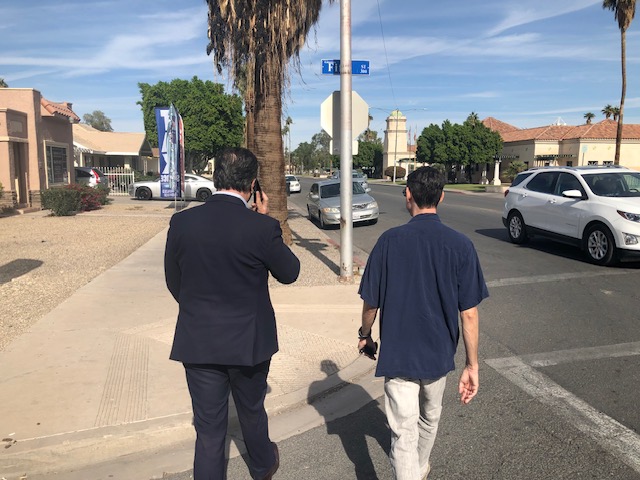
It was a beautiful late autumn day in Imperial Valley. Full sun with a light breeze in the crisp air. I wore a short sleeved blue Panama Jack styled shirt and tan jeans. Daniel was in a suit. He had already established a relationship with the mayor through his work with the chamber.

“Just be yourself and you’ll be fine,” Daniel told me.

We met the mayor at a health clinic where a long line of people, primarily Mexicans, waited to be seen by a doctor, free of charge. The mayor was a tall man, handsome, in shape and likely around my age.

“Welcome to Calexico,” he said, smiling while extending his hand. I returned a firm grip and maintained eye contact, renewing a diplomatic ritual robbed by the pandemic.

“Let’s meet the doctor,” he said. We went inside the clinic and the mayor greeted everyone, making small talk and gushing over the babies. The overwelming majority were women and children. Come to find out, the men rarely seek out medical attention for fear of losing work time. This reminded me of a comment a TSA colleague had uttered on checkpoint: “You can’t get COVID if you don’t get tested.”

I felt guilty as we butted to the front of the line and into the doctor’s office. “Have a seat gentleman,” he said. The doctor was a bald, portly older white fellow who seemed to be in need of sleep. He explained to us that most of the patients were living in abject poverty and needed basic antibiotics to combat their various ailments. More resources were needed, the doctor said, and the mayor pledged to deliver.

After reassuring the doc, the mayor and I did the walk from the clinic to city hall as Daniel had directed. Along the way, several SUVs with dark tinted windows slowly rode by us. The mayor asked me about the Pacific Northwest and attitudes towards drugs. He said he had friends in southwest Washington state who were concerned the cartels were gaining a foothold in the region. Fentanyl, he warned, was having a devasting effect in Los Angeles and Phoenix.

We had lunch at a little mom and pop restaurant planted near the border crossing. Over enchiladas and chile rellenos, the mayor informed us of the power dynamics on the city council. Daniel proded him to seek a promotion and run for Congress, a proposal that drew a hearty chuckle. He was flattered, but not stupid. I got a sense, he had it good here and wanted to keep it that way. Everywhere we went, people nodded their respect.

Daniel picked up the bill and we walked the mayor out to his vehicle, a modest mid-sized SUV that was dusty and had seen some miles. “John, I want you to have something,” he said, opening the back door and digging into a brief case to pull out an evergreen colored folder with a thick set of papers inside. “Some reading for your return trip.”

I opened the folder and there on the first page was a government timestamp that read: Declassified, December 2, 1993.

Puzzled, I looked up only to see the mayor wink and drive away.


A Dog Gone Mistake

28 08 2023

First, let me begin this post by affirming my love for dogs. I have owned dogs and they have been a fixture in my family for generations.

My all-time favorite was a little black lab mix named Mabel. She was such a sweet girl.

So sweet, in fact, that she provided comfort to some thieves that broke into my brother’s apartment when he was in college. As the story goes, they loaded up the television and electronics, while Mabel gleefully stood by during the heist.

Not long after that, Mabel came to live with me. I took her to Texas where she would show off her adorable pointer pose at the park whenever a squirrel or bird was nearby.

I have so many Mabel stories. She was the best.

My parents eventually adopted her after I moved back to Florida and she enhanced the quality of their lives for many years. After all, that is what a good pet is supposed to do.

Now, back to our story. I’m in El Centro, California visiting my good friend Daniel on a business trip. Daniel had graciously offered to quarter me at his house and as we pulled into the driveway you could hear the sound of barking coming from inside the house.

“I’m going to unlock the door and get the dogs, John, so you just run past them and into the house,” Daniel instructed.

For the life of me, I don’t know why I didn’t immediately refuse to do this.

It was a big mistake.

Daniel opened the door and instead of running to him, they chased after me. The golden retriever clawed me in the leg and the tiny mutt leaped and took a painful bite into the back of my upper thigh.

Ouch!

Daniel quickly scooped up the mutt before any more damage was done as I raced up the stairs and into the bathroom. There, behind a closed door, I nursed my wounds.

It was a traumatizing incident. My leg hurt for days and it would be a month before the bite mark disappeared. Daniel apologized profusely and assured me the dogs had all of their shots and there was no chance of catching rabies.

The little mutt was named GG, after a former congresswoman from North Florida, who I had helped elect before heading west to work in the national parks. Was this the universe’s way of getting back at me for leaving, I wondered.

After everything calmed down, I finally met Kai, Daniel’s husband. That night we toured the food bank with business leaders from the Imperial Valley.

A soft-spoken, tall and muscular young man, Kai emigrated to the States from Taiwan. He met Daniel in South Florida through a dating app and they quickly fell in love and were married in a very public ceremony inside the Florida Capitol. It was quite the statement, given the political climate at the time.

Kai liked living in California and hoped they would eventually find their way to Los Angeles or San Francisco. I quickly got the feeling, Imperial Valley was not the place they would be settling down longterm. For my safety, Kai kept GG locked away in their bedroom for the remainder of my stay.

At the food bank, Daniel worked the crowd with ease. He introduced me to the Commander of the Naval air facility, which serves as the winter home of the famous Blue Angels flight demonstration squadron. The Commander and I had a intelligent conversation about military readiness and the beauty of the Florida panhandle. I kept the dog bite story to myself.

The following morning, I would limp down to the border to finally set eyes on what had become a much ballyhooed issue. Daniel had lined us up a meeting with the mayor of Calexico.

“Get some rest, John,” Daniel advised as we left the chamber soiree. “Tomorrow is a big day.”