Winter, After the Silence

11 02 2026

It has been a while since I’ve written.

Not because nothing has happened. Quite the opposite. Life has been arriving in waves, and I have been standing in the surf without quite knowing how to describe the undertow.

Winter has hit harder this year.

In the early morning hours, walking home from the train station, I navigate mobs of crows clustered in the trees overhead. They cry out before they let loose, peppering the sidewalk with their droppings — a crude warning system. I walk carefully. There is something about the darkness at that hour, the industrial quiet broken only by wings and wind, that feels both ancient and immediate.
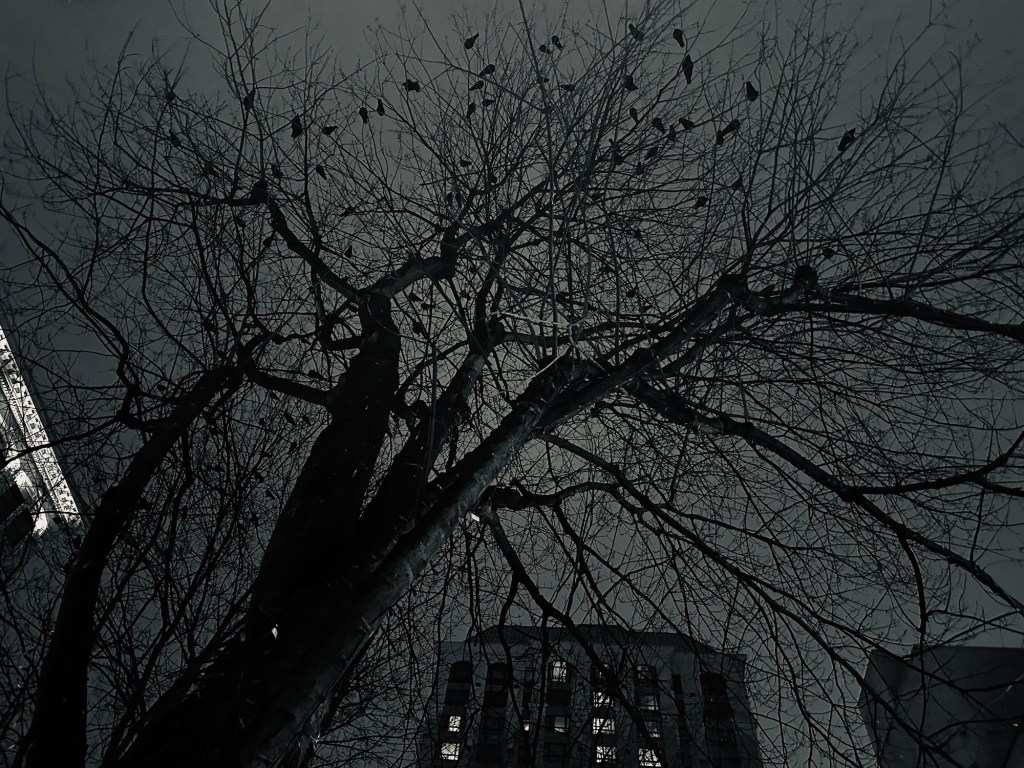
Crows Overhead

Along the way I pass people sleeping in doorways. Sometimes there are dogs curled beside them, wrapped in blankets, loyal in ways the rest of us struggle to be. The city breathes differently at that hour. Stripped down. No pretense. Just bodies trying to endure until daylight.

“You’re a very empathetic person,” my therapist friend once told me. “You give so much. Most people aren’t like that.”

I didn’t know what to say then. Empathy feels less like virtue and more like exposure. You feel everything. You absorb it. And lately, there has been a lot to absorb.

The people I looked up to most of my life are dying now. My father included. I have tried to memorialize them the best way I know how — in words — but grief does not move in tidy lines. It comes in waves. Regret rides in with it. Regrets, I’ve had a few. Some small. Some seismic.

The transit agency job keeps my writing afloat. I’m taking a college course in electricity, too. Dad would have liked that. There is something solid about learning how currents move, how power is transferred. It makes the invisible visible.

When I was disqualified from the rail operator position, the union stepped in and saved my job. That was the good news. The bad news was the overnight shift — outside, in winter — moving, coupling, and decoupling trains for the next day’s service.

The yard is all steel and breath and repetition. My fifty-year-old body has begun to protest. I sleep more. I battle colds and congestion. I’ve run out of sick time. With budget cuts looming, I pray for health the way some people pray for miracles. Just get me to spring. Let me sign up for a day shift. Let light return in some practical way.

David remains my rock. At his age, working forty hours a week in retail is no small thing. I wish he didn’t have to, but it keeps him moving. That’s the trick, isn’t it? Motion as survival. My step count has never been higher since taking the yard hostler role. A coworker told me, “I have no desire to be caged in that cab for ten hours a day.” I understood what he meant. Movement feels like proof of life.

Still, I miss the sun. I miss Florida’s warmth, even though there have been days colder there than here in the Pacific Northwest. It isn’t just temperature — it’s the rain. The gray. The way it seeps into the psyche. After eight years, I sometimes think I have battled depression to a draw. Not defeated it. Not surrendered. A stalemate.

I try not to get pulled into politics. I am a public servant. But the news some days is unbearable. The cruelty. The speed with which outrage ignites. Digital life has given us constant connection and constant combustion. It is hard not to look. Harder to look away.

I think often of the summers when I worked in the parks. The disconnection. The way nature set the pace. I fell in love in Yellowstone. It was, without exaggeration, the best summer of my life.

There are alternate versions of me that sometimes feel more vivid than the one I inhabit. The version who eloped to Italy with Ann. She loved me. It was true. I often wonder what that life would have been.

But there was a secret then. A stigmata I carried too long. It shaped my choices, narrowed my courage. Decades pass in the space of one unresolved truth. And just like that, the realization lands: I will never be a father. The sting comes sharp and sudden, like a Georgia yellowjacket on a hot afternoon. You don’t see it coming. You just feel the burn.

At my annual physical, I learned I have high blood pressure. Dad had it too. I ask myself why I cannot relax. Am I still trying to prove something? Am I restless because some part of me believes another life-altering opportunity has slipped by? Is this as good as it gets?

I flew to Alabama to see my mother and brother. I won’t write more about that. Empathy again — the instinct to protect, to soften edges, even when they cut me.

Tomorrow night, I will return to the train yard. The crows will still be there. The cold. The coupling and uncoupling of cars. The small prayers whispered into the fog.

My spirit is not broken. But it is bruised.

And I am hopeful — stubbornly, irrationally hopeful — that this static feeling will pass, that something in me is still recalibrating, that winter, like grief, like regret, like love withheld and love remembered, is not the whole story.

It is only a season.


The Dream That Carried Me

18 07 2025

When I was a boy in the Florida Panhandle — where the heat made any breeze that cut through the pine trees feel like a gift from heaven — I used to press my ear to the railroad tracks and wait.

For what, I wasn’t sure. A rumble. A tremor. A sound that confirmed something was coming. Trains moved through our coastal town, carrying paper from the mill. They moved like ghosts, urgent and unbothered, and I wanted, more than anything, to be the one driving them.

That was the dream: steel, speed, the illusion of control.

And now here I am, fifty-two years old, riding in a single-car light rail train into Hillsboro, Oregon, cloaked in the dark hush of a December morning. I am the one pulling into an empty platform, the one with hands on the lever. My left brings her into braking. My right taps the bell. The train stops clean.

“You don’t need to have a death grip,” Jorge tells me. “Be gentle with her.”

We were halfway through our training program and on the overnight shift. There are nine of us left, split into three teams. Jorge, all Cuban warmth and exacting calm. James, slower, quieter — Los Angeles cool, but alert beneath it. They don’t teach you how to handle the machine as much as they teach you how to be with it.

“Relax, take your time,” Jorge advised. “Do each step individually and it’ll all tie together and become natural.”

Sage advice. Slow your roll, essentially.

Before the yard-to-yard test — the one that moves you from theory to real track — I got sick. A stomach virus that left me wrecked and sweating through nights I couldn’t remember. I missed one day. James let me make it up. Another trainer might not have. I passed. Just barely. I passed.

“Watch your intermediates,” James told me as we walked through the Beaverton yard.

Signals, I learned, are prophecy. Intermediates tell you what’s coming — when to slow down, when to stop. Ignore one and anything can go sideways. Signals, switches, speed. There is no room for sentimentality out here. Only precision.

Oregon’s light rail system is complicated. Beautiful, yes. Ingenious, even. But also dangerous. Tracks run through intersections, weave alongside bike paths, share spaces with cars, pedestrians, skateboarders, scooters and dogs on leashes. You are constantly negotiating with chaos.

After the test, we entered line training. Three weeks of shadowing operators who knew too much, but said very little. They spoke in glances, in warnings you felt more than heard. This was no longer the dream. This was the reality.

You learn quickly: revenue service is where romance goes to die. Where you stop seeing yourself in the story and start seeing everyone else — angry passengers, lost time, bullying supervisors and the thousand ways things fall apart.

Still the horn cuts through a sleeping city, something stirs in me. That boy on the tracks, listening for the future. He never imagined what the job would cost. But he’d still want it.

So do I.


Can Do

20 01 2025

One word convinced me. Actually, it was the concept behind the word.

That concept took me to another level — snapping me out of a cautious funk of settling for the easy way out or crumbs along the path of least resistance.

The word is CAN.

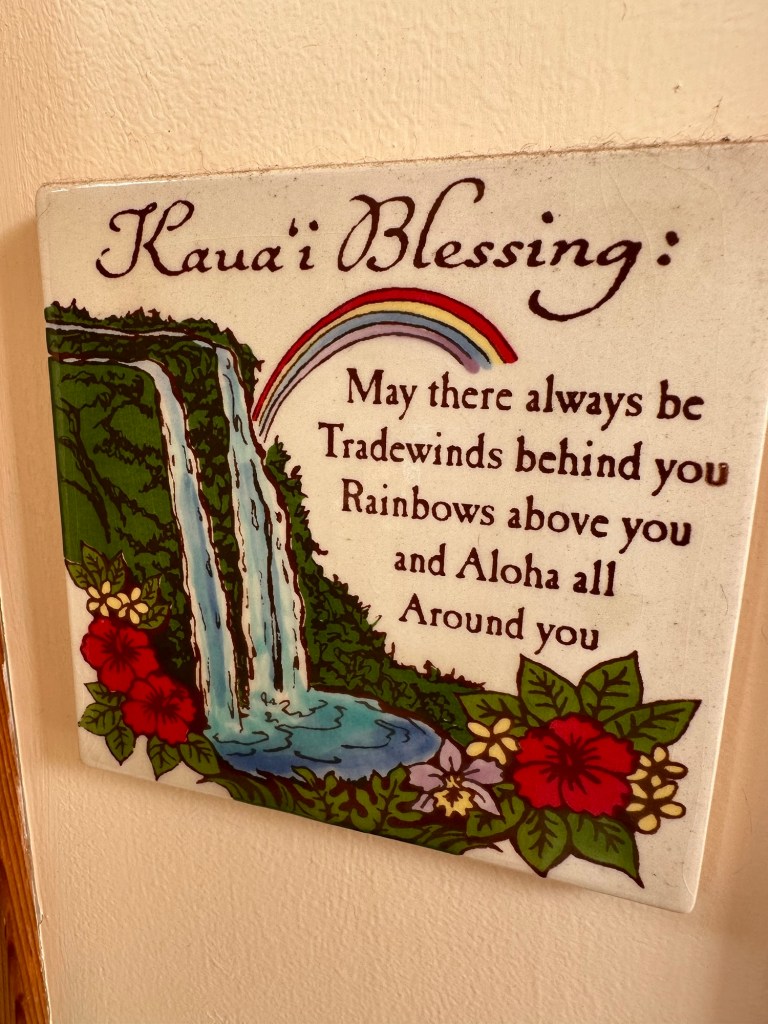
It first came to my attention through a sticker on the back of my cousin’s jeep. Come to find out a Hawaiian man, battling depression, decided to defeat the doubt and negativity in his life by changing his mindset.

CAN defeats Can’t. Simple as that, right?

Well, it’s not as easy as it sounds. As those who have accepted a challenge can attest, half the struggle is just getting started.

I have been fortunate enough to accomplish certain things in life that seemed impossible as a youngster. The list of achievements include running for public office, hiking the Grand Canyon, publishing a book, covering a presidential election and getting married.

Some would say that’s a life well lived.

But I know there is more to experience. Who wants to be mopping trains forever? Not this guy. Could I operate them? You bet, I can.

There was also a not so subtle desire to start a family. This is something Stanley picked up on in our therapy sessions, particularly when it came to my attachment to River.

“You want to be needed,” he said.

Who doesn’t, I thought.

David still needs me and we had a lovely time in Hawaii. The hospitality Rob & Shelley extended to us was above and beyond.

It’s amazing how fast the time goes. I still vividly recall summers on St. George Island and Apalachicola with Rob and all my other cousins. I now realize how precious those moments were.

Looking back, was there anything that could have altered my path? Would a different decision at a critical juncture turned out for the better?

Second-guessing now seems silly.

Changes did await on the mainland. A new work assignment, on the other side of town, would free me from the graveyard shift, challenge my thinking and provide the opportunity to put my new ‘CAN DO’ attitude on display.

For the first time in years, checking on my folks in Florida seemed both doable and desirable. My father’s health continued to deteriorate and mom’s cries for relief were like a broken record.

An old friend from Japan was also on my mind. Like many of the international friendships forged during my younger days traveling, promises of reunions now seemed possible.

CAN was already at work in me.

Fear no longer had a grip on my emotions. Failure, I had come to realize, was just part of the process — not the end result.

I was ready to enter the arena again. To dare greatly while speaking my truth softly. To strive valiantly without coming off overconfident and cocky.

I think I CAN. I think I CAN. Choo-Choo!

All Aboard!